
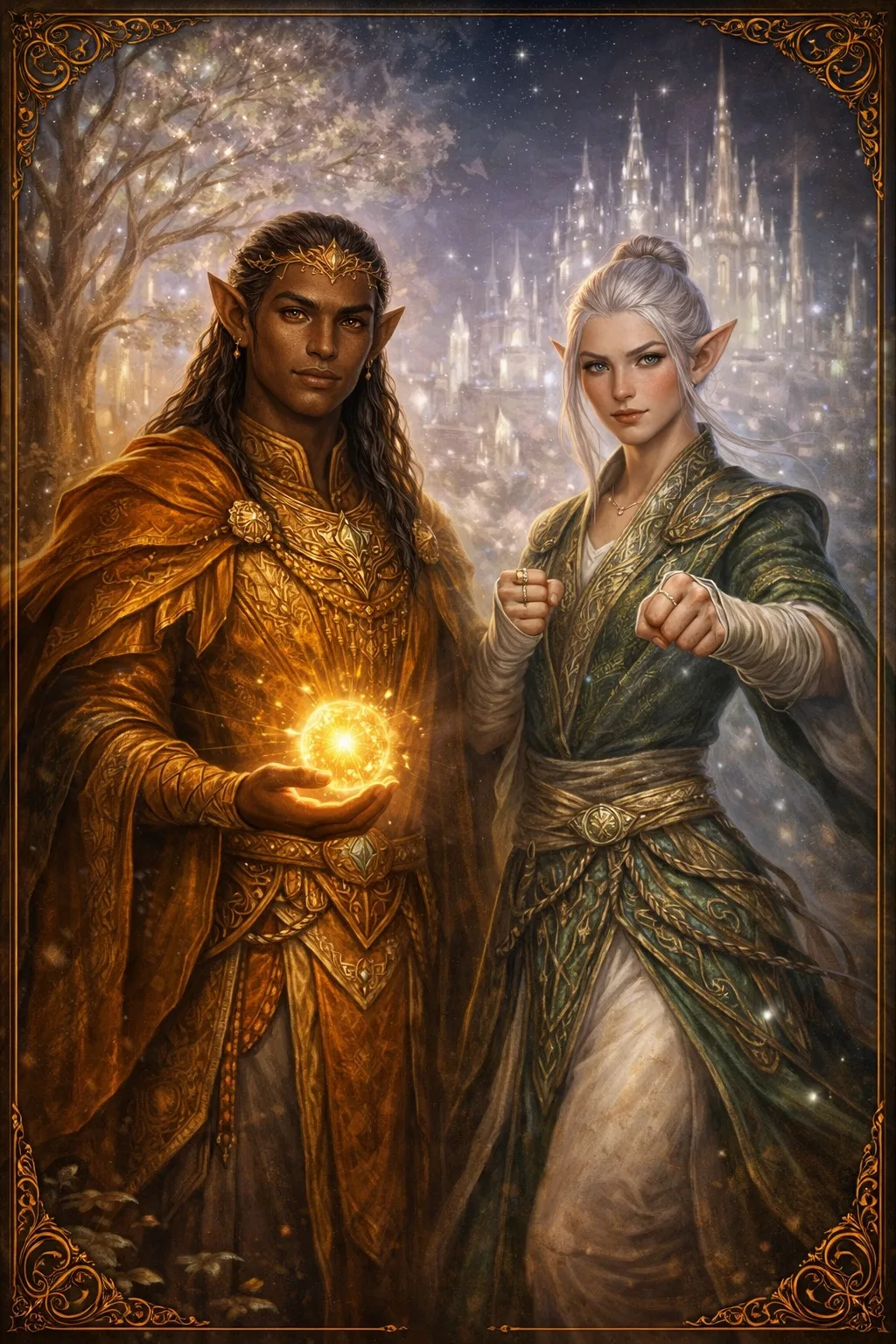
Syl’Aeris

The Syl’Aeris are among the more difficult peoples of Khassid to describe without either romanticizing them or translating away precisely those characteristics that distinguish them — a people whose language of light, breath, song, reflection, memory, and resonance may describe something quite literal.

Seal of the Aelorian Archives
Archival Release Authorization

Approved for circulation among the general populace by order of the Aelorian Archives.

People record released within the Codex Naturalis Khassidia; physiological, cultural, metaphysical, and historical observations preserved below for comparative reference.

Taxonomical Concordance

Primary Concordance Type
Sapient
Origin Designation
Indigenous
Disposition Classification
Variable
Regional Anchoring
Khassid and Aelindor, with established populations maintaining passage between the two through the Ithil
Syl’Aeris, a sapient people of Khassid distinguished by substantial adaptation among four recognized Echoes, an innate capacity to perceive the soul-aura of their own kind, and an enduring metaphysical relationship with the realm known as Aelindor
A representative gathering of Syl’Aeris displaying the physical variation present among the Rootkin, Boughkin, Sunward, and Duskwalkers.

Peoples Dossier

Classification
Sapient People
Origin
Khassid
Associated Realm
Aelindor
Recognized Echoes
Rootkin, Boughkin, Sunward, and Duskwalkers
Distinctive Faculty
Aelvar — perception of the soul-aura of other Syl’Aeris
Principal Social Unit
Hearthclan
Traditional Guidance
Elders of the Glen
Faith Tradition
The Aerisathyn
Inter-Realm Passage
The Ithil

The Syl’Aeris identify themselves as one people expressed through several enduring variations that they call Echoes. The Archives recognize four: Rootkin, Boughkin, Sunward, and Duskwalkers. These distinctions encompass visible physical traits, environmental adaptations, inherited traditions, and differences of cultural emphasis, but available evidence does not support treating them as separate peoples or subspecies. Syl’Aeris sources themselves describe an Echo as a branch shaped by where its members dwell and by what they remember, a definition that is considerably more useful than attempting to impose a stricter biological division upon them.

Their relationship with Aelindor presents a more unusual problem of classification. Syl’Aeris sources describe that realm as their spiritual and magical homeland, existing parallel to Khassid and accessible through the Ithil. Yet the same traditions place the first awakening of the Syl’Aeris within Khassid and associate the earliest development of Aelindor with that awakening. The result is a people who cannot comfortably be described as emigrants from Aelindor, colonists of Khassid, or inhabitants of two unrelated worlds. Their history belongs to both, although not in equal or easily separable ways.

Archival Summary

On the difficulty of observing a people who perceive one another differently than we do

There is a persistent temptation among outsiders to begin an account of the Syl’Aeris with their forests, their longevity, or their evident artistry. These are visible characteristics and therefore easy to catalogue. They are also poor places to begin. A far more consequential distinction lies in something those of us who are not Syl’Aeris cannot directly experience: Aelvar.

Aelvar is described consistently as a faculty by which one Syl’Aeris perceives the soul-aura of another. Their sources are quite explicit that this is not the reading of thought. Rather, the aura conveys something of emotional condition, physical health, and spiritual disturbance. The distinction deserves emphasis because an outsider accustomed to concealing emotion behind controlled speech may easily overestimate or underestimate what such a faculty means. A Syl’Aeris cannot ordinarily hear another’s private reasoning through Aelvar, but neither must they depend entirely upon expression, posture, or confession to know that distress, fear, affection, hostility, or illness is present.

I cannot personally attest to the sensation of Aelvar, nor can any archivist lacking the faculty. We can, however, observe its consequences. Syl’Aeris customs concerning trust, reconciliation, kinship, grief, and violence developed in a society where emotional concealment has never possessed quite the same certainty that it does among most other peoples. This does not make the Syl’Aeris incapable of deception, cruelty, resentment, or political calculation. Their histories furnish sufficient evidence to dispense with that romantic notion. What it does mean is that such things occur within a social environment where at least part of their effect upon others may be immediately perceptible.

Their celebrated concern with harmony should be understood in this context. Harmony is not merely an admirable principle they happened to adopt; it is an accommodation to the fact that the condition of one individual may become perceptible to another. Syl’Aeris society therefore appears to have developed not around the expectation that discord can be prevented, but around the necessity of living with its resonance when it occurs.

Field Record

Origin, observed form, metaphysical association, cultural organization, and confirmed social practice.

The following account draws principally upon Syl’Aeris records preserved by the Aelorian Archives, including their own historical, devotional, and memorial traditions. Such sources require ordinary archival caution. The Syl’Aeris frequently preserve not only an account of an event but the meaning subsequently attached to it, and their Luminaria deliberately value remembrance alongside chronology. This is not a defect in their historical practice; it is simply a different purpose from that of a ledger. Even Syl’Aeris archivists distinguish between preserving what occurred and preserving what mattered to those who experienced it.

The present record therefore does not treat every inherited Syl’Aeris tradition as independently verified fact. Where material belongs primarily to ancestral memory, theology, or metaphysical interpretation, it is retained as such.

Origin & First Reflection

The oldest Syl’Aeris traditions do not describe migration from an earlier homeland, nor do they preserve a creator figure who fashioned the people and then placed them within Khassid. Their record begins instead with an awakening remembered as the First Breath. In this account, the Firstborn emerge already formed but without language, memory, history, or any learned understanding of the world into which they have awakened. Sensation precedes comprehension: air, ground, light, bodily rhythm, and the presence of others are experienced before there are words with which to distinguish any of them.

How much of this should be treated as a literal preservation of events cannot be determined. The narrative is expressly situated before language, which necessarily means that every surviving version is a later reconstruction of an experience that could not have been recorded contemporaneously. That fact does not make the tradition worthless. On the contrary, it reveals what later Syl’Aeris generations considered essential about their own beginning.

Particularly important is the episode they call the First Reflection. The name is misleading if one expects water, glass, or polished metal. The reflection is inward. One of the Firstborn becomes aware of a distinction between the surrounding world and the self experiencing it, placing a hand upon the chest in what Syl’Aeris tradition regards as their earliest act of self-recognition. Others repeat the gesture, and over successive generations the motion develops into the greeting still used among the Syl’Aeris: hand to the heart and then extended toward another.

The cultural significance of this sequence is difficult to miss even for an outsider. Recognition begins with the self, but does not end there. The same tradition immediately proceeds from I exist toward recognition that another being possesses an existence distinct from one’s own. The modern gesture consequently acknowledges individuality before relationship rather than sacrificing one to the other. This same pattern appears elsewhere in Syl’Aeris culture often enough that the Archives consider the First Reflection useful as an interpretive key even where its literal antiquity cannot be proven.

Aelindor also enters these traditions at a very early stage. The First Breath does not initially present it as a completed realm waiting to be discovered. Instead, the Firstborn become aware of an answering resonance beyond ordinary perception, something described as not yet wholly shaped into place but responding to their own emerging awareness. Later tradition identifies this presence as Aelindor.

Whether Aelindor existed beforehand, emerged through the awakening of the Syl’Aeris, or was changed by their mutual recognition remains unresolved. Syl’Aeris theologians and historians have advanced different explanations, and the surviving record does not permit the Archives to choose confidently among them. The safer conclusion is simply that Syl’Aeris memory places their relationship with Aelindor very near the beginning of their existence and does not treat it as a later discovery.

Observed Manifestation: Appearance

The Syl’Aeris possess enough physical variation that an observer encountering members of different Echoes separately might initially assume a greater biological distinction than actually exists. Their shared morphology remains readily identifiable: generally slender proportions, tapered ears, fine facial structure, and a breadth of pigmentation that includes several tones less commonly encountered among neighboring peoples. What differs most markedly is the manner in which these common traits have developed among populations associated with different environments.

The Rootkin tend toward earthen or deeper pigmentation and are strongly associated with subterranean or root-bound environments, where adaptation to darkness is particularly apparent. Boughkin commonly display colors and physical characteristics associated with woodland life and arboreal movement. Sunward populations more frequently possess warm copper, gold, and honeyed tones, while the Duskwalkers are often described in cooler shades of silver, grey, or dusk-brown. None of these tendencies is absolute, and they should not be used as the sole basis for assigning an Echo.

It is equally hazardous to treat the customary descriptions of Echo temperament as biological fact. Syl’Aeris sources often speak of Rootkin as grounded, Boughkin as fluid, Sunward as expressive, and Duskwalkers as contemplative or reserved. Such descriptions may contain genuine patterns, but centuries of cultural expectation can produce the very behaviors later cited as evidence of innate disposition. The Archives therefore record these tendencies as cultural associations rather than fixed traits.

More revealing than the differences themselves is the absence of any Syl’Aeris insistence that they represent separate peoples. Their own terminology is deliberately relational. An echo is altered by the space through which it travels without ceasing to belong to the sound from which it arose. The analogy is characteristic of Syl’Aeris thought, but in this instance it is also taxonomically useful.

Aelindor & the Dual-Realm Condition

Aelindor is commonly called the spiritual and magical homeland of the Syl’Aeris, though this phrase becomes less satisfactory the more closely the matter is examined. Syl’Aeris accounts describe it as an overlapping realm existing in the same time and space as Khassid while remaining metaphysically distinct, its forests and waters reflecting the mortal world without reproducing them precisely.

An outsider should take some care with the word reflection. It would be easy to imagine Aelindor as a copy of Khassid made brighter, gentler, or more magical. That is not what surviving accounts describe. Correspondence exists, but so does independent development. Places may answer one another without being identical, and the realm possesses conditions, inhabitants, and histories that cannot be reduced to those of Khassid.

The Syl’Aeris relationship to Aelindor is similarly more intimate than ordinary planar travel. Passage between the realms occurs through the Ithil, and communities exist whose members maintain social and institutional ties across the boundary. A Syl’Aeris raised principally in Khassid may regard Aelindor as part of the inheritance of their people without having spent most of their life there, while one who dwells in Aelindor does not thereby cease to belong to Khassid.

I have found the distinction easiest to understand by abandoning the question of which realm is their “real” homeland. The Syl’Aeris themselves appear to find little use for it. Their civilization developed in relation to both, and the existence of the Ithil has allowed that relationship to remain active rather than purely ancestral.

This dual-realm existence has no precise equivalent among the other peoples presently catalogued by the Archives. It should therefore be allowed to remain unusual rather than forced into a more familiar category.

Aelvar

Aelvar warrants separate treatment because it affects Syl’Aeris social life more profoundly than any visible anatomical trait.

The faculty is described as perception of the soul-aura of another Syl’Aeris, a luminous or otherwise sensible manifestation through which broad emotional condition and aspects of health can be recognized. Syl’Aeris records are consistent in denying that Aelvar provides direct access to thought. An individual may know that another is afraid without knowing what has frightened them, recognize grief without seeing the memory that produced it, or sense unease without understanding whether it arises from guilt, danger, illness, or some private concern.

Those of us who do not possess Aelvar are necessarily dependent upon Syl’Aeris testimony for its subjective qualities. This limitation should be acknowledged rather than concealed beneath overly confident terminology. What can be independently observed are the social behaviors surrounding the faculty. Syl’Aeris commonly respond to emotional states that have not been verbalized, and disagreements may proceed with both participants already aware that the other is distressed even when neither has stated as much.

This complicates the ordinary outsider assumption that Aelvar must produce extraordinary honesty. It does not prevent lying, because speech and aura do not convey the same information. A practiced deceiver may still conceal the facts of a matter. What becomes difficult is concealing every emotional consequence of that deception. The distinction is important, because a society capable of detecting discomfort is not the same thing as a society capable of detecting falsehood.

Aelvar likewise does not ensure compassion. The ability to perceive suffering cannot oblige an individual to care about it. Syl’Aeris history contains sufficient hostility, estrangement, and violence to demonstrate that perception and virtue are not identical. What Aelvar changes is the possibility of pretending that no injury exists when its resonance is plainly visible to those around it.

This may explain why Syl’Aeris practices of reconciliation tend to emphasize acknowledgment before settlement. One cannot easily restore harmony by insisting that nothing has been disturbed when the disturbance itself is perceptible.

Essence & Cultural Nature

The term most frequently encountered when studying Syl’Aeris philosophy is resonance, and it is tempting to dismiss its ubiquity as a literary habit. That would be a mistake. Resonance supplies a remarkably consistent model through which the Syl’Aeris understand relationships between individuals, communities, realms, memories, and even divine powers.

The concept does not require sameness. Two things may remain distinct and nevertheless affect one another profoundly. This is visible in the relationship between Khassid and Aelindor, in the persistence of four Echoes within one people, and in Aelvar itself, which provides awareness of another without dissolving the boundary between minds. Even the Hearthclan incorporates biological kin and chosen family without requiring either form of relationship to become the other.

This sheds some light upon the frequently repeated claim that the Syl’Aeris are a people devoted to harmony. Outsiders sometimes hear the term and imagine a society organized around agreement, tranquility, or avoidance of conflict. None of these interpretations survives prolonged observation. Syl’Aeris disagree readily enough, and individuals can be as stubborn, ambitious, offended, jealous, or difficult as members of any other people.

Their concept of harmony is more demanding than simple agreement. It concerns whether differences can remain in relation without becoming mutually destructive. A disagreement that preserves respect may remain harmonious in this sense, while outward silence masking unresolved injury may not.

The same distinction appears in their treatment of memory. Syl’Aeris records often preserve emotional consequence alongside factual chronology, particularly in the Luminaria. This practice does not mean that their archivists disregard objective sequence. Indeed, the surviving commentary of Aleryn Duskwhisper and Sylrenith Miriel explicitly distinguishes between preserving the structure of history and preserving what an event meant to those who experienced it.

From outside the culture, this can initially seem an untidy separation of scholarship and remembrance. It is better understood as an insistence that a complete record may require both.

The Echoes

The four recognized Echoes—Rootkin, Boughkin, Sunward, and Duskwalkers—are best approached as durable cultural and environmental expressions within a single people. The term avoids several errors common in earlier external scholarship, particularly attempts to treat the Echoes as castes, blood-pure lineages, or entirely separate elven populations.

Environment has clearly played a role in their development. Rootkin traditions arose in close relationship with deep earth, root systems, buried stone, and environments in which darkness is ordinary rather than exceptional. Their records display a recurring concern with what is preserved beneath visible surfaces, and this tendency has influenced both material practices and cultural memory.

Boughkin communities are associated more strongly with the living canopy and the changing conditions of woodland environments. Their traditions tend to emphasize responsiveness to seasonal and ecological change, and they are perhaps the Echo most responsible for the common outsider image of the Syl’Aeris as woodland elves. The resemblance is real but incomplete; it represents one expression of the people rather than their defining form.

The Sunward are associated with more open environments and with cultural traditions in which expression, artistry, warmth, and visible communal life receive greater emphasis. It is easy to turn these tendencies into caricature and imagine the Sunward as an artistic profession masquerading as an ancestry. The evidence does not support such a reduction. Their identity encompasses all the ordinary occupations and temperaments found among any settled population.

Duskwalkers are most closely associated with thresholds: low light, transition, the Veil, and circumstances that resist simple division. Their traditions have produced particular expertise in subtle perception and liminal conditions, but here again cultural specialization should not be mistaken for vocational destiny.

The boundaries between Echoes are permeable in ordinary life. Individuals marry across them, settle in communities associated with another Echo, adopt practices foreign to their ancestral environment, and participate in institutions containing all four. There is little indication that the Syl’Aeris regard such exchange as threatening the integrity of an Echo.

Indeed, their terminology suggests the opposite. Something that cannot change as it travels would scarcely qualify as an echo at all.

Social Organization

The principal intimate social structure among the Syl’Aeris is the Hearthclan, which encompasses both kinship and chosen family. The latter element is significant. Membership is not restricted to common ancestry, and a relationship sustained by loyalty, shared responsibility, and long association may possess standing comparable to blood kinship.

Hearthclans provide far more than residence. They function as repositories of memory, networks of mutual responsibility, and enduring social identities through which individuals participate in a wider community. Their composition can therefore appear irregular to outsiders accustomed to defining family primarily by descent or marriage. The Syl’Aeris appear less troubled by such irregularity than the outsider attempting to diagram it.

At the broader communal level, authority is often associated with the Elders of the Glen, whose role is described in Syl’Aeris sources as guidance through memory and counsel rather than command. This should not be interpreted to mean that Syl’Aeris settlements lack law, hierarchy, or the ability to impose decisions where required. Rather, durable authority is expected to demonstrate understanding before resorting to compulsion.

The distinction becomes clearer when one remembers the importance of relationship within Syl’Aeris society. A ruler can compel obedience to a decision and still damage the network upon which future cooperation depends. Elders therefore appear particularly concerned with whether a resolution can remain stable after the immediate dispute has ended.

To an outsider, their deliberation can seem unnecessarily slow. I suspect many Syl’Aeris find our preference for rapid decisions equally strange, particularly when we subsequently spend years repairing what was settled in an afternoon.

The Ithil

The Ithil are the thresholds through which passage between Khassid and Aelindor is ordinarily maintained. Syl’Aeris descriptions call them silver-lit gates grown from the earth and serving simultaneously as pathways of spirit and matter.

The language of growth is significant because the Ithil do not appear to behave like conventional constructed portals. They are associated with particular places and with the underlying relationship between the two realms rather than merely with an applied spell capable of opening a temporary planar route. Attempts to classify them entirely within ordinary portal theory have therefore been of limited value.

Their importance to Syl’Aeris civilization is difficult to overstate. Because the Ithil make repeated movement possible, separation between Khassid and Aelindor need not produce a permanent rupture in family, religious practice, scholarship, or social obligation. The two realms remain distinct, but the Syl’Aeris have built institutions under the assumption that the distinction can be crossed.

The Dral’Vyrn provide the most troubling evidence that passage through an Ithil depends upon something more than reaching the correct location. Those who bear the Dral’Vyrn condition are unable to enter Aelindor through them. Whether the Ithil actively refuse them, their altered soul-aura is no longer compatible with passage, or some property of Aelindor itself prevents entry is not presently established.

One should therefore be cautious about describing the Ithil as doors.

Doors do not ordinarily care who attempts to pass through them.

Faith & the Aerisathyn

The Syl’Aeris pantheon is collectively known as the Aerisathyn, whose divine traditions are frequently described through the language of a chorus. Their gods remain distinct divine beings rather than symbolic facets of a single deity, but Syl’Aeris theology repeatedly places emphasis upon the relationship among their voices rather than upon exclusive supremacy of one over the rest. The surviving glossary describes the Aerisathyn as guiding the people through balance, harmony, and caution.

This theological structure resembles, though does not simply reproduce, the broader Syl’Aeris preference for distinction held within relationship. Individual communities and devotees may favor particular deities, and nothing in the record suggests that devotion is evenly distributed among the pantheon. What remains characteristic is an expectation that one divine perspective does not necessarily exhaust the whole of wisdom.

For an outsider accustomed to religions organized around command, this can make Syl’Aeris devotional language appear unusually contemplative. Listening, restraint, and the weighing of different influences occur frequently in their rites. Yet it would be an error to convert the Aerisathyn into philosophical principles merely because their worship encourages reflection. Syl’Aeris records treat them as gods capable of agency, attention, intervention, and relationship.

The distinction is worth preserving. A theology may be sophisticated without becoming metaphor.

The Dral’Vyrn

The Dral’Vyrn are perhaps the clearest demonstration that Syl’Aeris ideals of harmony are accompanied by equally serious concepts of rupture. The term does not describe a fifth Echo, an ancestry, or a hereditary people. It identifies a condition affecting a Syl’Aeris who has unjustly killed another of their own kind. The change is said to manifest directly in the soul-aura perceived through Aelvar, which becomes darkened and visibly altered.

This is one area in which an outside archivist must rely heavily upon Syl’Aeris testimony. Those without Aelvar cannot directly observe the soulmark itself. We can, however, verify that unrelated Syl’Aeris observers consistently identify the same affected individuals and describe comparable changes, which makes a purely conventional social designation unlikely.

The consequences are not merely reputational. Dral’Vyrn are unable to return to Aelindor through the Ithil, and this exclusion persists independently of whether family or former companions continue to associate with them. Syl’Aeris records are surprisingly careful on this latter point. A Dral’Vyrn is exiled from Aelindor, but not thereby erased from every bond formed before the offense. Parents may continue to care for a marked child, siblings may maintain contact, and former friends are not universally forbidden from extending compassion.

The distinction prevents the practice from being reduced to simple banishment. The Dral’Vyrn remain Syl’Aeris, and that fact appears to make their condition more painful rather than less. The people do not solve the contradiction by declaring them something else.

Syl’Aeris sources also distinguish unjustified kin-slaying from lethal self-defense against a Dral’Vyrn who attempts further murder. In such circumstances, the defender is not considered to acquire the same stain, provided the act is understood to arise from necessity rather than malice. Their account attributes this distinction to the capacity of Aelvar to reveal intent.

Claims that the condition can be reversed are exceedingly rare. The best-known tradition concerns the human blacksmith Calen Matisse and a Dral’Vyrn enclave that fought beside him against a dragon. Their shared defense is said to have resulted in the restoration of the exiles’ soul-auras, an event attributed in Syl’Aeris tradition to extraordinary unity, sacrifice, and the attention of the Aerisathyn.

The Archives preserve the account without pretending to understand its mechanism. Even accepting the Syl’Aeris testimony as accurate, a single exceptional event is poor grounds for predicting repeatability.

It is, however, sufficient grounds for avoiding the word impossible.

Cultural Praxis

Syl’Aeris rites are numerous, and a complete catalogue belongs elsewhere. Two practices are particularly useful to the present record because they reveal how the people translate their broader principles into ordinary social life.

The Lira’vaien

The Lira’vaien is a rite of quiet listening employed in the softening of disputes. Syl’Aeris descriptions emphasize the hush of Aelvar, suggesting that the purpose is not merely to make disputants stop speaking, but to reduce the noise of argument sufficiently that each can attend to the condition of the other.

This practice should correct another common misunderstanding of Aelvar. Emotional perception does not automatically settle disagreement. It may make disagreement considerably harder. One can perceive another person’s pain and remain convinced that they are wrong; indeed, recognition of that pain can produce guilt, defensiveness, anger, or renewed accusation. The Lira’vaien appears designed to create enough restraint for perception to become useful rather than simply adding another layer to the conflict.

The Silver Flame

The Silver Flame serves a different purpose. During this farewell rite, a flame is maintained for a month while the living and departed are understood to remain in a final period of wordless communion before the farewell is completed. The associated Velaenari offers thanks and remembrance during this interval.

Whether actual contact with the dead occurs during the rite is not something I can establish, and Syl’Aeris explanations differ in emphasis. Its social purpose is easier to observe. Death is acknowledged without requiring immediate emotional severance. The bereaved are given a defined period in which relationship changes before ritual finally recognizes the separation.

The practice is consistent with much else in Syl’Aeris culture. They appear less interested than many peoples in pretending that transitions occur at the exact moment an event legally or biologically takes place.

Death & Remembrance

Syl’Aeris remembrance should not be confused with an inability to accept loss. Their memorial traditions are elaborate precisely because they recognize that loss alters the relationship between the living and what has been lost.

This distinction is visible in their archival practice. A factual account establishes that an individual lived, acted, and died at particular times. A Luminaria may instead preserve the way that life remains present in the memory of others: gestures imitated by descendants, phrases still repeated, places altered by association, injuries that changed a family, or kindness remembered centuries later.

To those trained in more conventional archival methods, such material may initially seem too subjective for serious preservation. The Syl’Aeris do not make the error of pretending otherwise. Their own archivists explicitly distinguish remembrance from chronology and assign each a different purpose.

There is merit in the distinction.

A list of dates may tell us precisely when a person lived and still fail to tell us why anyone continued speaking their name.

Observational Profile

It is easy to recognize Syl’Aeris material culture and still fail to understand a Syl’Aeris settlement. Architecture, woodland integration, art, and the visible differences among the Echoes attract attention first, but the more characteristic feature is the amount of work devoted to maintaining relationships among people, place, and memory.

Hearthclans remain socially distinct within larger settlements rather than disappearing into a single civic identity. Communal spaces frequently accommodate counsel, gathering, ritual, and quiet use without requiring every function to center upon a dominant administrative building. Objects of practical value are often embellished with artistic or memorial significance, not because utility is secondary but because the Syl’Aeris rarely insist that beauty, memory, and use occupy separate categories.

Visitors sometimes describe such environments as effortless or naturally harmonious. This is perhaps the least accurate compliment one can give them. Syl’Aeris settlements require maintenance, disagreement requires negotiation, woodland environments require tending, and the preservation of memory demands deliberate labor. The difference is that Syl’Aeris cultural practice often conceals the seam between maintenance and ordinary life.

Their harmony is maintained because people maintain it.

That observation seems obvious once stated, yet outsiders repeatedly prefer the more flattering fiction that it occurs by nature.

Relations with Other Peoples

Interaction with non-Syl’Aeris necessarily occurs without the ordinary mutual perception provided by Aelvar. This creates a difference that outsiders may fail to notice because we experience nothing unusual at all. From the Syl’Aeris perspective, however, communication with another people removes a sensory context available in most interactions with their own kin.

The result appears to be caution rather than incapacity. Syl’Aeris can form friendships, alliances, families, professional relationships, and profound loyalties with other peoples, but the establishment of trust may rely more heavily upon sustained behavior than it does among those whose auras they can perceive.

This point is worth remembering when Syl’Aeris reserve is interpreted as arrogance. It may sometimes be arrogance; no people is exempt from it. At other times we are simply asking them to judge us while deprived of a sense they normally use when judging one another.

One point of terminology deserves explicit note, since outsiders encounter it more often than any other. Distant peoples unfamiliar with their true origin frequently and incorrectly refer to the Syl’Aeris as “elves.” Within Syl’Aeris society the term is not received as a harmless simplification but as an insult, and the correction that follows is characteristically quiet rather than heated — a level voice and a narrowed silence rather than raised words. A first such error may be forgiven as ignorance; a second is not, regardless of the speaker’s rank. The fuller account of this exchange, and the reasoning behind it, is preserved in the Eternal Record’s own Syl’Aeris entry.

Their surviving traditions contain numerous examples of cross-cultural relationships, and the Hearthclan’s inclusion of chosen family already demonstrates that the Syl’Aeris concept of belonging is not restricted narrowly to birth. The Calen Matisse tradition remains especially significant because a human’s conduct toward an outcast Dral’Vyrn community is remembered as having accomplished something Syl’Aeris society itself had regarded as nearly beyond recovery.

That account is theological as well as historical, and its miraculous elements should be treated accordingly. Its cultural significance requires no such qualification.

The man could not see their soul-auras.

He apparently did not need to.

Archival Considerations

There is a particular danger in writing about the Syl’Aeris from outside their people. Their vocabulary is attractive enough that the scholar may begin repeating it before understanding it, and their culture is unfamiliar enough that the opposite error—stripping away every term that sounds poetic—can appear more rigorous than it actually is.

Neither approach serves the record.

Aelvar is not made less real because the Syl’Aeris describe the soul-aura in the language of light. Aelindor does not become easier to classify because one substitutes the word plane for reflection. The Echoes are not clarified by forcing them into categories of caste or subspecies that the evidence does not support. Nor should Syl’Aeris assertions be accepted uncritically merely because their own accounts are eloquent.

The archivist’s task is to preserve the distinction between what is observed, what is reported, what is believed, and what remains unresolved.

In the case of the Syl’Aeris, that distinction has another value. It prevents those of us who cannot perceive Aelvar, who were not raised with the Ithil as an ordinary possibility, and who do not carry personal memory of Aelindor from assuming that our experience supplies the neutral standard against which theirs should be measured.

The Syl’Aeris are neither as mysterious as their admirers often make them nor as easily explained as their detractors suppose. They are a people whose senses, environment, metaphysics, and institutions developed together over a very long period, and each becomes less intelligible when separated from the others.

For purposes of the Codex Naturalis Khassidia, that is the essential observation.

One need not be Syl’Aeris to study them.

One must simply remember that they do not experience being Syl’Aeris from the outside.