
Sweetgrave Vine

A perennial climbing plant that lures sapient prey with bioluminescent flowers and euphoric fruit, then consumes the unconscious over several days through root-borne feeding structures.

Seal of the Aelorian Archives
Archival Release Authorization

Approved for circulation among the general populace by order of the Aelorian Archives.

Bestiary record released within the Codex Naturalis Khassidia. This specimen carries no combat statistics; it is a passive, non-mobile hazard rather than a creature that engages in combat.

Taxonomical Concordance

Primary Concordance Type
Rootbound
Origin Designation
Post-Cataclysmic
Disposition Classification
Predatory
Regional Anchoring
Non-regional; recorded in temperate, warm-temperate, and subtropical mature forests
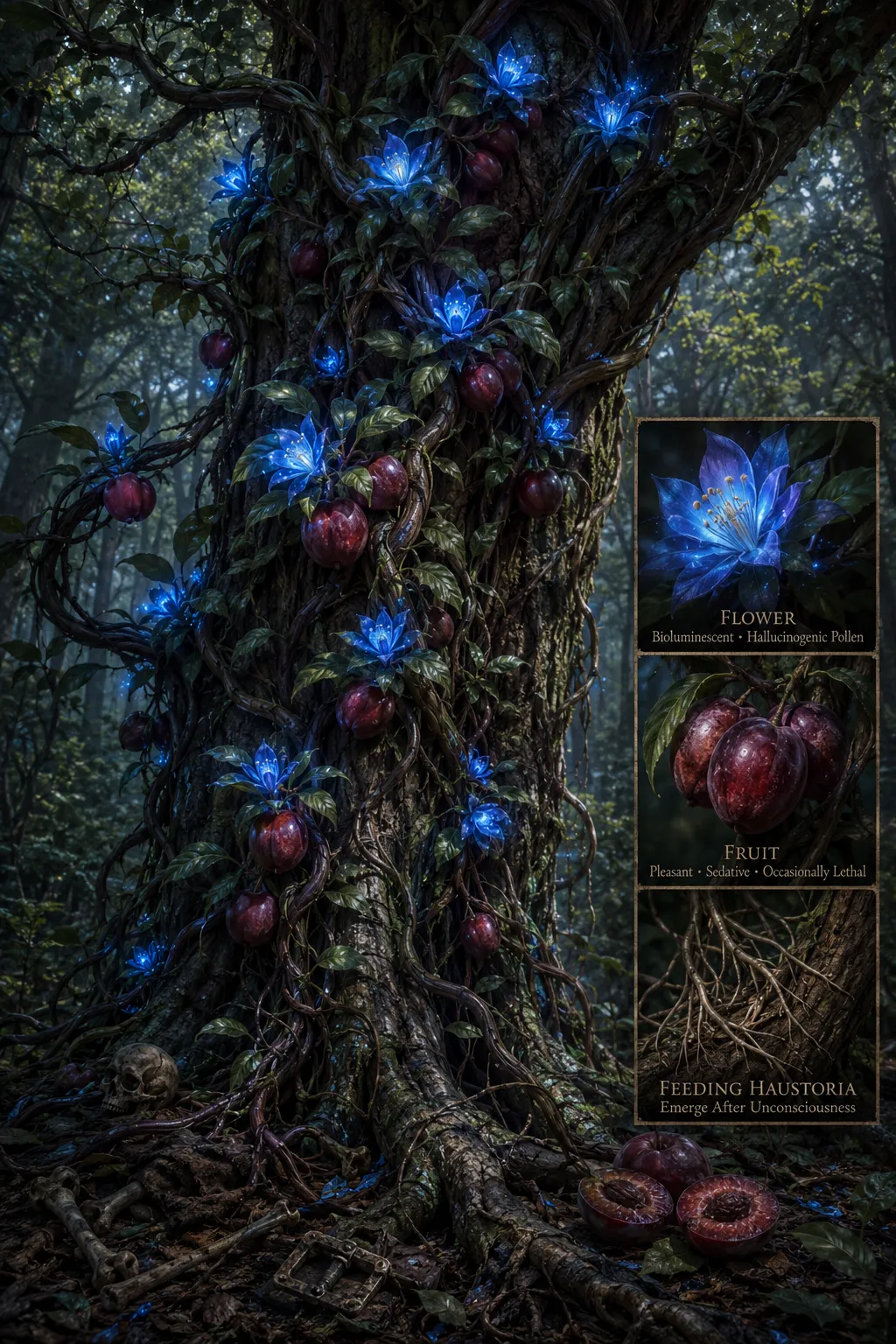
A Sweetgrave Vine in full bloom, its bioluminescent blue flowers and dark fruit climbing a mature host tree, with detail insets of the flower, fruit, and feeding haustoria
A mature Sweetgrave Vine climbing its host, in flower and fruit.

Bestiary Dossier

Classification
Host-dependent predatory climbing plant
Region
Temperate Forest; Warm-Temperate Forest; Subtropical Forest; Mature Woodland
Alignment
Unaligned
Threat / Role
No combat rating — sessile predator; hallucinogenic and sedative lure organism
Senses
None known
Languages
None

The Sweetgrave Vine is a perennial climbing plant that establishes itself upon a mature living tree, using the host for support, light, concealment, and stored nutrients. It lures sapient creatures with bioluminescent flowers and euphoric fruit, then consumes the unconscious over one to four days through root-borne feeding structures. It is rarely dangerous once properly identified — its greatest advantage is that it seldom appears dangerous before then.

Archival Summary

Rarely dangerous once identified. That is precisely the danger.

The Sweetgrave Vine is believed to have appeared after the Cataclysm. No reliable pre-Cataclysmic botanical record describes the species, and there is presently no evidence that it was deliberately created, shaped by a known divine power, or produced through artificial cultivation. The prevailing view within the Aelorian Archives is that the Sweetgrave descended from an ordinary climbing plant altered by the wider changes that followed the Cataclysm — changes that produced an unusual relationship with its host tree, compounds that affect sapient creatures, and the ability to retain fragments of memory from certain creatures it consumes. How those memories are preserved remains unknown.

The Sweetgrave is classified as Rootbound because it remains, in every fundamental respect, a plant. Its Predatory designation refers to the way it feeds and should not be taken as evidence of intelligence, malice, or deliberate hunting behavior. Among Rangers, Wildkin, druids, and clergy closely associated with The Wild, the Sweetgrave is commonly regarded as a perversion of the natural order — not because it preys, but because it has joined feeding, pleasure, sleep, death, and memory into a single cycle. Known specimens are therefore commonly destroyed.

Field Record

Origin, form, behavior, and confirmed engagement.

This record preserves the Sweetgrave Vine's origin, observed manifestation, essence, behavioral profile, habitat, threat assessment, Gravefruit, observational profile, signs of presence, cultural praxis, harvest value, and one archivist's firsthand account of engagement.

Origin
Primary Concordance Type
Rootbound
Origin Designation
Post-Cataclysmic
Disposition Classification
Predatory
Regional Anchoring
Non-regional; recorded in temperate, warm-temperate, and subtropical mature forests

The Sweetgrave Vine is believed to have appeared after the Cataclysm. No reliable pre-Cataclysmic botanical record describes the species, and there is presently no evidence that it was deliberately created, shaped by a known divine power, or produced through artificial cultivation.

The prevailing view within the Aelorian Archives is that the Sweetgrave descended from an ordinary climbing plant altered by the wider changes that followed the Cataclysm. Those changes affected more than its growth. The vine developed an unusual relationship with its host tree, compounds that affect sapient creatures (those capable of reason, language, and self-awareness), and the ability to retain fragments of memory from certain creatures it consumes.

How those memories are preserved remains unknown.

The Sweetgrave is classified as Rootbound because it remains, in every fundamental respect, a plant. Its Predatory designation refers to the way it feeds and should not be taken as evidence of intelligence, malice, or deliberate hunting behavior.

Among Rangers, Wildkin, druids, and clergy closely associated with The Wild, the Sweetgrave is commonly regarded as a perversion of the natural order. Predation itself is not their objection. Their concern lies in the way the plant has joined feeding, pleasure, sleep, death, and memory into a single cycle.

Known specimens are therefore commonly destroyed.

Observed Manifestation: Appearance

A Sweetgrave Vine is not itself a tree, though it can easily be mistaken for part of one at first glance. It roots at or near the base of a mature host and climbs the trunk, sending stems through the branches until vine and tree become difficult to separate without close inspection.

The leaves are generally unremarkable and resemble ordinary climbing growth. The fruit is more distinctive, though its position can still be misleading. It develops mainly along stems woven through the host canopy, often giving the impression that the tree itself is bearing it.

When ripe, Sweetgrave fruit is usually deep crimson to wine-purple and roughly comparable in form to a plum or fig. Each contains a single large central pit, with flesh that is somewhat firmer than its soft skin would suggest.

The flowers provide the clearest visible clue. They are blue and bioluminescent, producing a faint light of their own. In full daylight the glow can be difficult to notice, while in deep shade, at dusk, or after dark it becomes much more apparent.

The flowers are attractive rather than threatening. Several field reports describe them simply as beautiful, which is an accurate observation but not a useful measure of safety.

When disturbed, the blossoms release a fine blue pollen. In low light, this pollen can remain faintly visible in the air for a short time before dispersing, making recent disturbance easier to recognize.

Essence & Nature

The Sweetgrave forms a close physical connection with its host through haustoria, specialized structures that penetrate the host's tissues and allow the vine to exchange water and nutrients with it. This relationship is sometimes described as parasitic, but that is only partly accurate.

When prey is scarce, the vine draws water, sugars, and minerals from the host. After a successful feeding, however, some of the recovered nutrients pass back into the tree. Long-established hosts may therefore show unusually healthy foliage, vigorous growth, or greater resistance to poor conditions than neighboring trees.

The relationship is best described as enforced mutualism. Both organisms may benefit, but the arrangement exists because the Sweetgrave has imposed it. The host provides more than nourishment. It gives the vine height, access to light, concealment, and a stable structure from which to flower and fruit. For that reason, the Sweetgrave normally preserves a healthy host rather than exhausting it.

Only when the tree becomes badly diseased, severely damaged, or begins to fail through age does the vine draw more heavily upon its remaining reserves.

Behavioral Profile

The Sweetgrave does not hunt in any meaningful sense of the word. It remains where it grows, flowers, produces fruit, and feeds when the conditions are suitable. That this sequence is highly effective should not be mistaken for evidence of planning.

During flowering, pollen enters the surrounding air. In sapient creatures, exposure can cause mild hallucinations and changes in mood. Colors may seem brighter, scents more pleasant, and the immediate surroundings safer or more comfortable than they otherwise would. The pollen does not force a creature to approach the plant or eat its fruit.

The fruit itself requires little assistance. It is genuinely pleasant to eat, with a flavor closer to plum than fig and a firmer texture than either comparison suggests. A single fruit usually produces little beyond mild relaxation and euphoria. Continued consumption causes increasing drowsiness, slower reactions, poor coordination, and growing disorientation. With enough fruit, the individual eventually falls into a deep sleep. The effect is cumulative — one fruit is unlikely to incapacitate a healthy individual, but several eaten over a short period may do so.

The lethal fruit presents a different hazard. Approximately one in twenty ripe fruits contains a much stronger toxin. Nothing in the fruit's appearance, smell, texture, or flavor reliably distinguishes it from the rest. Severe poisoning usually begins with vomiting, followed by convulsions and, if the poison is not successfully treated, death.

Feeding begins only after a suitable victim is unconscious. Fine tendrils emerge from the lower vine and root zone and penetrate the body. These feeding structures gradually remove fluids and soft tissue over one to four days. The process usually leaves bone, teeth, hair, clothing, and other materials the vine cannot digest.

Ordinary animals do not appear to suffer the same deeper effects from the fruit. Birds and other wildlife consume it freely and carry the large central pit elsewhere — the Sweetgrave's primary means of reproduction. The sight of animals feeding beneath a Sweetgrave has reassured more travelers than it should have.

Habitat & Range

Sweetgrave Vines are associated with mature woodland capable of supporting large, established host trees. Confirmed specimens have been recorded in temperate, warm-temperate, and subtropical forests. They are not considered characteristic of equatorial rainforest, tundra, high alpine environments, or arid regions. Temperature appears to be one of the main limits on their range.

In temperate regions, sustained winter cold causes the vine to enter dormancy. Flowering stops, pollen production ceases, fruiting ends, and active growth contracts toward the trunk and root crown. The plant remains alive but largely inactive. In warmer climates where prolonged freezing does not occur, a Sweetgrave may remain active for most or all of the year.

This sensitivity to cold has practical importance. Winter is the safest season for removing the species in temperate regions, while cold magic or another reliable source of sustained cold can produce much the same effect elsewhere.

Threat Assessment

The Sweetgrave presents little direct danger once it has been recognized. It cannot pursue a traveler, has no known means of attacking a conscious creature, and does not deliberately defend itself when cut or damaged.

Careless removal can still create problems. Physical damage to a flowering specimen ruptures blossoms and pollen-bearing tissue, releasing a heavier concentration of pollen into the surrounding air. Cold should therefore be applied before cutting whenever circumstances allow.

The more serious danger is accidental exposure. A traveler may encounter what appears to be a healthy fruit tree covered in attractive blue flowers. Wildlife may be feeding nearby without harm. The fruit smells pleasant, tastes good, and produces only mild effects at first. Repeated consumption can eventually result in deep sleep. If the victim remains near the root zone for several minutes, feeding structures begin to emerge; once attached, the vine can consume the victim over the course of one to four days.

The lethal fruit creates an additional risk. Across the records available to the Archives, approximately one ripe fruit in twenty contains enough toxin to cause fatal poisoning in a susceptible individual. These fruits cannot be identified reliably before consumption.

Recognition changes the situation considerably. An informed traveler can avoid the fruit, leave the pollen-bearing area, or suppress the vine with cold before attempting removal. Most fatalities occur because the plant is mistaken for harmless vegetation until exposure is already underway.

Gravefruit

After the Sweetgrave consumes a sapient creature, some later fruit may contain fragments of that individual's memories. These fruits are known as Gravefruit.

The memories are incomplete and usually appear as sensory or emotional impressions rather than orderly recollections. A person consuming Gravefruit may experience a face, a voice, a familiar place, a moment of fear, a strong affection, or a physical sensation associated with the dead. The experience should not be confused with complete memory.

The Aelorian Archives does not consider a Gravefruit impression sufficient on its own to establish identity, historical fact, guilt, or motive. Memory is unreliable even when one possesses one's own; a fragment recovered from fruit deserves at least the same caution.

Even with these limitations, Gravefruit has considerable value to investigators, historians, ritual specialists, and those who study memory. It has also acquired predictable value among less respectable buyers.

Observational Profile

The Sweetgrave Vine is not mobile. It roots at the base of a single mature host and climbs the trunk and canopy, remaining fixed there for its entire life; it has never been observed relocating from one host to another.

It shows no known signs of intelligence, does not pursue prey, and does not defend itself with any apparent purpose when cut or damaged. Its scale is bound to its host — a mature specimen can be difficult to distinguish from the tree it climbs without close inspection.

The Sweetgrave is solitary in the sense that it does not form colonies or coordinate with other specimens; its "range" is the single host tree it has claimed, not open territory.

Signs of Presence

A mature Sweetgrave is often easier to identify by the condition of the surrounding site than by the vine itself. The host tree may appear unusually healthy, particularly during drought, poor soil conditions, or seasonal stress. This is not proof of infestation, but in combination with other signs it deserves attention.

The blue flowers are a stronger clue, especially at dusk or beneath heavy canopy when their natural light becomes easier to see. Wildlife feeding upon fallen fruit should not be taken as evidence of safety.

The ground beneath an older specimen is often more informative. Bone, teeth, hair, metal fastenings, jewelry, tools, scraps of clothing, and other materials the vine cannot consume may collect beneath leaf litter or among surface roots.

Sapient travelers lingering near the tree can provide another warning. Individuals already affected by pollen or fruit may appear unusually content, drowsy, or unwilling to accept that the site presents any danger. Such behavior should be treated as possible exposure before it is dismissed as poor judgment. The two, of course, are not mutually exclusive.

Cultural Praxis

The normal response to a confirmed Sweetgrave is eradication. Rangers, Wildkin, druids, and nature-aligned clergy are particularly likely to remove the species when they encounter it. Among these groups, the Sweetgrave is commonly regarded as a corruption of the ordinary relationships between plant, animal, death, and renewal.

The preferred method is summarized in a common field instruction: Frost before blade. Blade before flame. Where winters are sufficiently cold, removal is usually attempted during dormancy. Elsewhere, the plant is first chilled through magic, alchemical means, stored ice, or another practical source of sustained cold. This suppresses flowering activity, reduces pollen release, and causes exposed growth to contract.

The climbing stems are then cut away from the host in sections until the root crown can be exposed. The crown must be removed or destroyed; cutting away only the visible upper growth is insufficient. Detached plant matter is commonly burned afterward.

The host tree should be preserved whenever possible. Long-established hosts may have received substantial nourishment from the vine and can suffer considerable stress after its removal.

All fruit should be collected during eradication, and the pits destroyed unless specifically retained for controlled study. Leaving viable fruit for wildlife to disperse rather defeats the purpose of removing the vine in the first place, though this has apparently required explanation more than once.

Variant Forms/Manifestations: None currently recorded.

Harvest & Material Value

The Sweetgrave is dangerous, but several parts of the plant are valuable. Its blue flowers contain hallucinogenic compounds that can be used in carefully prepared dream tonics, incense, perfumes, sleep aids, and some recreational mixtures.

The fruit also has commercial value. Ordinary Sweetgrave fruit is prized for its flavor and mild euphoric effect. Trade is limited in many regions because approximately one fruit in twenty may be lethal, and there is no reliable method of identifying such fruit before consumption.

Gravefruit is considerably more valuable. Its memory fragments have uses in historical inquiry, investigation, funerary rites, memory study, and certain forms of ritual work. A black market exists for the same reasons.

Cultivation remains controversial. A Sweetgrave can be maintained for flowers and ordinary fruit without deliberately feeding it sapient prey. Gravefruit, however, cannot be produced without such a death — a distinction that has not prevented every prospective cultivator from arriving at an ethical interpretation convenient to their business. The Archives does not share their enthusiasm.

Field Account