
Humans

Humans are the most widespread people of Khassid and, perhaps for that reason, among the easiest to describe badly. There is no single human culture, no shared physiognomy beyond the broad limits of the species, and no ancestral tradition sufficiently dominant to represent humanity as a whole.

Seal of the Aelorian Archives
Archival Release Authorization

Approved for circulation among the general populace by order of the Aelorian Archives.

People record released within the Codex Naturalis Khassidia; physiological, cultural, historical, theological, and social observations preserved below for comparative reference.

Taxonomical Concordance

Primary Concordance Type
Sapient
Origin Designation
Indigenous
Disposition Classification
Variable
Regional Anchoring
Widespread throughout Khassid, with no singular homeland, cultural center, or dominant settlement pattern applicable to the species as a whole
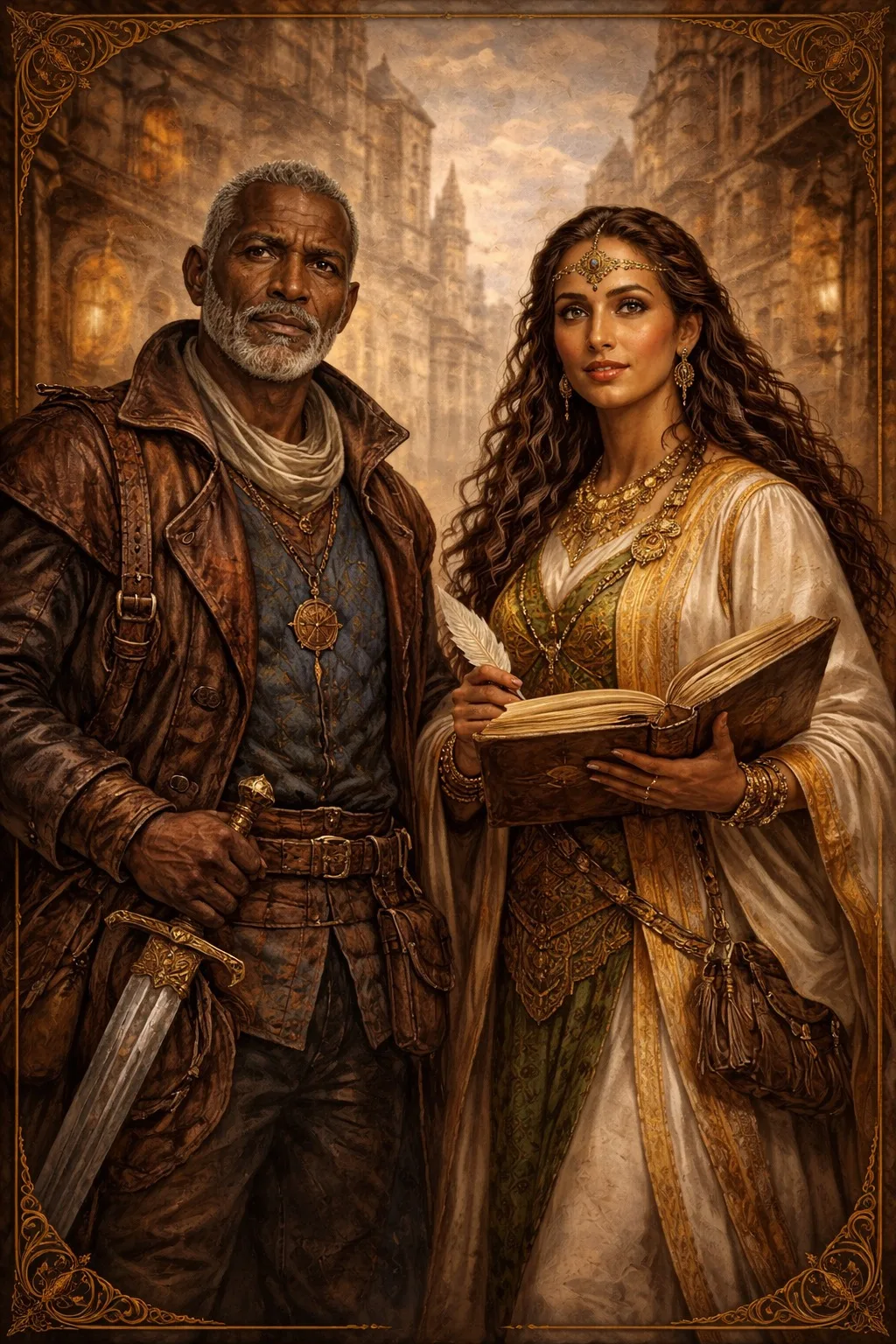
A human pair — an older traveler bearing a sword and a scholar holding an open book and quill — representative of one regional human pairing among countless others
A single regional human pairing, offered as illustration only. As the record itself notes, no one depiction can represent the physical or cultural range of humanity as a whole.

Peoples Dossier

Classification
Sapient People
Origin
Khassid
Distribution
Widespread across the known world
Primary Cultural Characteristic
Adaptation through revision and reconstruction
Average Lifespan
Approximately eighty years; individuals approaching or exceeding a century are documented under favorable conditions
Recognized Lineage Expressions
Ashlines, Echoborn, Shardmarked, and other post-Cataclysm inheritances recorded within human populations
Faith Tradition
Highly variable; commonly associated with the Human Pantheon, though devotion to the Elder Four and deities of other traditions is widespread
Primary Languages
Common, alongside numerous regional languages and dialects

Any attempt to identify a single organizing principle comparable to the Barazûn concept of continuation, the Felden Hearth, or Syl’Aeris resonance will eventually fail when applied to humanity. Human societies are simply too numerous and too historically fragmented for such coherence.

What can be identified is a recurrent method of response. Humans revise. A human community confronted with a broken institution will frequently attempt to repair it, but it shows little reluctance to alter its structure substantially in doing so. A city may preserve the foundation of an ancient wall while placing an entirely different civic order behind it. A religious practice may retain a saint’s name while changing the theology surrounding that saint. A kingdom may preserve titles from a vanished dynasty while redefining the authority those titles carry. Continuity matters to humans, but continuity rarely requires preservation of form.

This quality makes human civilization extraordinarily productive and occasionally exhausting to catalogue.

Archival Summary

A people who inherited less than they expected and rebuilt more than seemed likely

Human history after the Cataclysm differs significantly from that of several other native peoples of Khassid.

The disaster devastated all peoples, but human civilizations appear to have experienced an unusually severe fracture of cultural continuity. Cities disappeared, political institutions collapsed, archives were destroyed, and entire traditions survived only in fragments. More consequentially, humanity lacked the degree of consistent divine or institutional preservation documented elsewhere. The Barazûn retained a powerful tradition of continuative identity. The Felden reorganized around the surviving Hearth. The Syl’Aeris retained both Aelindor and cultural mechanisms capable of carrying memory across generations.

Humanity possessed no equivalent structure operating at comparable scale.

Early post-Cataclysm human communities apparently believed this condition universal. Subsequent contact with other peoples made the difference unmistakable. Humans gradually discovered that while others had suffered enormously, several had retained forms of continuity humanity had not. The realization was made more difficult by the widespread attribution of the Cataclysm to conflicts involving human deities, an association that continues to affect human diplomacy and religious reputation in some regions.

What followed is more instructive than the loss itself.

Human civilization reappeared without recovering a single shared model of what human civilization had previously been. Surviving populations gathered fragments, improvised institutions, borrowed from neighboring peoples, rediscovered older technologies, invented replacements where recovery failed, and built new political orders whose claim to legitimacy rested increasingly upon present function rather than unbroken descent.

This process continues. The result is not a culture of ruin. It is a culture — or, more accurately, many cultures — in which ruin has ceased to possess veto power over what may be built afterward.

Field Record

Origin, form, cultural variability, reconstruction, social organization, faith, and post-Cataclysm development.

The principal difficulty in compiling a Codex entry for humanity lies in separating species-wide tendencies from behaviors produced by particular kingdoms, regions, religions, or historical circumstances. Statements that would be perfectly reasonable within one human culture may become absurd when applied to another. One population may organize itself through hereditary monarchy, another through elected councils, another through mercantile oligarchy, and another through an arrangement so dependent upon local circumstance that none of those terms is especially useful.

The following record therefore concerns patterns sufficiently widespread to warrant comparison, while avoiding the implication that every human society expresses them identically.

Origin & Early Record

Humans are indigenous to Khassid and are counted among the mortal peoples whose earliest existence belongs to the world’s native history rather than later migration or planar arrival. Beyond that broad fact, attempts to reconstruct a unified human origin tradition encounter immediate difficulty.

This absence is itself revealing.

Humanity possessed ancient civilizations before the Cataclysm, but those civilizations did not necessarily share one creation account, language, political inheritance, or conception of themselves as a single cultural body. The category human appears to have been biologically obvious long before it was culturally sufficient.

Regional identity frequently mattered more.

The destruction of records during the Cataclysm deepened this fragmentation. Later historians found themselves reconstructing human antiquity from surviving royal chronicles, temple records, oral traditions, inscriptions, archaeological remains, and foreign accounts that did not always agree with one another.

For this reason, claims concerning the original human kingdom, the first human language, or the ancestral human culture should be treated skeptically unless geographically qualified.

Humanity began as one species. It does not follow that it ever constituted one people in the cultural sense.

The Cataclysmic Fracture

The Cataclysm is the central historical rupture in the modern human record.

The available evidence indicates near-total collapse across multiple human civilizations. Urban centers were destroyed or rendered uninhabitable, political networks dissolved, archives vanished, and communication between surviving populations became unreliable or impossible. The scale of this destruction created not merely demographic loss but what may reasonably be called a continuity crisis: too few intact institutions remained capable of telling later generations how the preceding world had functioned.

This distinction matters because physical rebuilding is comparatively straightforward to identify. Stones can be restacked. Roads can be cleared. Fields can be replanted.

Institutional reconstruction is harder.

What law applies when the authority that made it no longer exists? Who owns land when the records of ownership are gone? Which priest speaks for a temple whose hierarchy died with the city? Does a surviving noble inherit power from a kingdom that no longer exists? Does an ancient oath remain binding when half the parties to it have vanished?

Human communities answered such questions differently, and modern human diversity owes much to those answers.

Some attempted restoration. Others rejected the institutions associated with the old world entirely. Still others preserved titles, rites, languages, and customs while changing their meaning enough that the resulting society became something new beneath familiar names.

It is here that the most characteristic human pattern becomes visible.

When continuity could not be recovered, humans manufactured legitimacy from function. A government that kept people alive became a government. A road used often enough became a road again. An incomplete archive became the beginning of history rather than merely the remains of it.

Observed Manifestation: Appearance

Human physical appearance varies more substantially by geography and population history than by any species-wide pattern useful to field classification.

Skin pigmentation ranges across the natural human spectrum from very pale tones to deep brown, with substantial variation in undertone and regional prevalence. Hair occurs in numerous textures and colors, and eye coloration displays similarly broad range. Height, skeletal proportion, facial structure, and body type vary considerably even between populations separated by comparatively modest distances.

Unlike several other peoples recorded in the Codex, humans possess no consistent anatomical marker that reliably indicates cultural lineage. There is no human equivalent of Barazûn mineral striation or the pronounced environmental expression found among Syl’Aeris Echoes. Nor do the recognized human lineage expressions consistently produce externally visible traits.

The relationship between appearance and culture is therefore overwhelmingly environmental and historical.

A human from a highland population may resemble nearby non-kin more closely in dress, posture, pigmentation, and practical adaptation than another human from a distant desert or coastal society. Clothing intensifies this variation. Human garments reflect climate, profession, religion, rank, political affiliation, regional craft, fashion, inherited custom, and personal preference to such a degree that dress is frequently a more useful indicator of probable origin than physical form.

Even this requires caution.

Humans travel. They migrate readily, intermarry widely, adopt foreign customs without necessarily relinquishing prior identity, and are unusually willing to alter outward presentation when circumstances reward doing so.

Anyone attempting to identify a human’s origin by appearance should therefore prepare to be wrong with some frequency.

Essence & Cultural Nature

Humanity possesses no singular cultural essence, but the recurring tendency toward revision deserves special attention.

The distinction between revision and continuation is useful when comparing humans with the Barazûn. A Barazûn institution tends to maintain identity by ensuring that its underlying function continues through alteration. Humans are often more willing to ask whether the function itself should remain.

This is not merely innovation. It is reconsideration.

Human societies routinely preserve parts of an inherited structure while discarding others, and they are capable of doing so with remarkable speed when necessity, ambition, ideology, or opportunity provides sufficient pressure. A legal code may be rewritten after a war. A religious movement may redefine a deity’s civic importance within a generation. An unsuccessful form of government may be replaced not only by another ruler but by a different theory of rulership.

Such change can appear chaotic to peoples whose institutions operate across longer periods. Sometimes it is chaotic.

The flattering interpretation of human adaptability should not obscure the fact that the same capacity to reorganize permits repeated upheaval, political instability, aggressive expansion, ideological enthusiasm, and the rapid abandonment of systems that were functioning adequately before someone became convinced they could function better.

The Syl’Aeris description of humans as “rivers of change” is therefore less poetic than it first appears. Their records note both admiration for human creativity and concern regarding the human tendency to reshape environments and institutions according to present will.

That assessment is fair. Humans frequently improve what they inherit. They also frequently refuse to leave it alone.

Reconstruction

The clearest physical expression of human culture is found in their settlements.

Humans commonly build upon what already exists, though not with the Barazûn insistence that new construction remain conceptually continuous with the old. A ruined foundation may become the base of a new palace, warehouse, temple, tenement, or defensive wall regardless of the original structure’s purpose. Material is retained because it remains useful, because rebuilding from nothing is costly, or because association with antiquity provides legitimacy.

This produces cities with an almost archaeological verticality.

Older streets disappear beneath newer ones. Fortifications become residential walls. Temples are incorporated into civic complexes. Ruins acquire markets. Aqueducts change direction. Former palaces become administrative offices for governments whose founders would have been enemies of the rulers who built them.

Human historical consciousness is therefore often visible through appropriation rather than preservation. A building may remain because successive generations repeatedly found new reasons to use it.

This same behavior applies to ideas. Humans borrow readily. Foreign technologies, military practices, religious concepts, foods, clothing, artistic forms, and administrative methods are frequently adopted and altered rather than preserved in their imported form.

Other peoples occasionally complain that humans take something elegant and make it unrecognizable. This complaint is not without evidence. Neither is the human response that the altered version now works better for whatever they needed it to do.

Settlement & Social Order

No single form of human government dominates Khassid.

Monarchies, councils, republics, oligarchies, temple administrations, military governments, clan structures, city-states, federations, and less easily categorized local arrangements all appear in the surviving record. The more useful commonality lies not in the form of authority but in humanity’s repeated tendency to formalize it.

Human communities often create offices, jurisdictions, legal procedures, records, and defined responsibilities comparatively quickly once settlement stabilizes. This appears partly attributable to the experience of institutional collapse. A structure that depends entirely upon personal memory or informal agreement can disappear when the individuals carrying it die.

Humans therefore write things down. They register ownership, record marriages, enumerate taxes, issue appointments, define boundaries, archive treaties, establish courts, create bureaucracies, and then complain bitterly about the bureaucracies they created.

An outsider should not mistake the complaints for evidence that these institutions are considered unnecessary. Humans frequently distrust authority and depend upon it simultaneously.

Leaders are usually expected to preserve stability while remaining responsive to change. Where either function fails, human political systems can alter rapidly. Succession may provide the change peacefully. Reform may preserve the structure while revising its operation. Revolt, coup, civil war, or institutional collapse may accomplish the same task less gently.

The important point is that human authority is often treated as legitimate only while it continues to justify itself. Inheritance can establish a claim. It does not guarantee obedience forever.

Labor, Kinship & Continuity

Human labor is as diverse as human settlement, but it tends to carry a strong relationship with aspiration. Work may be inherited, chosen, imposed, purchased, apprenticed, abandoned, or transformed into something else entirely over the course of a single lifetime.

This distinguishes human occupational identity from societies in which craft is more tightly associated with lineage or enduring cultural function.

A farmer’s child may become a scholar. A merchant may enter a priesthood. A soldier may become a ruler. A noble may lose everything and become a trader. None of these transitions is inherently remarkable in human society, though individual cultures may place substantial obstacles in the way.

Kinship is similarly variable. Blood descent remains extremely important in many regions, especially where property, title, ancestry, or political legitimacy depends upon it. Elsewhere, adoption, household association, military fraternity, guild membership, oath-bonds, religious affiliation, and long-standing friendship may create relationships treated as kin in practice even when not in law.

The Cataclysm appears to have accelerated this flexibility. Where entire families and communities vanished, survivors frequently created new households from whoever remained. Later institutions formalized some of these emergency arrangements while others faded as stability returned. The modern human family is therefore not a single form but a collection of forms shaped by culture, economy, law, faith, and circumstance.

Continuity is maintained less through one fixed social mechanism than through redundancy. Humans make heirs, archives, contracts, schools, monuments, stories, guilds, laws, dynasties, memorials, and institutions because no single method is trusted entirely.

Considering their history, this caution seems justified.

Communication & Identity

Common functions as the principal interregional language among humans and, increasingly, among mixed populations throughout Khassid. This convenience can obscure the considerable linguistic diversity beneath it.

Human communities preserve numerous regional dialects and independent linguistic traditions, including Vandecari, Thalvani, Old Ceryn, and many others associated with particular regions or historical cultures. Religious institutions may retain ceremonial forms no longer used in ordinary speech, while noble houses, trade networks, and scholarly institutions frequently preserve specialized vocabularies of their own.

Human naming practices are correspondingly impossible to generalize beyond saying that they are culturally determined.

Names may identify family, place, profession, religion, aspiration, historical affiliation, patronage, or nothing more complicated than parental preference. Several cultures employ inherited family names; others privilege given names, titles, devotional names, or regional markers.

The absence of a universal human naming convention is not a deficiency in the record. It is one of the principal facts of the record.

This diversity also complicates the meaning of human identity itself. A person is likely to identify first by kingdom, region, city, faith, language, profession, household, lineage, or political affiliation depending upon context. Species becomes most salient where contact with other peoples makes it relevant.

A human in a human city may rarely think of themselves as human. A human negotiating with the Syl’Aeris, Barazûn, Felden, or Varnokh generally discovers the category rather quickly.

Faith & the Human Pantheon

Human religion displays the same diversity found in the rest of their culture.

The grouping conventionally called the Human Pantheon is not a unified system equivalent to the Dûn-Karr or Hearthweave. It is an archival convenience describing a broad divine tradition whose gods arose principally through human belief and whose worship remains most concentrated among human populations. The pantheon includes divine powers associated with love, war, passage, boundaries, law, history, sea, sun, safety, death, and numerous other experiences around which human communities have organized meaning.

This breadth is not accidental.

Human belief in Khassid is highly responsive to circumstance. A coastal population may organize religious life around the sea in a manner nearly absent inland. A city recovering from war may elevate deities of law, protection, healing, or remembrance. A mercantile culture may devote substantially more attention to fortune, oath, and safe passage than its neighbors.

Devotion can therefore change considerably across surprisingly short distances.

The relationship between humanity and divinity is also complicated by the Cataclysm. Human gods were widely associated with the conflicts preceding the disaster, and the failure of divine powers to preserve human civilization uniformly left a theological inheritance marked by both devotion and suspicion. Human worship consequently includes traditions of extraordinary faith alongside equally strong traditions of questioning, negotiation, reinterpretation, and rejection.

This is important in a world where belief itself influences divinity. Human religious variety does not merely produce many doctrines. It participates in the divine ecology through which gods emerge and persist. The Human Pantheon is therefore particularly illustrative of the principle that mortal communities do not simply receive divine meaning; over long periods, they participate in shaping it.

The Archives should nevertheless avoid claiming that humans possess some unique metaphysical authority over belief. All mortal peoples participate in this process. Humans simply appear unusually willing to reconsider whom they believe and why.

Lineage Expressions

The KRD recognizes several human lineage expressions, but these require more cautious archival treatment than comparable traditions among the Barazûn or Felden.

They are not cultural nations, hereditary castes, or reliably visible populations. Rather, they describe recurring inheritances associated with the aftermath of the Cataclysm and the metaphysical conditions that followed it. The best documented among them are the Ashlines, Echoborn, and Shardmarked.

Ashline traditions concern families or individuals in whom survival under catastrophic pressure appears to have left an unusually persistent legacy. The term is broad and does not necessarily indicate literal descent from a single disaster population. Its defining association is repeated endurance where failure might reasonably have been expected.

The Echoborn are described through a different phenomenon: the apparent persistence of favorable resonance around individuals whose lives seem unusually responsive to the accumulated weight of memory and circumstance. Human traditions surrounding them often invoke the idea that the world itself “remembers” them, though this language should not be treated as a settled metaphysical explanation.

Shardmarked individuals are associated with lingering fragments of the world’s fracture, whether through inheritance, localized exposure, or some mechanism not yet securely established. Here the archival record becomes especially cautious. The Cataclysm altered Khassid in ways still imperfectly understood, and the presence of a recurring trait does not establish the process by which it entered a bloodline.

These classifications demonstrate an important feature of modern humanity. Their lineages do not reach backward primarily toward a unified ancestral origin. They reach backward toward catastrophe. What differentiates them is often the manner in which the broken world remained present afterward.

Lifespan & Generational Pressure

Humans typically live approximately eighty years, with individuals reaching a century under favorable circumstances. This places them among the shorter-lived major peoples of Khassid and gives their social institutions a rhythm noticeably different from those of the Barazûn, Syl’Aeris, or Felden.

A human may reasonably expect political leadership, professional institutions, and cultural fashion to pass through several significant transformations within a single lifetime. A Barazûn may personally supervise a project for more years than several generations of humans remain alive. A Syl’Aeris elder may remember events known to human historians only through documents.

Humans are acutely aware of this disparity.

It would be overly romantic to attribute all human ambition to short lifespan, but the connection deserves consideration. Humans build quickly, train successors, record aggressively, seek advancement, establish dynasties, found institutions, and pursue achievements whose significance may outlive them.

They have less time in which to assume that someone else will eventually attend to a problem.

This pressure can produce extraordinary creativity. It also produces impatience.

Other long-lived peoples frequently criticize humans for attempting to accomplish in decades what they believe ought to develop across centuries. Humans reply, usually with some justification, that they do not possess centuries.

Neither position is irrational. The disagreement begins with mortality.

Relations with Other Peoples

Human ubiquity ensures that no single relationship with another people can be generalized safely.

Humans trade with everyone. They have fought nearly everyone. They have married into, governed alongside, studied under, conquered, liberated, exploited, admired, imitated, misunderstood, and been misunderstood by nearly every major people recorded in Khassid.

Their ability to adopt foreign practices facilitates integration but can create tension when adoption is perceived as appropriation, dilution, or careless modification. Humans have a tendency to encounter something useful elsewhere, carry it home, adapt it to local circumstances, and eventually forget that the resulting practice was once foreign.

This process has enriched human societies enormously. It has also irritated virtually everyone at one time or another.

The deeper post-Cataclysm issue concerns responsibility. Because conflicts among human-associated gods remain connected in historical memory with the disaster, human societies sometimes encounter suspicion disproportionate to the actions of the individuals involved. The KRD explicitly notes that this perception continues to affect diplomacy and religious interaction.

Human responses vary predictably. Some accept a particular responsibility to demonstrate restraint. Some reject inherited blame entirely. Some attempt reconciliation. Others become defensive and thereby confirm every suspicion held against them.

Humanity contains enough populations for every possible answer to coexist.

Observational Profile

It is difficult to identify a human settlement from a single architectural form, but comparatively easy to recognize the human habit of layering function over history.

Their cities accumulate evidence of changing use. Buildings are expanded, subdivided, repurposed, reinforced, demolished selectively, or incorporated into later structures. Old districts acquire new names. New governments occupy old palaces. Religious buildings change affiliation. Fortifications become roads or markets when the threat that required them disappears.

Human communities rarely achieve the visual continuity of Barazûn construction or the environmental integration characteristic of many Felden and Syl’Aeris settlements.

They produce something else: visible revision.

The same is true socially. Humans form organizations rapidly when a need emerges and may dissolve them just as rapidly once the need has passed or another system replaces them. Guilds, militias, committees, courts, religious movements, merchant houses, adventuring companies, political factions, academies, and informal associations appear with remarkable frequency.

This organizational fertility is one reason human influence spreads beyond their demographic presence.

Where several humans gather around a problem, someone will eventually propose an institution. Another will object to its structure. A third will begin collecting dues. A fourth will already be writing the rules. The fifth has probably founded a competing organization across the street.

I record this with affection, but not exaggeration.

Archival Considerations

Humanity resists the kind of elegant conclusion an archivist might prefer.

There is no single phrase equivalent to the Barazûn refusal of ending, the Felden defense of the Hearth, or the Syl’Aeris pursuit of resonance that captures human civilization without excluding enormous portions of it.

Perhaps this is appropriate. Humans are the people most inclined to resist whatever definition was last applied to them.

Their diversity should not be mistaken for lack of identity, however. Beneath the regional difference, political instability, theological argument, and repeated reinvention lies a pattern sufficiently consistent to warrant preservation.

When their world collapsed, human continuity failed in ways it did not fail everywhere else.

They rebuilt anyway. Not by recreating the old world precisely, and not by agreeing upon what should replace it, but by constructing thousands of answers wherever survivors found themselves capable of doing so. Some of those answers became kingdoms. Some became faiths. Some became institutions still functioning today. Others failed so thoroughly that the ruins of the reconstruction now sit atop the ruins of the civilization it attempted to replace.

Humans built again after those failures as well.

This capacity deserves neither uncritical praise nor suspicion. Adaptability can produce renewal or instability, tolerance or opportunism, invention or destruction. The same willingness to reconsider established structures allows humans to repair what no longer works and to dismantle what perhaps should have been left alone.

That ambiguity is not incidental to humanity. It may be the closest thing the Archives possess to a defining characteristic.

Other peoples preserve, continue, endure, remember, or maintain according to traditions that give those acts recognizable form.

Humans are more likely to look at what remains and ask a different question: what can be made from this now?

For good or ill, much of modern Khassid exists because someone answered.