
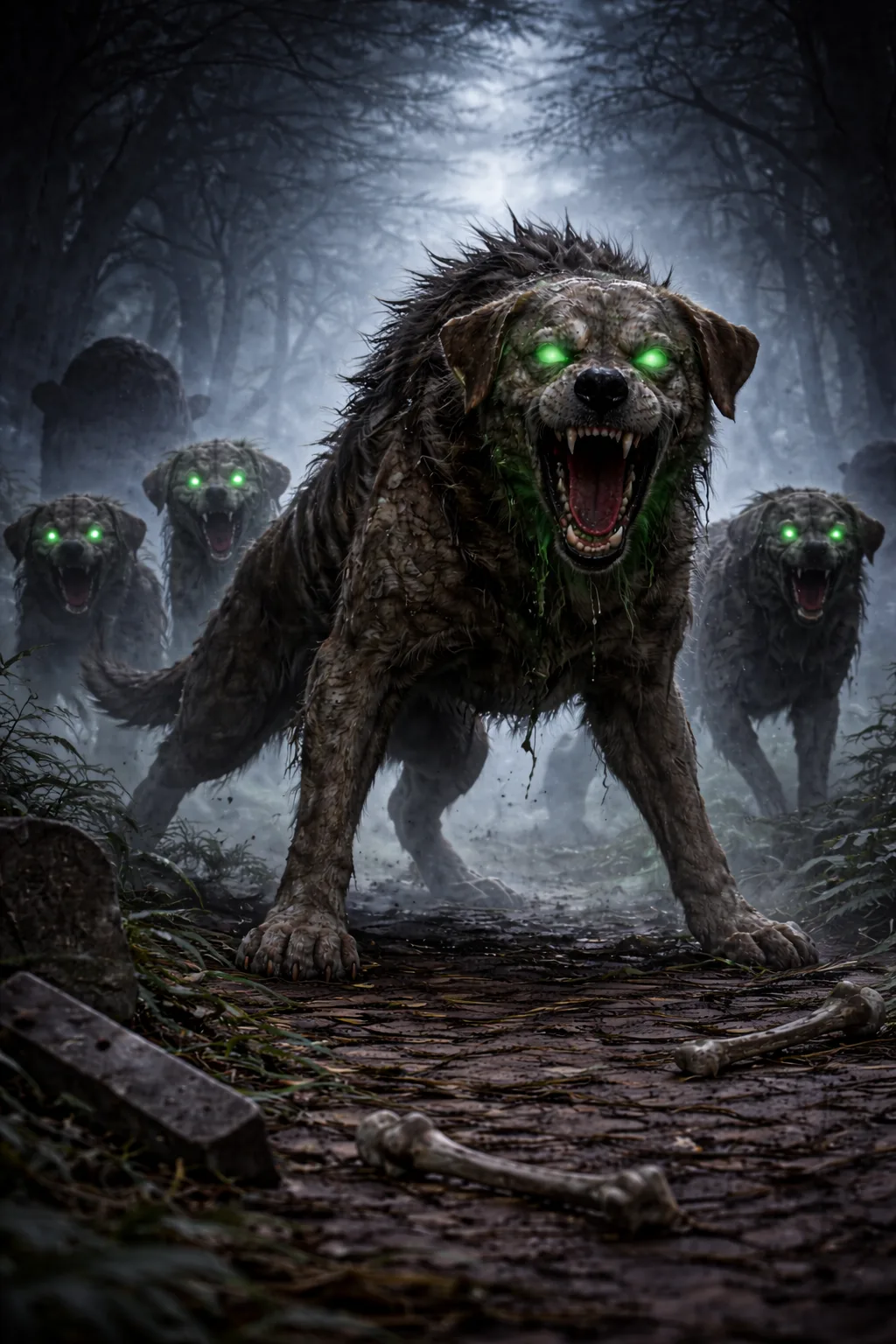
Gravehound

A necromantically sustained pack hunter that tracks the living by their vitality alone—relentless, infectious, and disproportionately dangerous once an Alpha takes command.

Seal of the Aelorian Archives
Archival Release Authorization

Approved for circulation among the general populace by order of the Aelorian Archives.

Bestiary record released within the Hall of the Living World; combat statistics for both the base and Alpha profile preserved below for field reference.

Gravehound, a reanimated canine with a dim necrotic glow in its eyes
A Gravehound, mid-pursuit, its jaw slack and eyes lit with necrotic glow.

Bestiary Dossier

Classification
Undead
Region
Battlefields, mass graves, cursed kennels, necromantic domains, war-torn territories
Alignment
Unaligned
Threat / Role
Challenge 1 (200 XP) — pack hunter, tracking predator
Alpha Variant: Challenge 3 (700 XP) — pack commander, coordinated predator
Senses
Darkvision 60 ft., Passive Perception 13
Languages
Understands the languages of its creator, cannot speak

Gravehounds are raised from the remains of canines, reanimated through necromantic rites that bind obedience at the moment of return. The process embeds a persistent necrotic corruption within their flesh, allowing the creature to function as both hunter and vector of decay.

Archival Summary

An extension of its creator's will, and inevitability given legs.

The Gravehound is a necromantically sustained predator designed for pursuit, detection, and coordinated assault. It functions less as an independent entity and more as an extension of its creator's will, operating with singular focus once a target has been identified.

Its primary significance lies in its capacity to transform pursuit into inevitability. Gravehounds do not abandon a trail, nor do they rely solely on sight or sound; instead, they track the vitality of the living itself, allowing them to locate prey that would otherwise remain concealed. This renders conventional evasion unreliable, particularly over extended durations.

While individually manageable, their true lethality emerges in groups. Gravehounds exhibit coordinated engagement patterns, overwhelming targets through proximity and sustained pressure. Their attacks further compound danger by introducing necrotic infection, ensuring that even survivors remain compromised.

The presence of Gravehounds within a region is indicative of deliberate necromantic activity or residual death saturation sufficient to sustain repeated reanimation.

Field Record

Origin, form, behavior, and confirmed engagement.

This record preserves the Gravehound's origin, observed manifestation, essence, behavioral profile, habitat, threat assessment, combat statistics for both the base and Alpha profile, combat pattern, signs of presence, cultural praxis, harvest value, and a field account from Field Archivist Delren Vos.

Origin

Gravehounds are raised from the remains of canines, reanimated through necromantic rites that bind obedience at the moment of return.

The process embeds a persistent necrotic corruption within their flesh, allowing the creature to function as both hunter and vector of decay.

Observed Manifestation: Appearance

Gravehounds retain the general structure of their original form, though their bodies are visibly degraded. Flesh appears sunken or partially sloughed, with exposed bone visible along joints and flanks. Their fur is sparse, matted, or entirely absent in places, revealing gray-green tissue beneath.

Their eyes emit a dim, necrotic glow, lacking any natural movement or responsiveness. The jaw often hangs slightly open, revealing elongated teeth stained with dark residue. Saliva, when present, appears viscous and discolored.

Movement is uneven yet purposeful. Limbs articulate with a slight delay or stiffness, though this does not impede speed. When still, the creature appears inert—until motion resumes with sudden and direct intent.

Essence & Nature

The Gravehound is sustained by a necromantic binding that replaces instinct with directive function. It does not experience hunger, fear, or fatigue, but instead operates under a continuous compulsion toward assigned purpose.

Its defining capability—detection of the living—suggests an attunement not to scent in the traditional sense, but to the presence of vitality itself. This perception allows it to identify targets regardless of concealment, provided no magical interference is present.

The necrotic infection carried within its bite is not incidental, but integral. It represents a secondary extension of the animating force, propagating decay beyond the creature's immediate presence.

Behavioral Profile

Gravehounds operate with direct, purpose-driven behavior. Once a target is identified, they engage in persistent pursuit, maintaining pressure until the objective is completed or external interference prevents continuation.

They rarely act alone. In groups, they demonstrate coordinated positioning, closing distance from multiple angles to restrict escape routes. While lacking true intelligence, their behavior reflects imposed structure rather than instinctive chaos.

The creatures do not vocalize frequently. When they do, the sound is low and irregular—more a byproduct of movement than communication. Most coordination occurs through proximity and shared directive rather than active signaling.

They do not retreat. Damage does not alter their engagement pattern unless total structural failure occurs.

Habitat & Range

Gravehounds are most commonly encountered in areas where death has accumulated in sufficient volume to support necromantic activity. These include battlefields, mass burial sites, and regions subjected to prolonged violence or ritual corruption.

They may also be maintained within controlled environments, such as necromantic enclaves or fortified compounds, where they serve as patrol or tracking units.

Their range is typically defined by command. Unbound Gravehounds may wander, but such instances are rare; most remain tethered to a source of control or a designated territory.

Threat Assessment

The Gravehound presents a layered threat that extends beyond immediate physical harm. Its ability to detect living creatures renders concealment ineffective, particularly against prolonged pursuit.

In direct engagement, its primary danger lies in infection. Even minor injuries may result in necrotic degradation that prevents recovery, compounding risk over time. This transforms otherwise survivable encounters into extended hazards.

Group encounters significantly increase lethality. Multiple Gravehounds can restrict movement, overwhelm defenses, and ensure sustained contact, accelerating both physical and systemic damage.

While individually limited, their collective function as tracking and attrition units makes them disproportionately dangerous relative to their apparent strength.

Statistical Profile

Gravehound

Medium undead, unaligned

Armor Class 13 (natural armor)

Hit Points 27 (5d8 + 5)

Speed 40 ft.


STR14 (+2)
DEX14 (+2)
CON13 (+1)
INT2 (−4)
WIS12 (+1)
CHA5 (−3)

Saving Throws Wis +3

Skills Perception +3, Survival +3

Damage Resistances Necrotic

Damage Immunities Poison

Condition Immunities Charmed, Exhaustion, Poisoned

Senses Darkvision 60 ft., Passive Perception 13

Languages Understands the languages of its creator, cannot speak

Proficiency Bonus +2


Actions

Bite. Melee Weapon Attack: +4 to hit, reach 5 ft., one target. Hit: 8 (2d4 + 2) piercing damage plus 3 (1d6) necrotic damage. The target must succeed on a DC 12 Constitution saving throw or be infected with gravebite rot.
Gravebite Rot (Infection). An infected creature cannot regain hit points. At the end of each long rest, it must succeed on a DC 12 Constitution saving throw or take 3 (1d6) necrotic damage until cured.

Traits

Gravebound Tenacity. The gravehound has advantage on saving throws against being turned or frightened.
Death Scent. The gravehound can detect living creatures within 60 feet, even if they are hidden or invisible. This sense does not penetrate magical concealment.
Pack Coordination. The gravehound has advantage on attack rolls against a creature if at least one of its allies is within 5 feet of the target and isn't incapacitated.
Combat Profile

Gravehounds engage through sustained pursuit and coordinated pressure. They close distance rapidly, using their detection ability to negate attempts at concealment or ambush. Once within range, they prioritize maintaining proximity, ensuring repeated opportunities to deliver infective bites.

In group encounters, they position to flank targets, maximizing the effectiveness of their coordinated attacks. They do not overextend or break formation, instead relying on consistent pressure to wear down resistance.

They do not disengage or reposition defensively. Their combat pattern is defined by forward momentum and repetition, with effectiveness increasing over time as infection takes hold.

Signs of Presence

Areas inhabited by Gravehounds exhibit subtle but consistent indications of disturbance. Tracks may appear irregular or partially collapsed, as if the ground does not fully register their passage.

Animals avoid such regions entirely. Silence becomes pronounced, broken only by occasional low, wet sounds carried through the air without clear source.

In some cases, individuals report the sensation of being followed prior to any visible encounter. This is often accompanied by a persistent unease, as if movement has already been observed.

Cultural Praxis

Communities exposed to Gravehound activity develop preventative measures focused on avoidance and containment. Burial practices may be altered to prevent mass interment, reducing the likelihood of reanimation.

Protective rituals are commonly employed, including the use of warded markers or consecrated boundaries intended to disrupt necromantic influence. In regions with repeated incidents, trained groups may be tasked specifically with locating and destroying Gravehound packs before they establish territory.

Despite these measures, success is inconsistent. The creatures' ability to detect the living often places responders at immediate disadvantage.

Variant: The Alpha
Challenge 3 (700 XP)

Gravehound packs rarely consist of uniform specimens. Among them, certain individuals develop into more stable and directive forms, commonly identified as Alpha Gravehounds. These variants arise through reinforced necromantic binding, repeated reanimation, or prolonged exposure to death-saturated environments.

Alpha Gravehounds exhibit increased physical cohesion and reduced visible decay, their forms appearing more intact despite carrying a denser concentration of necrotic influence. This stability allows them to coordinate nearby undead, directing movement and aggression through positioning and vocalization.

Where standard Gravehounds function as tracking instruments, Alphas serve as command nodes within the pack. Their presence alters engagement patterns significantly, transforming disordered pursuit into structured assault. Packs led by an Alpha demonstrate improved coordination, increased aggression, and a marked reduction in failed engagements.

Gravehounds are most often encountered in packs of three to six individuals. Packs led by an Alpha Gravehound are significantly more dangerous, combining coordinated assault with heightened aggression and control. Even a small pack under an Alpha's direction represents a substantial escalation in threat beyond the capabilities of its individual members.

Variant Forms/Manifestations: The Alpha is the only confirmed variant currently recorded; no further mutations have been documented.

Harvest & Material Value

Remains recovered from Gravehounds retain traces of necrotic energy, though such materials are unstable and degrade rapidly if not preserved.

Teeth and bone fragments are sometimes collected for use in necromantic practices, particularly in rituals involving tracking or binding. However, handling these materials carries risk, as residual corruption may transfer through prolonged exposure.

Due to their condition, most components have limited practical value outside specialized applications.

Field Account