
Arechi

Diminutive, four-armed Fey whose relationship with spiders sustains a distinctive society of cooperative hunting, intricate silkcraft, and communal protection. Wary of strangers but generally peaceful, the Arechi inhabit environments supporting giant spiders and sometimes assist travelers without revealing themselves.

Seal of the Aelorian Archives
Archival Release Authorization

Approved for circulation among the general populace by order of the Aelorian Archives.

Bestiary record released within the Codex Naturalis Khassidia, Volume V: Fey. Anatomical, ecological, behavioral, and cultural observations are preserved for scholarly and general reference.

Taxonomical Concordance

Primary Concordance Type
Fey
Origin Designation
Wildborn
Disposition Classification
Concordant
Regional Anchoring
Regions throughout Khassid supporting giant spiders, including forests, caves, subterranean areas, and ruins; the Webbed Hollow within the Forest of Mir is one confirmed settlement.
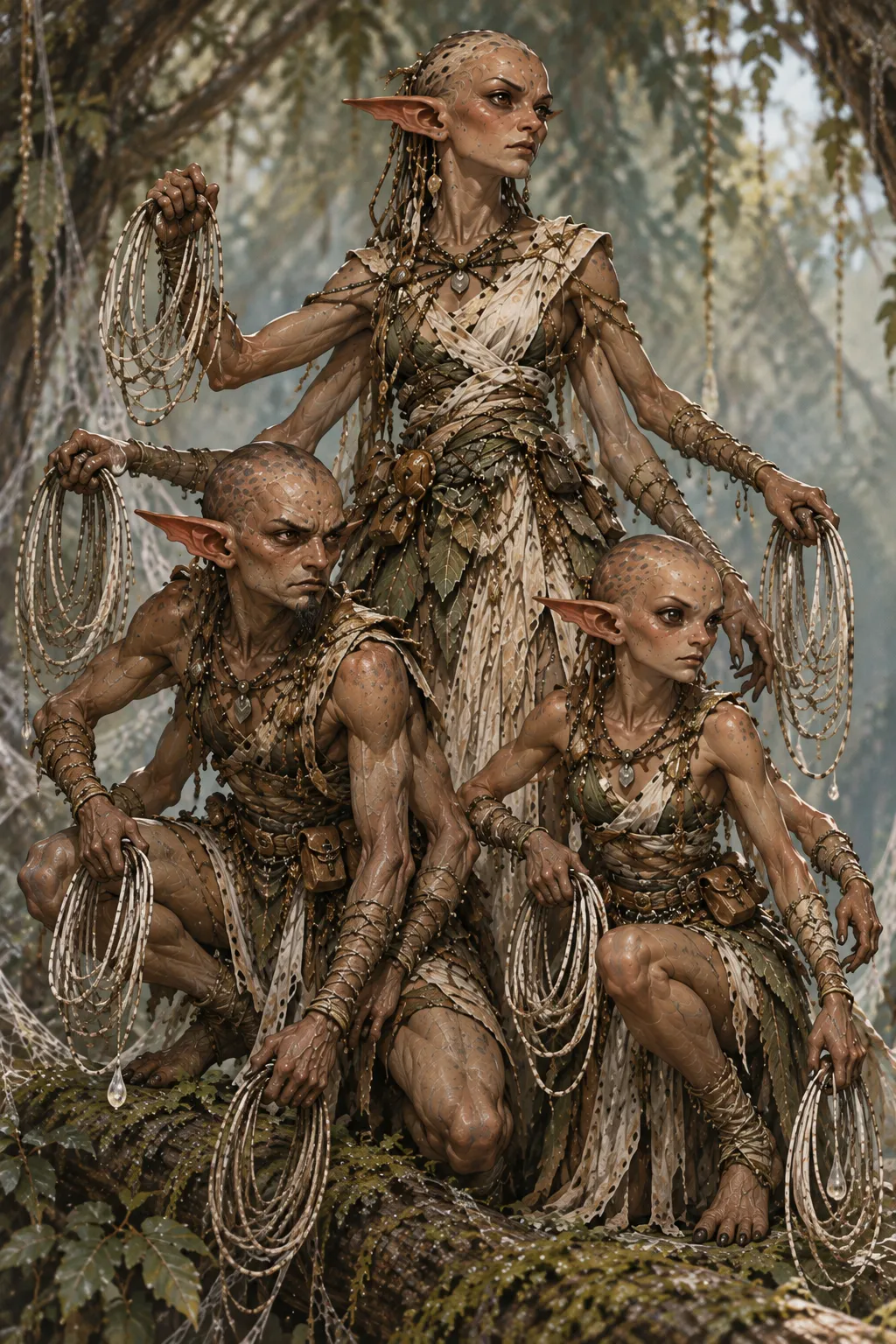
An Arechi queen with two smaller four-armed Arechi carrying silk cords
Arechi, including a queen, with worked silk cords.

Bestiary Dossier

Classification
Fey
Region
Regions throughout Khassid supporting giant spiders, including forests, caves, subterranean areas, and ruins; the Webbed Hollow within the Forest of Mir is one confirmed settlement.
Alignment
Neutral
Threat / Role
Challenge 1/4 (50 XP); Queen: Challenge 1 (200 XP) — generally peaceful colonial inhabitants; cooperative hunters and protective defenders
Senses
Darkvision; sensitivity to vibrations within continuous spiderweb networks
Languages
Sylvan, Common, Spider Speech

The Arechi are a diminutive species of Fey distinguished by their four arms, powerful legs, and remarkable affinity with spiders. Their unusual anatomy and extraordinary agility allow them to flourish in environments where dense vegetation, uneven terrain, and extensive web networks make passage difficult for most other creatures. Although their appearance and hunting practices may inspire unease, Arechi are generally peaceful. They prefer concealment and observation to confrontation, frequently watching unfamiliar travelers from elevated positions or concealed locations within their settlements.

Their communities are organized into colonies governed by queens, rare females possessing greater stature and unusual abilities. Within these colonies, silkcraft, cooperative hunting, and relationships with spiders form the foundation of daily life. While the Webbed Hollow within the Forest of Mir is one documented site of habitation, Arechi are not restricted to woodlands. Their affinity with spiders permits them to establish communities wherever suitable conditions and sufficient spider populations exist.

Archival Summary

A society founded upon cooperation rather than dominion.

Among the many Fey peoples of Khassid, the Arechi are distinguished not merely by their physical characteristics but by the extraordinary relationship they maintain with spiders. This relationship extends beyond the familiarity ordinarily observed between different species. Arechi communicate naturally with spiders, exchanging information, expressing intentions, and making requests through sounds, gestures, and vibrations. Their ability does not compel obedience, nor does it deprive spiders of independent will. This cooperation has produced a way of life in which the needs and abilities of each complement the other.

Spiders provide silk that the Arechi fashion into shelters, walkways, clothing, and hunting implements. Giant wolf spiders have even been observed carrying Arechi riders, apparently through voluntary partnerships rather than enforced obedience. The resulting communities are remarkable examples of adaptation to environments that many other peoples would consider hostile. Whether among the branches of an ancient forest, within the chambers of a subterranean cavern, or among the remnants of abandoned structures, the Arechi adapt their settlements to the surrounding terrain.

Their social organization is equally distinctive. Arechi colonies are governed by queens, but unlike the social structures of certain insects, their queens are not the exclusive reproductive females of the community. Rather, they serve as leaders and guardians whose welfare is closely associated with that of the colony. Although cautious toward outsiders, Arechi do not ordinarily exhibit aggression without provocation. Travelers who demonstrate peaceful intentions may receive assistance in the form of food, shelter, guidance, or useful materials. Such assistance is frequently anonymous. The prevailing archival interpretation is that the Arechi are neither servants of spiders nor masters over them, but an independent Fey people whose society demonstrates the possibilities of sustained cooperation between markedly different forms of life.

Field Record

Origin, form, behavior, and documented ecological relationships.

This record examines the Arechi’s origin, anatomy, natural abilities, social organization, habitat, and relationships with other inhabitants of Khassid. Particular attention is given to their spider affinity, ecological adaptability, and the biological distinction of their queens.

Origin
Primary Concordance Type
Fey
Origin Designation
Wildborn
Disposition Classification
Concordant
Regional Anchoring
Regions throughout Khassid supporting giant spiders, including forests, caves, subterranean areas, and ruins; the Webbed Hollow within the Forest of Mir is one confirmed settlement.

The Arechi are classified as Wildborn Fey, their existence arising from the influence of The Wild or the deep natural convergence through which certain forms of life emerge upon Khassid. The precise circumstances of their earliest emergence remain unknown. No definitive account establishes where the first Arechi appeared, nor whether their unusual relationship with spiders developed simultaneously with their physical form.

The available observations indicate that their anatomy, natural abilities, and manner of life are closely suited to environments inhabited by spiders. Their four arms, powerful legs, sensitivity to vibrations, and affinity with spiders suggest a species whose development has been profoundly influenced by life among complex web networks. Although the Forest of Mir provides a confirmed location of Arechi habitation, there is no evidence establishing it as their original homeland or the sole region in which they exist.

Their classification as Concordant reflects their generally harmonious relationship with the natural order and their tendency toward coexistence rather than indiscriminate hostility.

Observed Manifestation: Appearance

Arechi are small, hairless humanoid Fey possessing muddy-brown skin and grayish, subtly mottled heads. Their faces are characterized by prominent pointed ears and large, dark eyes. Their bodies are slender, with narrow waists and wiry musculature that conceals surprising strength.

Each Arechi possesses four arms. The larger upper pair is principally employed for climbing, handling tools, carrying objects, and manipulating silk cords. The smaller lower pair provides additional gripping and bracing ability, allowing the individual to maintain secure contact with surfaces while performing other tasks. Their legs are disproportionately powerful for their otherwise slight bodies, permitting sudden, forceful leaps between branches, platforms, rocky ledges, and other elevated surfaces. This combination of anatomical features gives the Arechi remarkable mobility in environments where ordinary walking is impractical.

Arechi clothing is generally fashioned from worked spider silk, gathered plant fibers, and other materials available within their surroundings. Such garments are practical and lightweight, allowing unrestricted movement through the environments they inhabit. Queens possess the same fundamental anatomical features as ordinary Arechi but develop into considerably larger individuals, with greater physical strength and a more commanding presence.

Essence & Nature

The Arechi possess several unusual natural characteristics associated with their Fey heritage and their close relationship with spiders. Foremost among these is their innate capacity to communicate with spiders. Through natural sounds, gestures, and vibrations, an Arechi can convey intentions, exchange information, and make requests. This relationship does not constitute magical domination. Spiders retain their independence and may refuse requests according to their own inclinations.

The Arechi also demonstrate a remarkable sensitivity to vibrations within spiderweb networks. When physically connected to a continuous web structure, they can perceive disturbances caused by other creatures sharing that network, even when those creatures are concealed from direct view. Their ability to move through webbing is similarly unusual. Adhesive strands that would entangle most creatures do not ordinarily impede an Arechi, allowing them to traverse intricate networks with little difficulty. They are naturally immune to the venomous effects of spiders and ettercaps. They are also unaffected by the adhesive properties of substances produced by members of their own species, including queens.

Despite their close association with spiders, Arechi do not produce silk. Their dependence upon gathered spider silk is therefore a matter of resourcefulness and cooperation rather than biological production. Their ability to fashion such material into elaborate structures demonstrates both practical intelligence and considerable craftsmanship.

Behavioral Profile

Arechi are naturally wary of unfamiliar creatures and generally avoid direct contact unless circumstances make it necessary. When travelers enter an area occupied by Arechi, the inhabitants commonly withdraw to concealed positions where they can observe the visitors before determining whether an approach is warranted. Their reserve is not necessarily an indication of hostility. Arechi generally prefer peaceful coexistence and are known to provide assistance to travelers who demonstrate no aggressive intentions. Such assistance may take the form of provisions left near a campsite, guidance through difficult terrain, or useful equipment recovered from abandoned camps and pathways. Frequently, the travelers never encounter the individuals responsible.

Although Arechi speak both Sylvan and Common, they seldom choose to converse in Common unless necessary. Their reluctance to communicate openly can lead unfamiliar observers to mistake them for unintelligent or dangerous creatures. Within their communities, however, Arechi demonstrate considerable cooperation. Hunting, gathering, construction, and settlement maintenance are undertaken through coordinated activity. Their hunting methods, in particular, depend upon several individuals working together to immobilize prey through the use of adhesive silk cords.

Arechi are strongly protective of their colonies, especially their queens. Threats directed against a queen may produce an immediate collective response, transforming an otherwise cautious population into determined defenders. They coexist with ettercaps where their territories overlap, although no alliance between the two has been established. Their relationship appears cautious, with the Arechi possessing sufficient means of defense to discourage aggression.

Habitat & Range

Arechi inhabit a wide variety of environments where giant spiders establish themselves. Although frequently associated with forests, their distribution is not restricted to woodland regions. Caverns, subterranean passages, abandoned ruins, and other environments supporting substantial spider populations may also sustain Arechi colonies.

Their settlements are adapted to the surrounding terrain. Within forests, Arechi construct elevated shelters, suspended walkways, and interconnected platforms among the branches. In subterranean environments, similar structures may be suspended between rock formations, anchored to cavern walls, or incorporated into existing web networks. Ruined structures likewise provide opportunities for settlement wherever sufficient shelter and spider activity exist. Their extraordinary climbing and leaping abilities allow them to navigate these environments with relative ease. Their skill in silkcraft permits the construction of pathways and shelters in locations otherwise difficult to access.

The Webbed Hollow within the Forest of Mir is one documented Arechi settlement, but it should not be regarded as their exclusive habitat or ancestral homeland. The presence of giant spiders is a strong indicator of potentially suitable Arechi habitat, although it does not necessarily establish that an Arechi colony is present. Arechi are omnivorous, gathering mushrooms, fruits, insects, small animals, and other available foods according to their surroundings. Their adaptability allows them to exploit the resources of different environments while maintaining their distinctive relationship with spiders.

Threat Assessment

Arechi are generally peaceful and do not ordinarily present a threat to travelers who refrain from hostile actions. Their preference for concealment, observation, and withdrawal makes unnecessary confrontation relatively uncommon. Nevertheless, their small stature should not be mistaken for physical weakness. An individual Arechi possesses surprising strength and considerable agility, particularly when operating among elevated structures and intricate web networks. Their ability to attach adhesive silk cords to the legs of other creatures permits them to restrict movement and disrupt balance. When several Arechi cooperate, they can restrain creatures substantially larger than themselves.

A direct threat to the colony produces the most pronounced defensive response. Arechi demonstrate an especially strong protective response toward their queen. An attack against her can provoke a defensive frenzy among surrounding colony members, who converge upon the threat without their customary hesitation. The queen herself possesses greater physical strength and unusual defensive abilities, including venomous spittle and the capacity to manipulate existing web structures.

Despite these capabilities, Arechi generally cease hostilities once an aggressor withdraws or surrenders, provided the colony is no longer endangered. Respectful passage and avoidance of threatening behavior remain the most reliable means of preventing conflict.

Observational Profile

Arechi are exceptionally agile inhabitants whose physical characteristics are particularly well suited to life among elevated structures and extensive spiderweb networks. Their four arms provide considerable gripping and bracing ability, while their powerful hind limbs permit rapid movement between surfaces. They possess keen awareness of disturbances transmitted through continuous web networks and are capable of navigating darkened environments. Their intelligence is demonstrated through elaborate silkcraft, cooperative hunting, colony organization, and their capacity to communicate with spiders.

Arechi are social creatures, living in small colonies governed by a queen. Individual members participate in gathering provisions, maintaining structures, hunting, and protecting the community. Although reserved toward strangers, they appear capable of distinguishing between hostile intruders and travelers who pose no immediate danger. Their use of indirect assistance suggests that their reluctance to engage outsiders does not preclude concern for their welfare.

Combat Profile

Arechi rely upon mobility, coordinated restraint, and familiarity with their surroundings rather than direct physical confrontation. When threatened, an individual commonly seeks an elevated or concealed position from which it can observe or impede an aggressor while remaining difficult to reach. Their favored hunting and defensive implements are adhesive-tipped silk cords, which they attach to the legs of prey or threatening creatures. Once attached, the cords are kept taut, restricting movement and creating opportunities for other Arechi to establish additional restraints. When several individuals cooperate, the combined tension can pull a creature off balance, bring it to the ground, or prevent further movement. Their ability to climb and leap between surfaces allows them to reposition while maintaining pressure upon their target.

Such tactics are particularly effective within the elevated structures and dense web networks of an established colony. The queen employs similar methods but is capable of maintaining several restraints while also using her greater strength and unusual abilities. Her venomous spittle can injure and poison an aggressor, while her magical influence over existing webbing allows her to entangle creatures already in contact with those structures. An attack upon the queen may provoke immediate intervention from nearby colony members. Arechi generally employ these tactics to restrain, disable, or drive away threatening creatures rather than to pursue unnecessary slaughter.

Signs of Presence

Arechi habitation is frequently indicated by carefully worked silk structures incorporated into existing spiderweb networks. Unlike naturally formed webs, Arechi construction displays deliberate reinforcement, arranged junctions, knots, and pathways designed to support repeated movement. Suspended platforms, narrow bridges, and concealed shelters may be visible among trees, cavern walls, rocky formations, or abandoned structures, although their integration with the surrounding environment often makes them difficult to identify. Additional indications include discarded food remains, bundles of gathered materials, and signs of activity in locations ordinarily inaccessible to creatures of their size.

Giant wolf spiders carrying small, four-armed riders provide an especially distinctive indication of Arechi presence. Less conspicuous indications may be encountered by travelers. Unexpected provisions, recovered equipment placed near a campsite, or a safe passage indicated through dangerous terrain may suggest that an Arechi patrol has been observing the area. Such gestures are often made without direct conversation or any attempt to reveal the identity of those responsible.

Cultural Praxis

Arechi live in small colonies governed by a single queen. The queen is a biologically distinct female whose birth is accompanied by a recognizable pheromonal signature. Such births are uncommon, occurring in approximately one of every hundred Arechi births. Unlike the queens of certain social insects, an Arechi queen is not the exclusive reproductive female of her community. She serves as the colony's leader, overseeing its welfare and providing a central point of continuity and protection. When a queen-born infant is recognized, the reigning queen assumes responsibility for her upbringing. If the reigning queen is elderly, the younger female may remain within the colony as her eventual successor. Otherwise, she is raised to maturity before departing to establish a new colony. This arrangement permits the gradual establishment of additional Arechi communities without requiring territorial conquest.

The importance of the queen is reflected in the extraordinary response of colony members when she is threatened. Her protection is treated as a collective responsibility. Silkcraft occupies a central place in Arechi material culture. Their settlements, garments, pathways, and hunting implements are fashioned largely from gathered spider silk and other locally available materials. Their accomplishments depend not upon the production of silk, but upon their skill in obtaining and working it. Their relationship with spiders is likewise fundamental to colony life. Communication and cooperation permit the Arechi to coexist closely with creatures that other peoples commonly fear or avoid.

Outside the colony, Arechi are generally reserved. They may observe unfamiliar travelers for extended periods without approaching, and their occasional acts of assistance are frequently performed anonymously. The details of their religious observances, ceremonial traditions, and other internal cultural practices remain insufficiently documented.

Variant Forms/Manifestations: Arechi Queen.

The Arechi Queen represents a rare biological variation within the species rather than a separate kind of Fey. Queens are distinguished from birth by a characteristic pheromonal signature recognizable to other queens. Approximately one in every hundred Arechi births produces a queen-born female. As they mature, queens develop into substantially larger individuals than ordinary Arechi, possessing greater physical strength and a more commanding presence. They retain the characteristic four arms, powerful legs, and other anatomical features of their species.

Queens also possess abilities not ordinarily manifested by other Arechi. Their venomous spittle can injure and poison threatening creatures, while their capacity to manipulate existing spiderweb structures permits them to restrain aggressors through magical means. They cannot produce spider silk themselves, and their manipulation of webbing depends upon material already present. The queen's significance within the colony also extends to its social continuity.

She serves as the leader and guardian of her colony, overseeing its welfare and protecting its continuity. Her position is not founded upon exclusive reproductive authority. When a queen-born female is recognized, the reigning queen assumes responsibility for her upbringing. Depending upon the reigning queen's age and circumstances, the younger female may eventually succeed her or depart to establish a separate colony. Arechi demonstrate extraordinary protective behavior toward their queens. When a queen is injured or directly threatened, nearby members of her colony may enter a defensive frenzy, converging upon the aggressor with an intensity uncommon in their otherwise cautious behavior. No additional distinct biological variations have been reliably documented.

Harvest & Material Value

The principal materials associated with the Arechi are the products of their silkcraft rather than substances obtained from their bodies. Arechi are skilled at gathering and working spider silk into cords, bindings, clothing, shelters, and suspended structures. Their craftsmanship demonstrates an ability to produce lightweight, flexible materials capable of supporting considerable tension and repeated use. Particularly noteworthy are the adhesive-tipped silk cords employed during hunting. These implements are prepared to attach securely to the limbs of moving creatures while remaining sufficiently durable for sustained restraint.

The practical value of such craftsmanship is evident in the construction of their settlements, where suspended walkways and reinforced platforms depend upon carefully prepared silk. However, the Arechi do not produce silk themselves. Their materials are acquired through their relationships with spiders and subsequently fashioned into finished objects. The Archives distinguish these crafted materials from biological substances taken from the Arechi. As a sapient Fey people, the Arechi are not regarded as a source of harvestable bodily materials.

No established commercial trade in Arechi silkwork has been sufficiently documented for this record.

Field Account

No authenticated firsthand field account has been appended to this dossier. Available observations establish the Arechi's distinctive anatomy, spider affinity, cooperative hunting practices, colony organization, and known habitation within the Forest of Mir. Accounts of concealed observation, giant wolf spider riders, and unexpected assistance to travelers are consistent with the species' documented behavior, but no individually attributed field narrative is presently available for archival reproduction. The Aelorian Archives therefore retain this section for the inclusion of a verified account.