Amechroi

A rare Wildborn expression occurring among otherwise ordinary animals — sapient and telepathic from birth, capable of choosing a Bound companion and Revealing into a larger, fiercer expression of itself.

Seal of the Aelorian Archives
Archival Release Authorization

Approved for circulation among the general populace by order of the Aelorian Archives.

Bestiary record released within the Codex Naturalis Khassidia. Threat and physical capability vary entirely by the individual animal in which the expression occurs.

Taxonomical Concordance

Primary Concordance Type
Beast
Origin Designation
Wildborn
Disposition Classification
Adaptive (provisional)
Regional Anchoring
Non-regional; confirmed wherever suitable natural animal populations occur
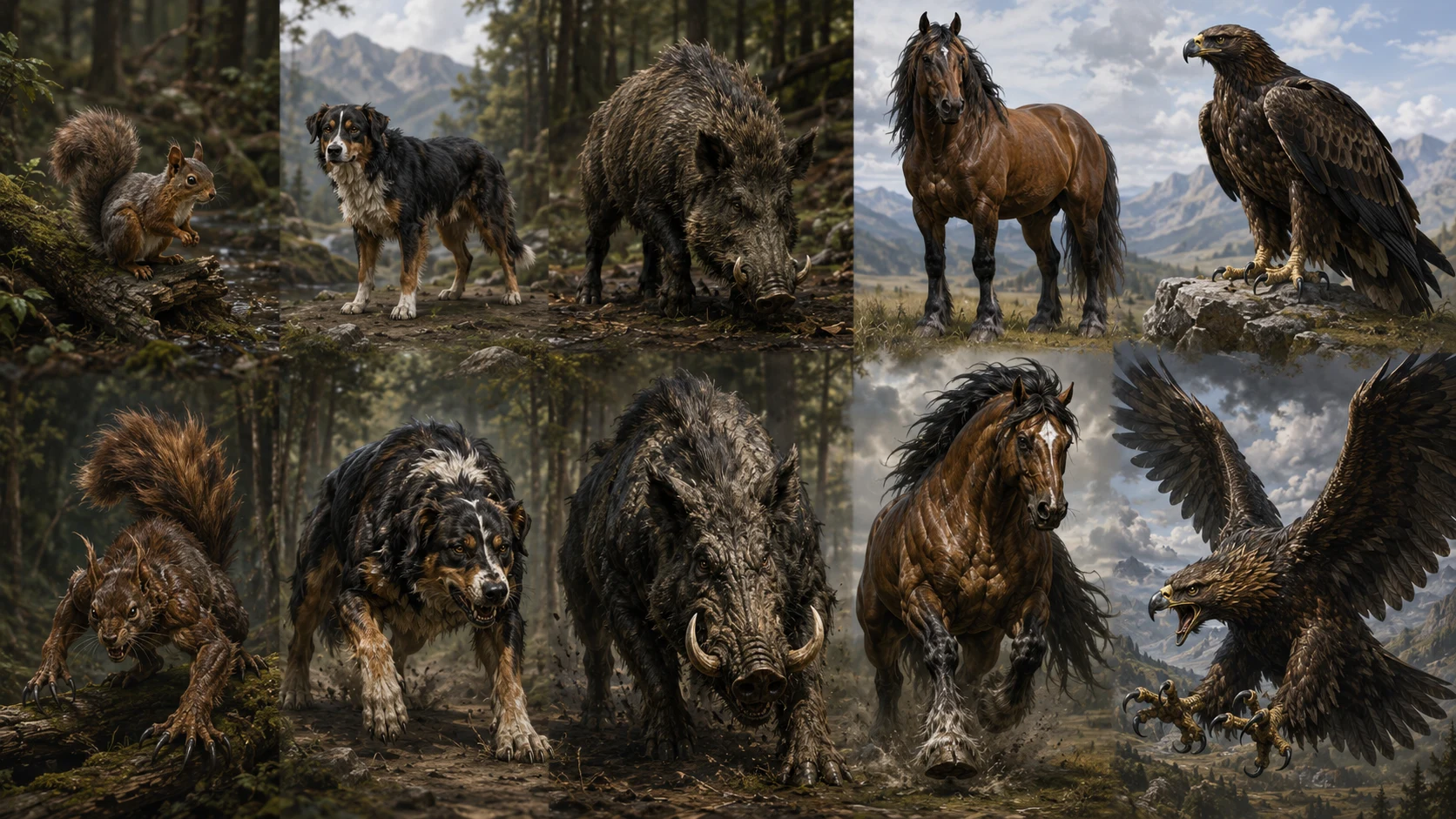
Six confirmed Amechroi host species shown unrevealed above and in the Revealed State below: squirrel, dog, boar, horse, and golden eagle
Confirmed Amechroi expression across five documented host species, shown unrevealed (above) and in the Revealed State (below).

Bestiary Dossier

Classification
Wildborn expression occurring among otherwise natural animals
Region
Non-regional
Alignment
Variable by individual
Threat / Role
Concealed sapient animal; chosen companion; defensive guardian
Senses
As the animal in which the expression occurs
Languages
Acquired through exposure; telepathic projection to 120 feet

The name Amechroi does not describe a species. It is an archival designation for a rare condition, expression, or occurrence observed among animals that are otherwise natural and nonmagical. An Amechroi dog remains a dog, an Amechroi boar remains a boar, and an Amechroi raven remains a raven. Confirmed records presently impose an important limit upon that statement: every authenticated Amechroi examined by the Archives has belonged to one of three broad animal groups — mammalian, reptilian, or avian.

Archival Summary

Few entries in the Concordance have been complicated so thoroughly by the subjects' apparent preference not to be catalogued.

An unrevealed Amechroi presents no dependable anatomical distinction from an ordinary member of its species. No reliable birth sign, coloration, scent, mark, eye characteristic, deformity, or magical emanation has been identified across confirmed cases. What remains concealed is not another body but another degree of awareness.

Confirmed Amechroi possess sapience from birth, along with an innate capacity for telepathic projection. Under circumstances the creature itself determines, it may also undergo a profound physical transformation now termed the Revealed State — larger, stronger, more imposing, and markedly more feral, without becoming anatomically other than what it already was. Taken together, these features account for the Wildborn designation. They do not explain it.

Field Record

Origin, manifestation, behavior, Binding, and confirmed Wild response.

The following record distinguishes wherever possible between direct observation, repeated testimony, and conclusions inferred from patterns across otherwise unrelated cases. This caution is especially necessary with Amechroi, since the creature capable of supplying the most useful testimony is also fully capable of deciding that the Archives need not receive it.

Archival Summary
Primary Concordance Type
Beast
Origin Designation
Wildborn
Disposition Classification
Adaptive (provisional)
Regional Anchoring
Non-regional; confirmed wherever suitable natural animal populations occur

Few entries in the Concordance have been complicated so thoroughly by the subjects' apparent preference not to be catalogued.

An unrevealed Amechroi presents no dependable anatomical distinction from an ordinary member of its species. It is born through ordinary reproduction, matures according to the expectations of its kind, and participates in the feeding, resting, play, courtship, territorial behavior, migration, herd structure, nesting, hunting, or other patterns appropriate to that animal. No reliable birth sign, coloration, scent, mark, eye characteristic, deformity, or magical emanation has been identified across confirmed cases. An Amechroi may therefore spend years within a household, herd, rookery, stable, woodland, or settlement without any person present having reason to suspect it.

What remains concealed is not another body but another degree of awareness.

Confirmed Amechroi possess sapience from birth. They remember, judge, reason, interpret intention, and may learn spoken language through exposure. They also possess an innate capacity for telepathic projection. These abilities do not appear to diminish or replace the animal's natural instincts. An Amechroi is not properly understood as a humanoid consciousness inhabiting an animal body; rather, it is the animal itself, possessed of an intellectual reach beyond that normally documented for its species.

The most significant relationship observed among them is the voluntary attachment scholars have termed the Binding. An Amechroi may choose an individual to whom it eventually reveals its intelligence, most commonly through deliberate telepathic communication. That individual is thereafter described as the Bound. The terminology has unfortunately encouraged assumptions of obedience, magical compulsion, or ownership for which the evidence offers no support. An Amechroi may refuse its Bound, abandon its Bound, grieve a Bound who dies, or eventually choose another.

Under circumstances determined by the Amechroi itself, the animal may also undergo a profound physical transformation. The Archives presently uses the term Revealed State for this manifestation, though the designation should not be regarded as settled nomenclature. During it, the creature becomes larger, stronger, more imposing, and markedly more feral without becoming anatomically other than what it already was.

More remarkable still are the rare incidents now collected under the title The Wild Answers, during which surrounding natural animals act in sudden and extraordinary agreement with a Revealed Amechroi.

Taken together, these features account for the Wildborn designation. They do not explain it.

Origin

An Amechroi is born in the same manner as every other member of its biological species. No separate reproductive cycle, supernatural gestation, ritual event, or physical alteration of the parents has been established. Litters containing one confirmed Amechroi have otherwise consisted of ordinary offspring, and no reliable evidence suggests that the parents themselves must be unusual.

More importantly, the expression is not hereditary.

The offspring of an Amechroi is no more likely, so far as the records indicate, to be Amechroi than the offspring of an ordinary member of the same species. The same remains true where both parents are known or strongly believed to possess the expression. Conversely, cases have arisen among lineages in which no antecedent occurrence was known. Selective breeding has therefore produced nothing except disappointed breeders, questionable ethical decisions, and a body of evidence useful primarily for disproving selective breeding.

This absence of inheritance is one reason the Archives treats the phenomenon as an expression rather than a lineage.

The designation Wildborn follows from the remaining evidence. Amechroi possess no common sign of divine shaping, deliberate spellcraft, Bloodforging, planar intrusion, or constructed origin. Their most extraordinary abilities repeatedly intensify rather than replace natural animal form and behavior, and the phenomenon of The Wild Answers establishes a relationship with surrounding natural life that has proven difficult to interpret through any framework other than The Wild.

No competent authority has yet explained why.

Druids, Wildkin, rangers, and others whose lives are closely associated with The Wild have been consulted repeatedly. They have offered philosophies, suspicions, intuitions, and in several instances strongly stated opinions. None has demonstrated a reliable means of predicting an Amechroi birth or identifying a purpose behind one.

The Archives therefore records the origin as Wildborn without pretending that classification constitutes comprehension.

Observed Manifestation: Appearance

An unrevealed Amechroi has no known universal appearance.

The conclusion is stronger than the simple statement that no distinguishing mark has yet been discovered. Confirmed individuals have been examined after identification, allowing investigators to search retrospectively for traits that might have escaped notice before revelation. Those examinations have compared coloration, body proportion, dentition, claws, scales, feather arrangement, scent, temperature, ocular appearance, vocalization, growth rate, gait, scars, horn formation where applicable, and numerous other minor traits. No characteristic has survived comparison across species.

A person looking at an unrevealed Amechroi sees an animal.

That remains true even for observers whose profession or spiritual practice gives them unusual familiarity with animals. Druids, rangers, and Wildkin have not demonstrated a dependable capacity to recognize the expression before the animal itself provides evidence. Their experience may make unusual behavior easier to notice, but that is not the same as detecting Amechroi nature.

Some fey appear to fare somewhat better. Reports involving dryads are particularly irritating in this regard, as several have identified an animal as "interesting," "not quite ordinary," or equivalent expressions before mortal observers had reason to suspect anything. Whether this reflects an actual perception of the Wildborn expression or the established dryadic habit of noticing matters that others would prefer left unnoticed has not been determined.

Amechroi themselves appear capable of recognizing one another even before either has Revealed. No subject has yet provided a useful explanation of how this recognition occurs.

Known Biological Range

The Archives has authenticated Amechroi among mammals, reptiles, and birds.

This is the present extent of confirmed observation, not a declaration of natural law. Reports involving fish, amphibians, and invertebrates remain unverified. Some are obvious inventions; others are sufficiently plausible that they remain open files. Until one is directly examined or supported by evidence comparable to established cases, the Archives will not convert possibility into fact merely because the broader theory is attractive.

Accordingly, the common statement that "any natural animal may be Amechroi" is best understood as a working hypothesis. The more defensible formulation is that no natural mammalian, reptilian, or avian group yet examined has supplied evidence of an inherent exclusion.

That distinction is less elegant and considerably more useful.

The Revealed State

When an Amechroi Reveals, the alteration is unmistakably physical. The animal enlarges substantially, its frame strengthens, musculature becomes more pronounced, and the anatomical structures by which the species already moves, hunts, escapes, defends itself, or manipulates its surroundings become more formidable.

The transformation does not produce a uniform "Amechroi form."

A squirrel does not acquire the physique of a wolf. A dog does not grow horns. A raven does not become feathered in some universal Wildborn pattern. A boar remains a boar, but one in which the relationship between shoulder, neck, skull, tusk, and forward momentum has become alarmingly emphatic. A horse becomes larger and more powerful through the chest, legs, and hindquarters without becoming an enchanted warhorse. A bird's wings, talons, and flight musculature become proportionately more formidable because those are the structures upon which the animal already depends.

Individual identity persists throughout the change. Coat coloration, feather pattern, scales, scars, eye color, horn shape, and other recognizable characteristics remain consistent. No universal radiance, spectral outline, rune, elemental discharge, or other decorative manifestation accompanies the transformation.

Later artists have occasionally objected that this provides insufficient indication that anything magical or supernatural is occurring.

The animals have not shown similar concern.

The Revealed form is consequently best understood not as a replacement body but as an intensified expression of the existing one. This principle has proven remarkably consistent across the wide anatomical differences among confirmed subjects.

An Amechroi does not become something else when it Reveals. It becomes a larger, fiercer expression of the animal it has always been.

Essence & Nature

The intelligence of an Amechroi presents a persistent interpretive hazard because mortals tend to regard their own manner of thought as the default form intelligence should assume.

An Amechroi possesses sophisticated awareness but remains psychologically rooted in its species. It does not cease to experience the world according to the senses and instincts with which it was born. A dog may reason about loyalty while still understanding relationships in distinctly canine ways. A horse may comprehend an approaching conspiracy and still possess the powerful instinctive responses of a herd animal. A raven capable of forming complex judgments remains interested in the matters that interest ravens. A serpent does not become socially humanoid merely because it understands what has been said in its presence.

This appears not to be a limitation but the very character of the phenomenon. Amechroi cognition expands animal nature rather than superseding it.

The same observation helps explain why their behavior can confuse those expecting the dramatic habits of an enchanted familiar. An Amechroi may spend an afternoon sleeping in sunlight, steal food despite knowing perfectly well that it has been forbidden, refuse to approach something it dislikes, chase something it finds irresistible, or seek affection in the ordinary manner of its species. None of these behaviors contradicts its sapience.

It understands.

It is also still an animal.

Behavioral Profile

Most Amechroi display considerable discretion regarding their abilities. An individual may live for years without speaking telepathically to anyone, even when it has plainly learned the languages used around it. This silence appears voluntary rather than developmental; no evidence suggests that telepathy is acquired at maturity or granted by the Binding.

Such concealment does not require the animal to perform an elaborate imitation of ordinary behavior. Its ordinary behavior is authentic. The distinction lies only in how much it understands while doing it.

Because confirmed cases are generally discovered only after they reveal themselves, the Archives cannot estimate how many Amechroi remain entirely unknown. Any population figure would therefore measure successful discovery rather than actual frequency.

This limitation should be remembered whenever one encounters claims that Amechroi are "one in ten thousand," "one in a million," or similarly precise. Such figures are speculation wearing arithmetic.

The Binding

An Amechroi may choose an individual with whom it forms an exceptional attachment. The reasons for that choice vary and may include long familiarity, affection, trust, shared hardship, protection, companionship, or considerations the animal declines to explain. Nothing indicates that ritual, bloodline, wealth, status, magical aptitude, or moral worth automatically qualifies a person to become Bound.

Indeed, one of the most frustrating features of the phenomenon is that Amechroi apparently recognize no obligation to choose according to scholarly expectations.

The first deliberate telepathic communication with the chosen individual is treated by the Archives as the practical revelation of the Binding. It need not occur during violence or danger. An Amechroi may simply decide that concealment has lasted long enough.

Thereafter, the Bound may ask.

The Amechroi decides.

This distinction is not philosophical decoration. It has been demonstrated repeatedly. Bound individuals cannot compel Revealing, dictate the use of extraordinary abilities, or issue commands that override the Amechroi's judgment merely by virtue of the relationship. Requests may be obeyed, ignored, questioned, mocked, or refused according to the animal's temperament and opinion of the circumstances.

Cruelty can end the relationship. Persistent abuse, exploitation, or treatment incompatible with the Amechroi's judgment has caused confirmed individuals to leave their Bound. The departure requires no formal severing ritual. The animal simply ceases to remain.

The same independence applies after death. If a Bound dies, the Amechroi survives. Grief varies according to individual personality and species. Some remain near the deceased's household or kin; some wander; some withdraw for long periods; some eventually choose another Bound. No evidence suggests that a second Binding diminishes the first or that an Amechroi is permitted only one such relationship during its life.

The extraordinary feature of the Bound is therefore not control.

It is that the Amechroi continues to choose them.

Telepathic Communication

Amechroi possess an innate capacity to project thought to creatures within approximately 120 feet. Communication may include language, emotion, images, or other concepts the animal is capable of expressing.

The projection is ordinarily one-way.

A recipient without an independent means of telepathic communication cannot answer in kind and must respond through speech, gesture, or some other ordinary method. A creature already capable of telepathy, or using an effect that permits mental communication, may respond mentally.

Although an Amechroi can project to individuals other than its Bound, most confirmed specimens use this capability sparingly. Some conceal the breadth of their telepathy even after the Binding has become known, preferring to communicate through the Bound when other people are present.

This has produced a recurring social exchange in which an observer addresses the Bound regarding the animal, only to discover that the animal has heard perfectly well and has also formed an opinion regarding how it was addressed.

The Archives advises courtesy.

Species Expression

The Revealed State does not erase anatomical difference; it makes that difference more important.

Every confirmed Amechroi displays some extraordinary development of capabilities already meaningful to its species. The form this takes varies too widely to justify a single catalogue of abilities. Protective dogs have demonstrated remarkable interception and holding behavior. Serpentine specimens have shown exceptional restraint and constriction. Birds may turn flight, observation, warning, or aerial harassment into highly effective defenses. Hoofed mammals may use speed, carrying strength, charging mass, or the ability to place themselves bodily between danger and the Bound.

This variability should not be mistaken for inconsistency in the phenomenon. It is precisely the opposite. The recurring principle is that the Amechroi becomes extraordinary by becoming more itself.

For that reason, investigators should be suspicious of accounts in which an alleged Amechroi produces abilities wholly unrelated to its anatomy or natural behavior. An extraordinary animal is plausible. An animal acquiring a convenient catalogue of unrelated powers is more commonly evidence of a poor witness.

The Wild Answers

Of all recorded Amechroi phenomena, none has contributed more strongly to their Wildborn classification than the event known in Archive records as The Wild Answers.

The effect has been observed only in association with a Revealed Amechroi. Natural animals in the immediate area abruptly respond to the developing conflict, not through a uniform behavior but according to their own nature. Horses may rear, kick, bolt, or obstruct passage. Birds descend in agitated numbers, diving and harrying. Rodents emerge from cover. Snakes strike. Insects swarm. Animals ordinarily inclined to flee may instead remain close enough to disrupt movement or contribute to the confusion.

Nothing observed suggests that the Amechroi summons these creatures.

Nothing indicates that the responding animals are transformed, made sapient, conjured from elsewhere, or replaced by Wild spirits wearing animal shapes. Where the surrounding environment contains little animal life, correspondingly little may happen. The event therefore appears to work through the creatures actually present rather than producing convenient participants.

Neither does the response resemble individual domination. The animals do not move with the precision of commanded troops and are not known to accept detailed instruction.

One field observer summarized the distinction more accurately than the formal reports managed:

They are not obeying it. They are agreeing with it.

The Archives has retained the wording.

For those caught within such an event, the distinction is unlikely to provide comfort. A hostile individual does not need to believe the Amechroi itself terrifying when every horse has begun kicking, every bird overhead is diving, rats are pouring from concealment, and the undergrowth has acquired an unexpected interest in movement. Panic under these circumstances is directed as much toward the environment as toward the Revealed animal at its center.

Witnesses consistently describe efforts to reach open or apparently safe ground beyond the disturbance, accompanied by falls, collisions, loss of footing, and considerable difficulty maintaining formation.

No reliable explanation has been offered for why nearby animals participate.

The Wild, as usual, has declined to submit commentary.

Habitat & Range

Amechroi have no known habitat independent of the animals among which they arise. A mammalian example may therefore occur wherever its species normally lives; the same is true of reptilian and avian subjects.

This includes wild and domesticated animals alike.

An Amechroi may be born in woodland, grassland, mountain country, settlement, stable, kennel, farmyard, noble estate, rookery, caravan, or any other environment capable of supporting its species. Naturally giant animals are not presently excluded by the record, though confirmed cases are rarer simply because such creatures are themselves less commonly observed at close range.

The absence of verified aquatic examples should not presently be interpreted as ecological exclusion. The Archives records no confirmed fish or amphibian Amechroi, and therefore makes no stronger claim.

Geographic mapping has likewise produced no persuasive pattern. The phenomenon appears to follow animal populations rather than political boundaries, sacred territories, ley structures, or known Wild convergences.

Reproduction

Amechroi reproduce as members of their species and produce ordinary biological offspring.

The Wildborn expression itself does not appear transmissible through ancestry. This conclusion has survived enough independent cases that the Archives regards it as substantially more secure than many other aspects of Amechroi study.

Accordingly, breeding programs intended to produce Amechroi have no demonstrated practical basis.

There is also the less technical matter that any confirmed Amechroi involved in such an undertaking is a sapient participant whose consent cannot reasonably be treated as equivalent to the management of ordinary livestock.

Those contemplating coercive experimentation are further reminded that the subject may be capable of Revealing and, under exceptional circumstances, of persuading much of the surrounding animal population that the experimenter is presently a shared problem.

Threat Assessment

An unrevealed Amechroi presents whatever physical danger is normal for an animal of its species. The additional danger arises from intelligence, concealment, and the capacity to Reveal when it decides circumstances warrant doing so.

It is therefore misleading to assign Amechroi a single threat category independent of the animal involved. A Revealed squirrel and a Revealed giant eagle differ enormously in physical consequence even though both arise from the same phenomenon. Likewise, a defensive dog, ambushing reptile, charging boar, and aerial guardian will not engage a threat in the same manner.

Amechroi are not inherently hostile to mortals. Their most dangerous recorded behavior is strongly associated with defense of themselves, their Bound, or circumstances they have judged intolerable. This should not be confused with harmlessness. Their sapience permits them to recognize intention, and an individual who knowingly threatens the Bound may find that apparent harmlessness disappears with considerable speed.

Attempts to seize an Amechroi for study are specifically discouraged.

This recommendation is based on field experience rather than sentiment.

Observational Profile

The most important fact for field identification is inconvenient: before an Amechroi chooses to provide evidence, there may be nothing to observe.

Suspicion may arise from behavior. An animal that appears to understand unusually complex conversation, anticipate plans it could not reasonably have been trained to recognize, make judgments beyond expected conditioning, or repeatedly respond to events with improbable foresight deserves attention. None of these signs is sufficient by itself; ordinary animals are frequently underestimated, and observers are equally capable of finding intelligence where they hope to see it.

Telepathic projection constitutes considerably stronger evidence.

Revealing constitutes stronger evidence still.

A confirmed instance of The Wild Answers is presently regarded as among the clearest indicators available, provided the event has been independently observed and ordinary animal panic or coordinated training can reasonably be excluded.

Signs of Presence

There are no tracks belonging specifically to Amechroi, no characteristic nest, no unique scent, and no environmental marker by which a concealed individual can be followed.

This is not an omission in the record.

It is the record.

The signs of an Amechroi are the signs of whatever animal it is.

Only after revelation may unusual evidence remain: tracks suddenly increasing in size, damage inconsistent with the apparent animal responsible, accounts of telepathic communication, or the aftermath of an episode in which otherwise unrelated animals behaved with remarkable unanimity.

Even then, the Archives recommends caution. Extraordinary animal behavior has more than one cause, and it would be unfortunate to classify every offended horse as Wildborn.

Cultural Praxis

No universal cultural practice has formed around Amechroi, principally because most communities have never knowingly encountered one.

Where stories circulate, they frequently become tales of guardian animals, unusually loyal companions, speaking beasts, Wild-touched familiars, omens, ancestral protectors, or animals sent by gods. Such explanations are understandable and generally unsupported.

The relationship with the Bound also produces predictable misunderstandings. Cultures accustomed to treating domestic animals as property may assume that the Bound owns or commands the Amechroi. Those who actually live with a confirmed specimen generally abandon this assumption rather quickly.

Among people associated closely with The Wild, attitudes vary between reverence, curiosity, caution, and deliberate noninterference. Since no druidic tradition has demonstrated authority over Amechroi, claims that one can be identified, summoned, assigned, or induced to choose a particular person should be regarded with suspicion.

The Archives similarly rejects the practice of treating a revealed Amechroi as evidence that its Bound has been divinely chosen, morally vindicated, or granted political legitimacy.

The Amechroi chose them.

That is all the evidence establishes.

What the choice says about the individual is a matter between the two of them.

Harvest & Material Value

No verified material unique to the Amechroi expression has been identified. Hair, shed feathers, scales, claws, and other naturally lost material examined after confirmation have not demonstrated consistent properties distinguishing them from those of the underlying species.

Reports assigning unusual magical value to Amechroi remains are therefore unsupported by present archival evidence and have contributed to undesirable attempts at capture and killing.

The Archives does not purchase such material.

Field Account
Archival Conclusion

The confirmed record establishes that Amechroi are born among natural animals, possess sapience and telepathy from birth, may choose a Bound, and can physically Reveal into greatly intensified expressions of their existing animal form. Their reproduction remains ordinary and the phenomenon itself appears nonhereditary. Their strongest known manifestation produces a response among nearby natural animals consistent enough to justify the name The Wild Answers.

It does not establish that every form of natural animal may become Amechroi.

At present, authenticated specimens are confined to mammalian, reptilian, and avian life. Whether this represents an actual boundary of the phenomenon or merely the boundary of the Archives' evidence remains unknown.

The distinction shall remain in the record until the animals, The Wild, or circumstance provides reason to amend it.

Given the habits of all three, circumstance is presently considered the most cooperative.