Humans

Children of the Second Dawn

A people who rebuilt without continuity, carrying memory of collapse into every law, road, temple, and future they dare to make.

Seal of the Aelorian Archives
Archival Release Authorization

Approved for circulation among the general populace by order of the Aelorian Archives.

People record preserved for cultural, historical, and theological orientation.

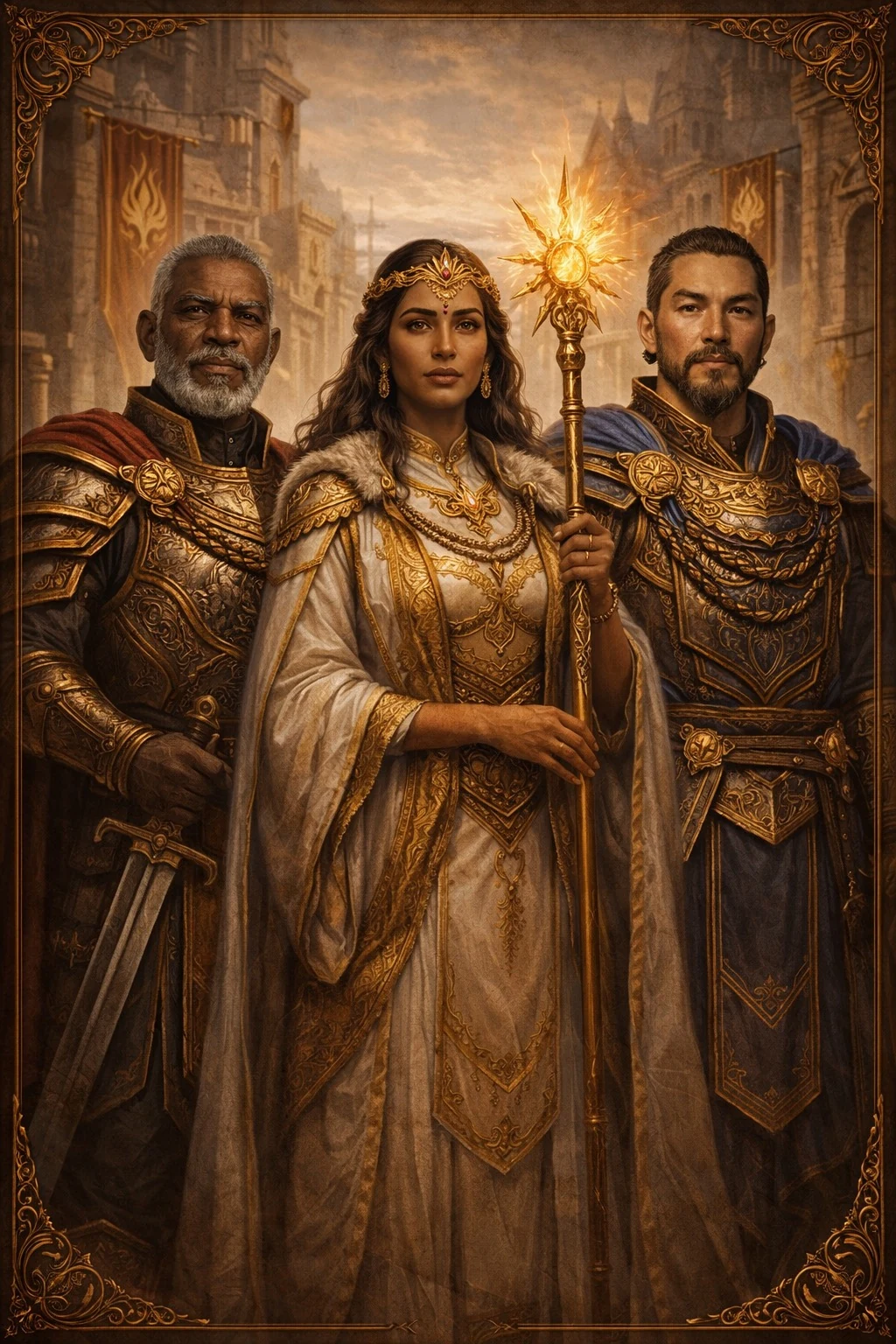
Three humans standing with a sunlit staff before banners
Human field depiction: civic, adaptive, and marked by the burden and promise of reconstruction.

People Dossier

Classification
People Record
Epithet
Children of the Second Dawn
Defining Event
Post-Cataclysm collapse, reconstruction, and the deliberate creation of new continuity
Primary Principle
Forward movement in the absence of certainty
Cultural Orientation
Reconstruction, record preservation, resilient institutions, and adaptable governance
Faith Pattern
Deliberate engagement with the divine shaped by memory, consent, and accountability
Average Lifespan
Approximately 70 to 100 years, with regional variation

This public record preserves humanity as a recognized people of Khassid and summarizes their cultural, historical, and theological frameworks.

Overview

Stability was not inherited. It was produced.

Humanity is not the oldest people of Khassid, nor the most physically enduring, nor the most closely aligned with the divine. Their distinction lies elsewhere.

They are the people who rebuilt after collapse without preserved continuity, and who continue to define what follows when inherited systems are no longer enough to stand on.

People Record

Collapse, reconstruction, faith, and the second dawn.

This record gathers the public human account as preserved by the Aelorian Archives, including appearance, cultural orientation, lifespan, divine engagement, and the return of hope through Z’hani.

Introduction

Humanity is a people defined not by preserved origin, but by post-Cataclysm decision.

When the Cataclysm moved across Khassid, human civilizations experienced widespread collapse. Cities were lost, historical continuity fractured, and cultural identity destabilized.

Where other peoples retained partial preservation through divine intervention, humanity did not experience such consistency. Their gods were divided, distant, or otherwise unable to sustain unified protection.

And yet, humanity persisted. In the two centuries since, human societies have re-established settlement, reconstructed knowledge from fragmentary record, and developed new systems of governance independent of what came before.

Appearance

Humans in Khassid exhibit extensive physical diversity, shaped by region, culture, and environment rather than a singular defining trait.

Height, build, complexion, hair texture, coloration, and facial features vary widely, often aligning more closely with local climate, ancestry, and environmental conditions than with any shared biological standard.

Human physiology remains entirely mortal and unmodified. They lack the distinct biological adaptations or inherited physical markers observed in other peoples of Khassid.

Despite this variability, humans frequently present with grounded posture, direct visual engagement, and heightened environmental awareness.

Essence

To understand humanity in Khassid is to examine continuity following collapse. The Cataclysm is not treated as distant history, but as a condition carried forward through narrative, institutional structure, and social practice.

Ruins are not regarded as relics, but as reference points. Naming conventions, record preservation, and historical reconstruction carry elevated importance across human societies.

This orientation does not produce a culture defined by grief. It produces one defined by response.

Humanity rebuilt without stable precedent, without guaranteed divine alignment, and without assurance that prior systems would prove reliable if restored.

Culture and Society

Human society is structurally oriented toward reconstruction. Settlements commonly develop atop pre-existing foundations, integrating new construction with remnants of prior habitation.

Institutional structures are rarely preserved intact; they are reformed, revised, or replaced in response to changing conditions.

Across human societies, recurring patterns include sustained record preservation, organized governance, clearly defined societal roles, expansion of settlement and infrastructure, and readiness to modify systems that no longer function effectively.

Human societies are not static in form. They exhibit continuous revision, with structures subject to adjustment as conditions change.

Lifespan

Humans reach physical and social maturity relatively quickly compared to many other peoples of Khassid, typically entering adulthood in their late teens.

Average lifespan ranges from approximately 70 to 100 years, with variation influenced by region, living conditions, and access to care.

This abbreviated lifespan shapes human temporal frameworks. Long-term efforts such as construction, governance, and knowledge preservation are frequently structured for continuation beyond the originating individual.

Human endeavors commonly emphasize succession, transfer of responsibility, recorded intent, and institutional persistence across generations.

In the World

Humans are present across nearly every region of Khassid, frequently concentrated in areas undergoing reconstruction, trade development, or political reorganization.

Their settlements range from restored urban centers built upon pre-Cataclysm foundations to newly established communities formed in unstable or previously unclaimed territories.

Human populations are represented across diplomacy, labor, scholarship, military service, infrastructure development, and governance. This distribution reflects situational engagement rather than inherited function.

Human influence is most evident at points of transition: places where recovery, expansion, or redefinition is actively occurring.

Faith and the Divine

Humanity’s relationship with the divine is characterized by deliberate engagement rather than assumed alignment.

Post-Cataclysm human traditions retain an active awareness of prior divine inconsistency. Faith is not typically framed as inherent or unquestioned, but as a condition entered into with consideration of historical precedent.

The Divine Accords further shape this relationship. Human religious practice often emphasizes agency, consent, and defined boundaries of divine interaction.

Human clerical identity is rarely defined by unquestioned devotion. Entry into divine service is more often characterized by deliberate decision to engage despite uncertainty. This does not diminish their faith; it often makes it more resilient.

Codified Addenda

Cultural Praxis: Z’hani and the Return of Hope

Two centuries after the Cataclysm, a human ascended to divinity. Z’hani, once mortal, became the god of dreams, omens, and prophecy, the first recorded instance of human apotheosis.

This event did not alter material recovery conditions. Structural losses persisted. Population restoration continued at established rates.

The measurable change occurred in forward-oriented behavior. Prior to this event, human planning emphasized preservation, risk mitigation, and short-term survivability. After Z’hani’s ascension, interpretive phenomena increased in both frequency and collective validation.

Human populations did not adopt fixed expectations of future certainty. Interpretive inputs are not treated as binding outcomes, but as supplementary variables subject to comparison, validation, and contextual limitation.

The resulting praxis is characterized by conditional anticipation. Future states are not assumed. They are considered.