Dragonborn

Bearers of the Living Claim

A people in whom draconic influence takes stable mortal form, defined not by a single origin but by the claim they uphold across a lifetime.

Seal of the Aelorian Archives
Archival Release Authorization

Approved for circulation among the general populace by order of the Aelorian Archives.

People record preserved for cultural, historical, and theological orientation.

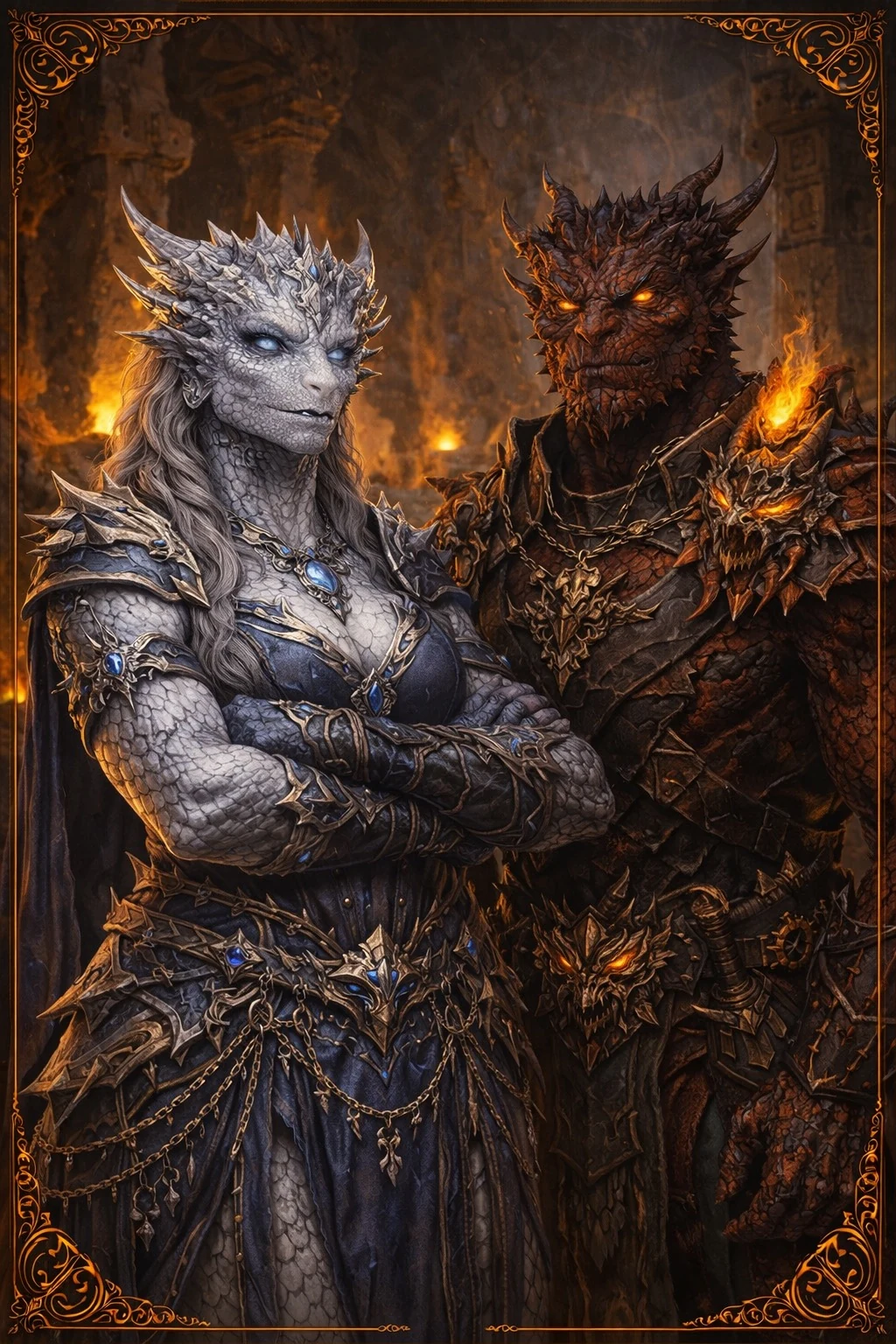
Two Dragonborn standing in a firelit chamber
Dragonborn field depiction: draconic influence expressed as stable mortal lineage, bearing, and declared identity.

People Dossier

Classification
People Record
Epithet
Bearers of the Living Claim
Recorded Emergence
Circa 1800 Pre-Cataclysm, following sustained draconic influence after the arrival of Arzathyr
Primary Principle
Identity established through declaration and maintained through sustained expression
Cultural Structure
Assertion-Based Structuring
Faith Pattern
Alignment-Selective Devotion
Average Lifespan
Usually one to two centuries; commonly one hundred twenty to one hundred eighty years

This public record preserves the Dragonborn as a recognized people of Khassid and summarizes their cultural, historical, and theological frameworks.

Overview

Their origin does not define them. Their claim does.

The Dragonborn of Khassid are not recorded as the product of one homeland, one migration, or one ancestral line. Their existence is tied to the presence of dragonkind, but their identity is not reduced to draconic parentage.

The Aelorian Archives classify them as the Bearers of the Living Claim: a people whose draconic inheritance becomes meaningful only when asserted, sustained, and proven over time.

People Record

Origin, appearance, essence, culture, and codified addenda.

This record gathers the public Dragonborn account as preserved by the Aelorian Archives, including physical profile, cultural praxis, lifespan, settlement patterns, and divine alignment.

Origin and Emergence

The Dragonborn of Khassid are not recorded as originating from a singular homeland or unified migratory event. Their emergence is instead tied to the presence of dragonkind, first observed in stable record at or about the year 1800 Pre-Cataclysm, following generations of sustained draconic influence after the arrival of Arzathyr.

Dragonborn births occur across multiple regions, often in proximity to prolonged or intense draconic presence. Some are attributed to direct pairings between dragons and mortals, while others arise without known draconic parentage, establishing that such lineage is not required for their emergence.

All documented Dragonborn are born through mortal lineage. No instance exists of manifestation independent of birth.

They are therefore not classified as the offspring of dragons, but as beings in whom draconic influence achieves stable, living expression.

Appearance

Dragonborn are a physically imposing people, typically standing between six and seven feet in height, with broad frames and pronounced structural definition. Their build favors density over excess mass, presenting as compact and deliberate rather than exaggerated.

Their bodies are reinforced in a manner not observed in other mortal peoples. The chest, shoulders, and upper back carry the greatest concentration of strength, producing a forward-weighted presence that remains balanced in motion.

Skin is covered in scales arranged in consistent patterning across the body. These scales vary in size and density, with thicker formations along the torso, shoulders, and outer limbs, and finer, more flexible scaling at joints and along the neck.

Coloration reflects draconic expression, most commonly aligning with chromatic or metallic ranges. Reds, blues, greens, blacks, and whites are observed alongside golds, silvers, bronzes, and coppers.

The head is distinctly draconic in structure, with pronounced brow ridge, elongated jaw, reinforced cranial plate, and horns in the majority of individuals. Hair is absent. The voice carries a natural resonance, often deeper in tone and measured in intensity even at conversational volume.

Essence

Dragonborn cultural identity is organized around the principle that legitimacy is established through declaration and maintained through sustained expression.

Origin is not treated as a prerequisite for identity. In the absence of a singular, verifiable point of descent, lineage is constructed through alignment with an asserted draconic ideal.

To claim such an alignment is to accept its expectation. The claim is treated as binding, both internally and externally. A Dragonborn does not state what they are in aspiration, but in assertion.

Failure to maintain alignment is not interpreted as error, but as fracture. Fracture does not negate identity, but renders it unstable and subject to correction, rededication, or severance from the asserted lineage.

Culture and Society

Dragonborn society is organized around the maintenance and recognition of asserted identity. Social structures are not built upon shared origin, but upon the consistent demonstration of declared alignment.

Authority is recognized through sustained expression of an individual’s claimed nature over time rather than through inheritance alone. Reputation functions as a stabilizing mechanism, measuring whether action remains consistent with declaration.

Dragonborn communities form under a range of conditions, but consistently orient around shared expressions of draconic alignment. These expressions often emphasize dominance, order, ambition, endurance, or measured restraint.

Conflict is not uncommon. Differences in asserted alignment may produce internal and external tension, and separation is sometimes preferred over forced reconciliation.

Naming conventions reflect asserted identity rather than lineage alone. Names may encode draconic alignment, personal claim, or defining acts, and may change when an individual’s expression undergoes significant shift.

Lifespan

Dragonborn lifespans typically extend between one and two centuries, with most individuals living between one hundred twenty and one hundred eighty years.

Longevity is not treated as continuity, but as extension of assertion. A Dragonborn life is structured in phases defined by the development and refinement of declared identity.

Maturity is not defined by age, but by stability of expression. A Dragonborn is considered fully realized not when they reach a certain year, but when their asserted nature is maintained without deviation over time.

Death is not treated as transition, but as conclusion of a maintained assertion. What remains is not continuation of the individual, but the consequences of their expression.

In the World

Dragonborn presence within Khassid is widespread but unevenly distributed. They are not confined to a singular region, and no central homeland is recorded.

Some establish communities organized around shared alignment, while others exist within mixed populations, maintaining individual identity without requiring collective structure.

Dragonborn-built environments emphasize durability and purpose, often incorporating defensive, hierarchical, or symbolic elements consistent with the disposition of the community or individual responsible for their construction.

They are found as military leaders, enforcers, magistrates, mercenaries, artisans, and independent actors operating outside formal systems. Their presence is often associated with decisiveness, endurance, and the capacity to impose or maintain order under pressure.

Faith and the Divine

Dragonborn do not possess a unified pantheon. Their emergence occurs within established cultures, and early Dragonborn are observed adopting the theological frameworks of the societies in which they are raised.

Religious alignment is not determined by ancestry, but by individual disposition and asserted identity. Devotion is most commonly directed toward deities whose domains reflect the Dragonborn’s expressed nature, including Sujaz, Antaz, Kieron, Astraea, and Ssthax.

Records also note belief systems among certain Dragonborn that reference draconic figures not recognized within the established pantheons of Khassid, most commonly identified as Bahamut and Tiamat. These figures are documented without doctrinal integration.

Within the Aelorian Archives, Dragonborn religious structure is classified as Alignment-Selective Devotion.

Codified Addenda

Observed Manifestation: Draconic Resonance at Birth

Across multiple independent records, Dragonborn births are occasionally accompanied by localized phenomena consistent with draconic influence, including temperature fluctuations, distorted air, transient light, particulate emissions, or brief vocalizations resembling draconic expression without identifiable source.

These manifestations are not present in all births and do not correlate consistently with lineage, coloration, or region. No predictive pattern is recorded.

Cultural Praxis: Assertion Events

Dragonborn are observed undertaking deliberate actions to establish, reaffirm, or correct alignment with an asserted identity. Recorded forms include formal challenge, voluntary trial, acts of acquisition or relinquishment, and withdrawal followed by reemergence with altered standing.

Outcomes are not symbolic. Assertion Events frequently result in measurable change, including elevation in standing, reassignment of role, or severance from prior association.

Cultural Praxis: Draconic Archetype Adherence

Some Dragonborn populations preserve belief structures centered on draconic figures not recognized within the established pantheons of Khassid. These figures are frequently treated as archetypal embodiments of opposing draconic principles rather than uniformly worshiped as deities.