Barazûn

Children of the Unending Forge

A people who came to Khassid from a collapsing world and refused to mistake silence, loss, or interruption for an ending.

Seal of the Aelorian Archives
Archival Release Authorization

Approved for circulation among the general populace by order of the Aelorian Archives.

People record preserved for cultural, historical, and theological orientation.

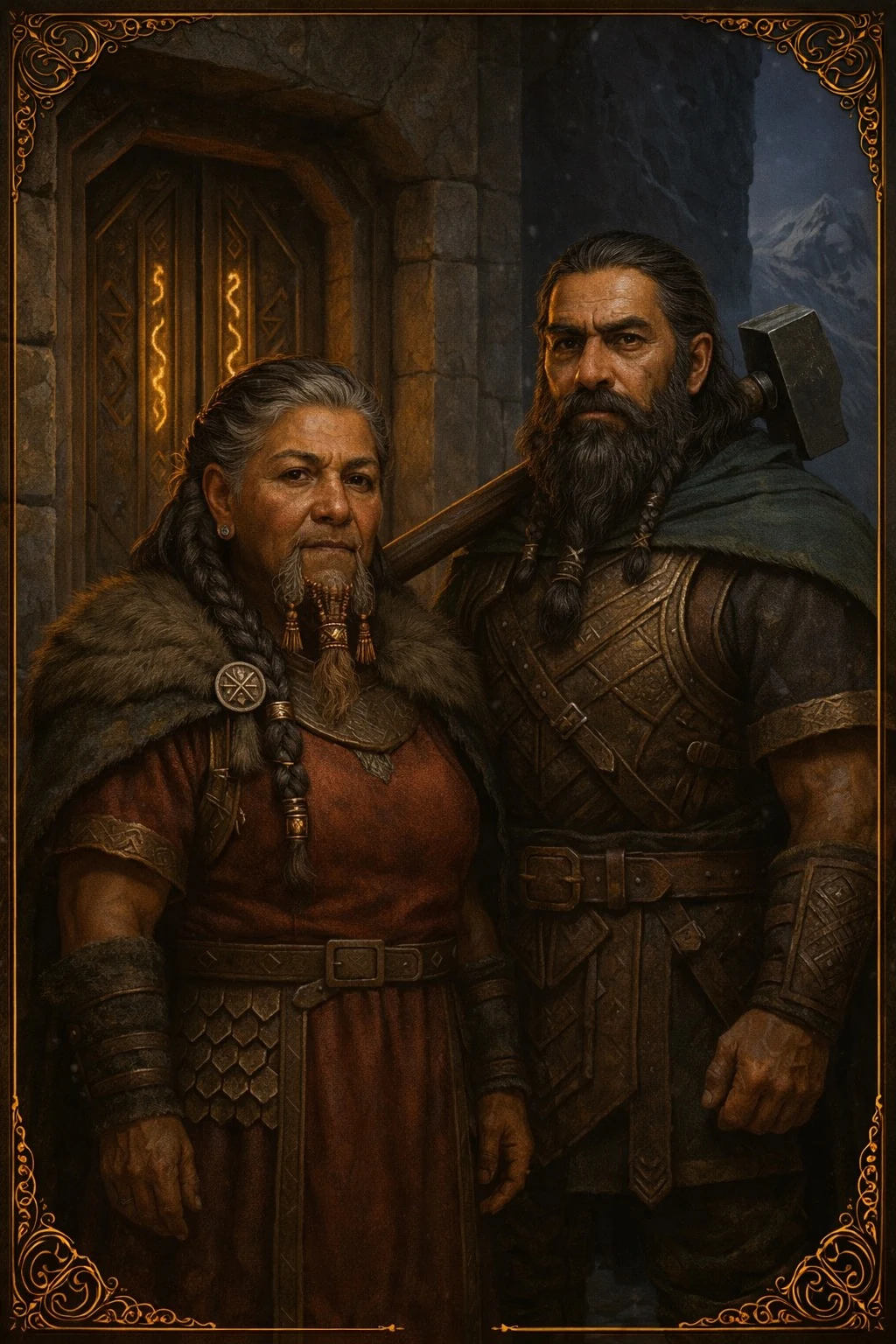
Two Barazûn standing before a stone gate
Barazûn field depiction: compact, powerfully built, and marked by craft, lineage, and endurance.

People Dossier

Classification
People Record
Epithet
Children of the Unending Forge
Origin
Beyond the firmament, within a now-collapsed crystal sphere
Arrival in Khassid
1022 Pre-Cataclysm
Primary Principle
Continuity maintained through enactment rather than preservation
Ancestral Lineages
Crystalkin, Emberforged, Gravemarked, and Stoneborn
Faith Tradition
The Dûn-Karr; divine silence understood as transition, not negation
Average Lifespan
Approximately three centuries

This public record preserves the Barazûn as a recognized people of Khassid and summarizes their cultural, historical, and theological frameworks.

Overview

They do not call themselves survivors.

The Barazûn came to Khassid after the collapse of their original world, but their records do not treat that loss as a final ending. To them, interruption does not conclude a thing while continuation remains possible.

The Aelorian Archives classify them as the Children of the Unending Forge: a people who preserve identity through sustained function, ritual, craft, oath, and work continued across generations.

People Record

Origin, essence, culture, and historical accounts.

This record gathers the public Barazûn account as preserved by the Aelorian Archives, including appearance, cultural praxis, theology, lineage frameworks, and notable historical entries.

Origin and Arrival

The Barazûn are a non-native people of Khassid, recorded as originating beyond the firmament within a now-collapsed crystal sphere. The destruction of their original world is attributed in Barazûn records to progressive entropic failure rather than singular catastrophe.

During this collapse, Barazûn sources indicate that their gods ceased responding in succession. The final remaining deity, Beldrun Emberforge, is recorded in Barazûn priesthood accounts as having secured sanctuary for his people through Aeru. The Barazûn migration to Khassid is dated to 1022 Pre-Cataclysm.

Following the relocation of his people, Beldrun likewise fell silent. Barazûn records do not interpret these events as termination, but as transition.

Within Barazûn cultural and theological frameworks, divine silence is not treated as absence, but as continuation beyond direct function. A god that no longer answers is not regarded as lost, but as having entered a state in which its influence persists without intervention.

Appearance

Barazûn are a compact, powerfully built people, typically standing between four feet and four feet eight inches in height. Individuals approaching five feet are considered notably tall.

Their musculature is dense and develops early, with even younger Barazûn exhibiting a degree of physical solidity uncommon among other peoples. Strength is not characterized by sudden exertion, but by the capacity to sustain force over extended periods without visible strain.

Skin tones range from basalt grey to burnished copper, often marked by faint mineral striations of iron, silver, or obsidian. Eye coloration tends toward subdued tones, most commonly amber, slate, and garnet.

Hair is worn long and structured, frequently incorporating metal elements and fixed ornamentation that denote lineage, craft, and standing. Beards are present in both men and women and are regarded as a natural and defining feature.

Among men, the beard is inseparable from identity. Among women, beard presentation varies; some wear them short and intricately structured, others long, and some remove them entirely. These choices are treated as personal expression without assigned social distinction.
Essence

Barazûn cultural identity is organized around the principle that continuity is maintained through enactment rather than preservation.

Objects, structures, lineages, and deities are not considered ended by interruption. They are considered incomplete only when no further form of continuation is undertaken. Accordingly, silence does not constitute absence, loss does not constitute erasure, and interruption does not constitute conclusion.

External sources frequently classify the Barazûn as survivors of a lost world. Within Barazûn records, this classification is not employed. Loss is not treated as a terminal condition, and the prevailing interpretation is continuation under altered circumstances.

Time, within this structure, is not treated as a sequence of beginnings and endings, but as an accumulation of continuations. Interruption is acknowledged, but is not granted finality.

Culture and Society

Barazûn society is structurally conservative and process-oriented. Expansion is limited. Settlement patterns favor long-term stability and iterative development.

Authority is derived from demonstrable contribution to continuity, including construction, preservation, record-keeping, and the successful completion of long-duration endeavors. Status is not assigned through inheritance alone, but through sustained function over time.

Craft is not categorized as profession, but as functional necessity. Acts of making are treated as continuative operations rather than economic activity. Production is evaluated by durability, integration, and capacity for extension rather than immediate output.

Trust is extended incrementally and maintained through consistency rather than declaration. Agreements are not considered binding at inception, but through demonstrated adherence over time.

Barazûn naming conventions are adaptive and may change across an individual's lifetime. Names encode completed actions, fulfilled obligations, or defining events, and are subject to revision as additional continuative acts are recorded.

Ancestral Lineages

Barazûn ancestral lineages are not defined by bloodline alone, but by sustained modes of continuity enacted across generations. These lineages do not function as hereditary classes, but as persistent frameworks through which specific forms of continuation are maintained.

LineageContinuative Function
CrystalkinPreservation and transmission of pre-arrival memory structures without degradation.
EmberforgedContinuation through applied craft, transformation, and successive functional forms.
GravemarkedRetention of entropic awareness without cessation of purpose.
StonebornStructural continuity through construction, defense, and stability under pressure.

These lineages are not mutually exclusive in practice, but are treated as primary continuative orientations within Barazûn society.

Lifespan

Average Barazûn lifespan extends to approximately three centuries.

Longevity is treated as functional necessity. Multi-generational continuity of work is assumed, with projects, records, and constructions designed to persist across lifetimes without requiring completion within a single generation.

Aging does not correspond to social withdrawal. Older Barazûn remain active participants in structural, material, and administrative continuity, with accumulated knowledge regarded as operational asset rather than passive inheritance.

Death is not treated as disruption, but as transition within an ongoing process. Work, titles, and responsibilities are not concluded, but reassigned or continued through designated successors.

In the World

Barazûn presence within Khassid is localized and stable. Settlements are not widely distributed, and expansion beyond established regions occurs infrequently.

Barazûn-built environments are identifiable by continuity of construction, with additions integrated into existing frameworks rather than developed as separate expansions. Surface, subterranean, and transitional structures are designed for long-term persistence under variable conditions.

Interaction with external populations is consistent but limited in scope. Barazûn do not pursue integration into foreign systems, nor do they impose their own structures beyond their settlements.

They are routinely sought in contexts requiring structural reliability, material expertise, and sustained labor under adverse conditions. Their involvement is associated with projects where failure is not acceptable and timelines extend beyond conventional expectations.

Faith and the Divine

The Barazûn pantheon, the Dûn-Karr, is recorded in Barazûn sources as predating their arrival in Khassid. During the collapse of their original world, priesthood records indicate that divine response ceased sequentially across the pantheon.

Following relocation, Beldrun Emberforge likewise ceased answering invocation. No declaration, terminal event, or concluding communication is recorded in association with this cessation. The condition is recorded only as absence of response.

Despite this, ritual structure remained unchanged. Invocation cycles, oath-binding procedures, and inscription practices continued without modification across all recorded priesthoods.

In 1100 Post-Arrival, priesthood records document the resumption of response from Beldrun Emberforge. Subsequent records indicate additional reappearances of response among other deities of the Dûn-Karr.

Barazûn theological texts do not distinguish between prior and current divine states, and no terminology equivalent to "return" is employed. A deity is present if it answers, and absence of response does not constitute negation.

Codified Addenda

Cultural Praxis: The Unbound Oath

Beard ornamentation functions within Barazûn society as a visible record of social integration. Rings, braids, and forged elements denote lineage, profession, oath-binding, and standing within clan and kin structures.

A Barazûn who removes all beard adornment is understood to have entered a state referred to as the Oath Unbound. This state denotes the assumption of full personal responsibility for a matter that cannot be resolved within existing social, legal, or structural systems.

During the Oath Unbound, the individual withdraws from all markers of clan and kin affiliation. Material support may be provided, but such aid is classified as facilitative rather than participatory.

Conceptual Framework: The Unending Forge

Within Barazûn usage, a forge is not defined by the presence of flame, but by the retained capacity to produce it. A forge is considered ended only when the knowledge required to rekindle it is no longer extant.

Worlds are considered ongoing insofar as their populations persist. Deities are considered present insofar as they respond. Identity is considered intact insofar as it continues to be enacted.

Historical Records

The Silent Exodus

Coordinated Barazûn withdrawal from surface presence is recorded in the year 3180 and classified within the Aelorian Archives as the Silent Exodus. The event is defined by absence of transition rather than presence of action.

Available records indicate absence of prior notice, with simultaneous cessation of Barazûn activity observed across multiple settlements. Sites of departure retained evidence of in-progress activity, including incomplete construction, active forges, and maintained infrastructure left in functional state.

Subsequent Barazûn records indicate relocation to subterranean strongholds. These sites are described as sealed and rendered inaccessible, with no corresponding entries in external records prior to this disclosure.

Barazûn Re-emergence

Barazûn re-emergence to surface presence is recorded in Pre-Cataclysm archives dated approximately to the year 4500. The event is not marked by singular occurrence, but is identified through accumulation of consistent observations across multiple regions.

Initial records indicate isolated activity characterized by limited scouting, controlled movement, and absence of formal engagement. Early re-emergent activity is frequently associated with small, mobile parties attributed in Barazûn sources to priesthoods aligned with Tolgrin Ironflare.

Barazûn sources do not classify this period as return. Internal records describe surface presence as continuation of prior function without interruption.

Appended Accounts

Structural Load Bearing

Recovered Account — Date and Origin Unspecified

The passage gave way without warning. I heard the stone shift before I saw it, and by then it was already coming down. The forward supports failed almost immediately.

One of the Barazûn stepped into it — into the fall itself — before anyone else could move. She said nothing.

She set her shoulder beneath the descending stone and caught it. I do not have better words for it than that. She caught it and held.

We moved past her while she bore the weight. I remember thinking the sound would change — that something would crack, or give — but it did not. She did not.

When the last of us cleared the passage, she shifted her footing and forced just enough space to pull herself free. The collapse followed immediately.

When I turned back, she was still on her feet. She did not appear surprised by this. Nor particularly winded.