Deeds & Destinies / Ranger Archetype

Briarwarden

Ranger archetypes who make movement costly by turning chosen ground into a controlled boundary.

Seal of the Aelorian Archives
Archival Release Authorization

Released by the Aelorian Archives for public study of recognized vocation traditions within Khassid.

This record preserves cultural doctrine and feature names without disclosing complete mechanical instruction.

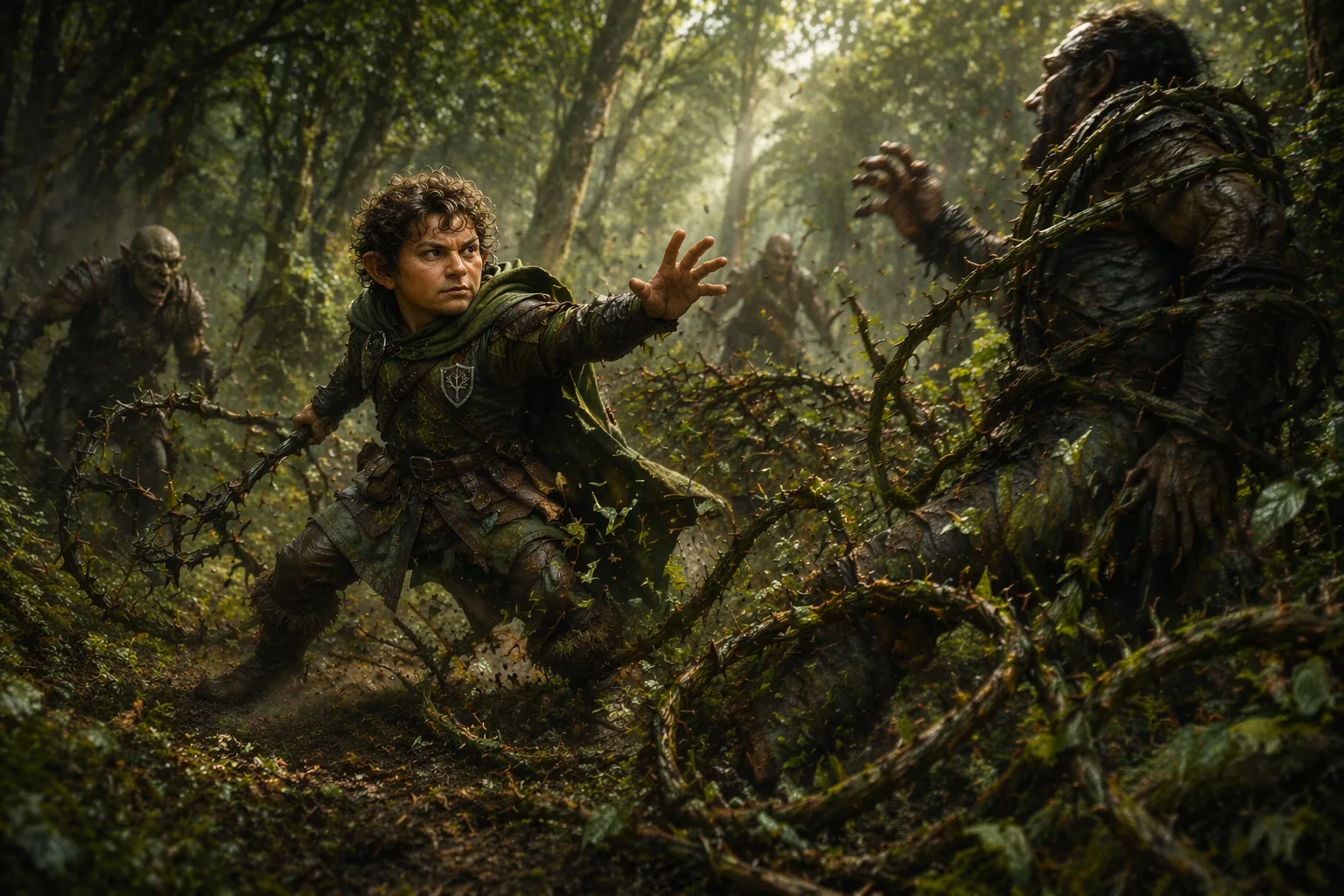
A Briarwarden binding enemies in thorn and root within a shadowed forest
Briarwarden field depiction: thorn, root, and watchful silence turned against trespass.

Vocation Dossier

Classification
Ranger Archetype
Doctrine Path
Briarwarden
Common Name
The Uncles, among the Felden
Primary Role
Terrain controller, trap-layer, and preemptive responder
Cultural Origin
Felden hedgerows, orchards, fence lines, and guarded communal borders
Associated Themes
Terrain, control, preparation, snares, restriction, commitment, and costly movement
Public Features
Hedgerow Snares; Snap the Teeth; Briar Thicket; Orchard’s Final Wardens

Rules text, numbers, and full playable mechanics are intentionally withheld from the public archive record.

Overview

Movement is a choice.

A Briarwarden operates on a simple principle: movement is a choice, and most creatures make it poorly.

They do not pursue enemies or rely on direct confrontation. Instead, they determine where movement becomes a liability and shape the environment accordingly. Open ground is redefined into controlled space, where every step carries consequence.

A Briarwarden does not prevent entry. They make entry costly.

Subclass Record

Doctrine, progression, training, and signs.

This public record preserves the identity of the Briarwarden path as a doctrine of controlled terrain, costly movement, and prepared consequence.

Doctrine

“You ever wonder why some ground stays quiet?

No tracks. No broken brush. Just... untouched.

It’s not because nothing passes through.

It’s because nothing makes it through twice.

I don’t guard a line the way you’re thinking. No walls. No shouting. No grand stand. I just choose a place. And after that, the place starts choosing with me.

You step wrong, it answers.

Slow at first. A catch at the foot. A drag at the ankle. Enough to make you think you can pull free.

That’s the point.

Because once you commit, once you decide to force it, everything closes at once.

And by then?

...you already found out the ground doesn’t let go.”

Their methods are deliberate and preemptive. They prepare terrain in advance, placing snares, manipulating natural growth, and establishing overlapping zones of restriction.

These are not barriers meant to stop movement outright, but systems that punish commitment to it.

Once a creature commits to crossing the space they control, the environment begins to respond. Movement slows, positioning degrades, and options narrow. By the time a direct engagement occurs, the outcome has already been influenced by the terrain.

Feature Progression

The public archive preserves feature names and levels only. Complete rules text is reserved for official release material.

Ranger Level Feature
3rd Hedgerow Snares
7th Snap the Teeth
11th Briar Thicket
15th Orchard’s Final Wardens
Training and Calling

Briarwarden training begins with attention to space. Apprentices learn where a body must place its weight, where a path narrows without seeming narrow, and where roots, brush, stone, and slope can turn motion into exposure.

The path is most strongly associated with Felden communities, where the title of Uncle carries protective weight beyond bloodline. An Uncle walks the edge, prepares the ground, and answers before the household wakes in fear.

Outside Felden lands, the path adapts well to border scouts, ruin-delvers, woodland sentries, and any ranger whose work depends on making hostile terrain answer to a chosen boundary.

Reputation

Briarwardens are rarely praised for spectacle. Their successes are often discovered as absences: the raid that never reached the gate, the beast that turned aside, the tunnel that swallowed its own ambush, the field that remained untouched.

They do not rely on strength or speed to win encounters. They rely on control.

Those who travel with them learn not to mistake patience for passivity. Once a creature decides to force the crossing, the Briarwarden’s preparations begin narrowing every choice that follows.

Signs and Presentation

Common signs associated with Briarwardens include braided thorn-cord, seed pouches, hand-carved fence charms, careful walking staffs, and quiet pauses at thresholds others fail to notice.

They are often seen kneeling beside hedges, gateposts, roots, or broken stone, reading the ground for the places where movement will betray itself.

  • A path that seems open until commitment makes it dangerous.
  • A trespasser slowed at the exact place force becomes a mistake.
  • Thorn, root, snare, or brush arranged to look accidental until it answers.
  • Ground that appears untouched because nothing crosses it twice.
Chronicler’s Note

Field observers often mistake Briarwarden ground for untouched terrain. This is rarely an accident. The absence of warning is part of the method, especially when the Warden wants a trespasser to believe the first few steps still belong to them.

In effect, they do not guard boundaries in the conventional sense. They create conditions where crossing a boundary is the mistake.