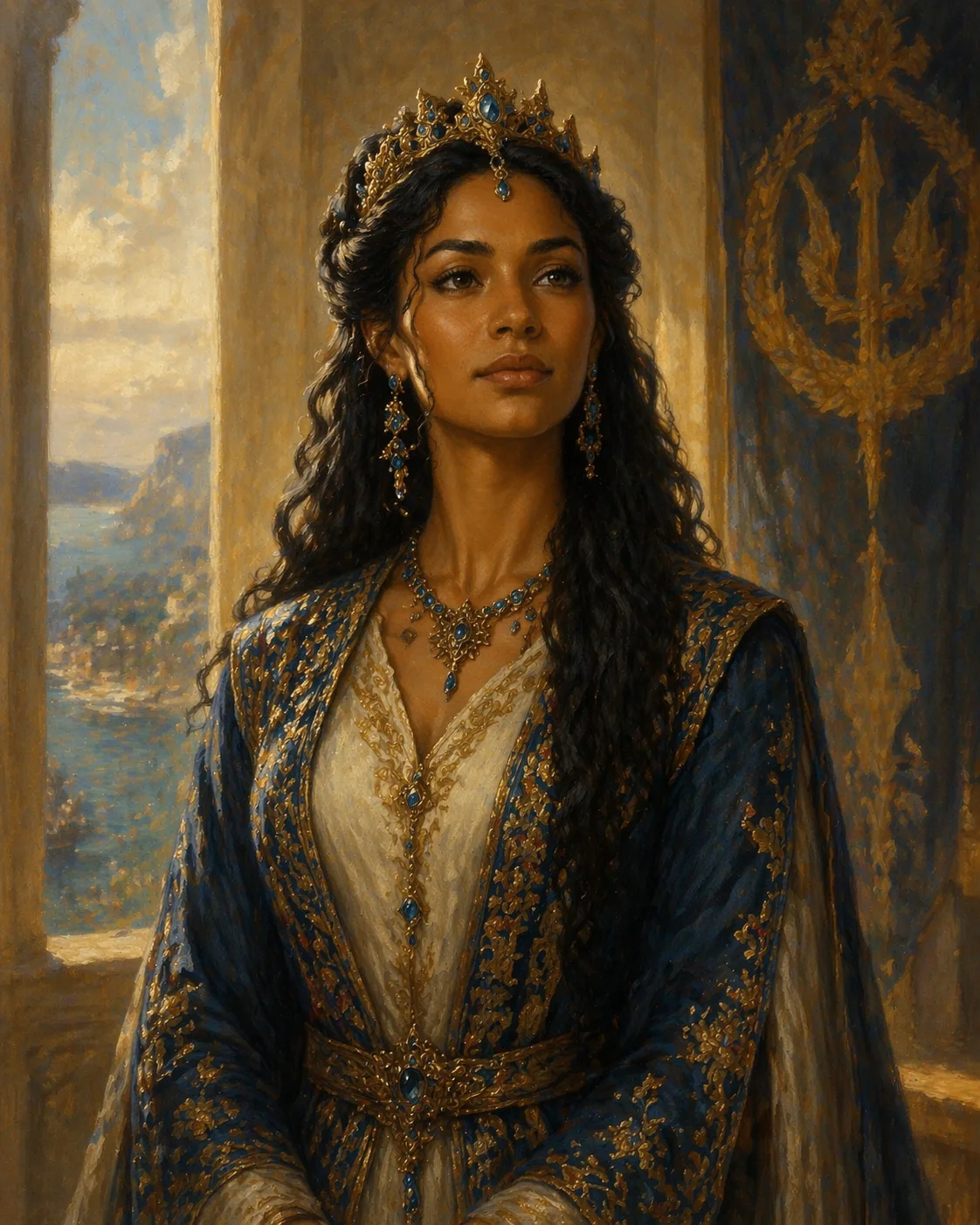
The Abdication
Vaelandrytha assumed the throne following the voluntary abdication of King Emeritus Aerthain Caledrix Lynaldi. The transition was neither contested nor forced by immediate crisis, and is widely regarded as a deliberate transfer of authority rather than a necessity. Records suggest confidence in her readiness, though the full extent of that confidence is not documented.
The Veiled Current Intervention & Aftermath
Early in her reign, Vaelandrytha authorized the removal of the Veiled Current’s Guildmaster following sustained internal abuses and destabilizing conduct. The individual remains imprisoned on Kaxon Island. In the immediate aftermath, the organization fractured. Known operations ceased, communication lines collapsed, and members dispersed. Efforts by Crown authorities to identify centralized leadership or a fixed operational base proved unsuccessful. For a time, the Veiled Current was believed by some to have been effectively dismantled. This condition did not persist.
Criminal activity resumed gradually, without clear structure or identifiable leadership. Over time, patterns consistent with prior Veiled Current operations re-emerged, though no formal reconstitution was ever publicly confirmed.
Since that period, illicit activity within the Archipelago has remained broadly consistent in scale. Reports of theft, smuggling, and underground exchange continue, while large-scale fragmentation, sustained turf conflict, and overt disruption of trade have not reoccurred at previously recorded levels.
Crown enforcement through the Harbor Watch and Guard has increased during Vaelandrytha’s reign, with mixed effectiveness. Some operations succeed, others fail, and no singular trend defines the outcome.
The mechanisms by which criminal activity has remained comparatively contained—despite the apparent absence of centralized structure—are not fully documented within available records.
Within the Council of Seven, criticism persists that Crown efforts have not gone far enough. Among common populations, the prevailing perception remains straightforward: crime exists, it is pursued, and it has not worsened beyond expectation.
Whether this reflects natural reorganization, effective enforcement, or factors not visible within official record remains unresolved.
The Gharnakthul Accord
Vaelandrytha spent months attempting to secure a trade agreement with Gharnakthul, the homeland of the Varnokh—a people who do not trust human rulers, and have reason not to. Correspondence was slow, deliberate, and without clear progress. An invitation was eventually extended.
She sailed aboard the Tidebound Grace with a modest honor escort—against her father's wish to send more—and Champion-Consort Tavian Vantheos and Prince Vaelendryn among her party. Within sight of Gharnakthul, a Varnokh vessel came out to meet them and marked the ship for passage through a rite that named it to the Archipelago's own drowned dead: the Wraithhulks and their crews, who kept silent pace beneath the hull for the remainder of the voyage as witnesses rather than threat.
She was received not with immediate negotiation but before the Gharnakthul War Council, where the eldest chieftain and a war-priest set old grievance plainly before her—the Red Pact and the memory of human promises broken—and asked what stood between her people and theirs should a future Crown's fear turn against them. Vaelandrytha did not answer with law or treaty alone. She answered: “I do.”
Gharnakthul's champion rose to test that claim. By custom the challenge belonged to her consort; Vaelandrytha overruled him and took it herself, forbidding any Morgdhavian hand—blade, spell, prayer, or shield—from entering the contest on her behalf, on pain of death for the interference. She fought with Azure Wake, an ancestral maritime spear kept in her father's private keeping, and was struck down partway through the engagement. When a household guard broke ranks to defend her, she halted the duel to enforce her own word: Prince Vaelendryn, at her command, ended the guard's life to preserve the terms she had set before Gharnakthul.
She rose and continued. The engagement ended when she drove the spearhead beneath the champion's ribs—then knelt at once and called on Morgdhav to heal the wound she herself had made, before the full War Council. Though the victory was hers, she publicly credited fortune and the champion's own god, and yielded the contest's honor rather than require Gharnakthul to accept defeat before its own hall.
The Trade Charter was signed before sunrise. The fallen guard's body was returned to the Archipelago; Vaelandrytha ordered his family provided for and sought his soul's restoration through the priesthood at Morgdhav City, judging his debt for breaking her word already paid in full.
Within the Archipelago, the accord is remembered less for the duel than for what it revealed: that the Queen would answer for her Crown's word personally, and had the discipline to demand the same of no one else present.
The Serava Disruption
During the fifth year of her reign, trade through Serava shifted unexpectedly. Goods failed to arrive along established routes and appeared elsewhere without recorded cause. The disruption resolved without formal declaration of crisis. No singular origin was identified. Those who track such patterns note that it did not appear to resolve on its own.
Council Friction
Members of the Council of Seven have, at multiple points, aligned in opposition to Crown authority on matters of taxation, jurisdiction, and resource control. These alignments have consistently dissolved prior to escalation. No single cause is recorded for this pattern.
Storm Irregularities
Tidecaller records indicate a period in which storm behavior deviated from established post-Cataclysm patterns. Storms weakened prematurely and shifted direction without clear cause. The phenomenon stabilized without escalation. Clerical records contain no unified interpretation. The most consistent phrasing appears across multiple accounts: “Restraint beyond precedent.”