
Eternal Record / Human Pantheon

Úmbrōs

The Inevitability of Fear, Loss and Madness

Seal of the Aelorian Archives
Archival Release Authorization

Approved for circulation among the general populace by order of the Aelorian Archives.

Divine record authenticated for public study.

Úmbrōs

Divine Dossier

Classification
Lesser Power
Disposition
Neutral Evil
Portfolio
Darkness, Loss, Fear, Madness
Worshippers
Asylum keepers, mindwardens, interrogators, and those who study or contain fractured minds, alongside the broken, the obsessed, and those who believe clarity lies beyond sanity.
Sacred Symbol
A hollow black circle swallowing a dim, fading light, often rendered as a split mask or an eye eclipsed by shadow.
Common Titles
The Quiet End, Lord of the Hollow, He Who Waits in the Dark, The Unseen Fracture, The Sleepless Watcher, Keeper of What Remains
Clergy Style
Wardens, examiners, and unsettling guides who contain fear, cultivate it, or walk the thin line between both.
Domains Granted
Despair 18% • Discord 10% • Dream 12% • Faith 5% • Psyche 20% • Torment 20% • Vitality 15%

Percentages represent the proportion of the deity’s clergy who serve within each domain, indicating how commonly each path is practiced within the faith.

Archival Summary

Where Fracture Reveals What Remains

Umbros is the theological and psychological embodiment of inevitable fracture, where certainty fails, identity is challenged, and perception reshapes itself under pressure. His portfolio does not introduce suffering into the world; rather, it defines and governs the conditions under which suffering reveals truth. Darkness, within his domain, is not absence but presence: weight, depth, and obscured understanding. Fear is not weakness but exposure. Loss is not merely absence but transformation. Madness is not disorder alone, but a reconfiguration of perception when prior frameworks fail.

Across Khassid, Umbros is not widely worshipped in the traditional sense, yet he is universally accounted for. His influence is recognized wherever individuals or societies encounter limits they cannot bypass, moments where resilience is tested not by choice, but by circumstance. His existence provides a framework through which mortals interpret these events, often retrospectively, attributing meaning to outcomes that appear to confirm his doctrine.

He is not a god of comfort, nor of destruction. He is the god of what remains when neither comfort nor control can be maintained.

Extended Divine Record

Dogma, doctrine, worship, rites, cultural practice, omens, clergy, orders, and tensions.

This record preserves Úmbrōs as the divine framework of fear, loss, and mental fracture: the point at which old certainties fail and something harsher, clearer, and less merciful remains.

Dogma

You stand here now because something in you refused to look away. That matters more than you yet understand.

You have been told that fear is something to overcome, that loss is something to mend, that madness is something to cure. These are comforts, not truths. I do not take these things from you. I show you that they were always waiting. Fear is the moment you recognize what you are not prepared for. Loss is the moment you see what you depended upon that could not endure. Madness is the moment your understanding fails to contain what is real.

You are not here to be broken. You are here to learn what breaks, and why. Others will tell you to turn away, to preserve yourself, to hold to what feels whole. I will not. If you are to walk this path, you will look directly at what unsettles you. You will not rush past it, and you will not dress it in kinder language. You will name it. You will understand it. And when it changes you, you will not pretend that you are what you were before.

Do not mistake me for cruelty. I do not seek your suffering. I do not require your pain. But I will not lie to you to spare you either. There will be moments when you wish I would. There will be moments when the weight of what you see feels too much to carry. Those moments are not failure. They are the threshold. Stand there. Learn what stands with you, and what falls away.

You will be told that only strength emerges from this path. That is not always true. Some who walk it are diminished. Some are changed in ways they do not welcome. But those who endure do not return uncertain. They do not rely on hope to hold them upright. They stand because they know what remains when hope is gone.

That is what I offer you: not safety, not comfort, not certainty of outcome. I offer you clarity without illusion. If you remain, you will carry that clarity into a world that often refuses it. You will not force it upon others. You will not seek to break them. But when they stand where you now stand, you will not turn them away.

Remain, and you will understand me. Leave, and you will still meet me. The difference is whether you meet me unprepared.

Observed Manifestation: Appearance

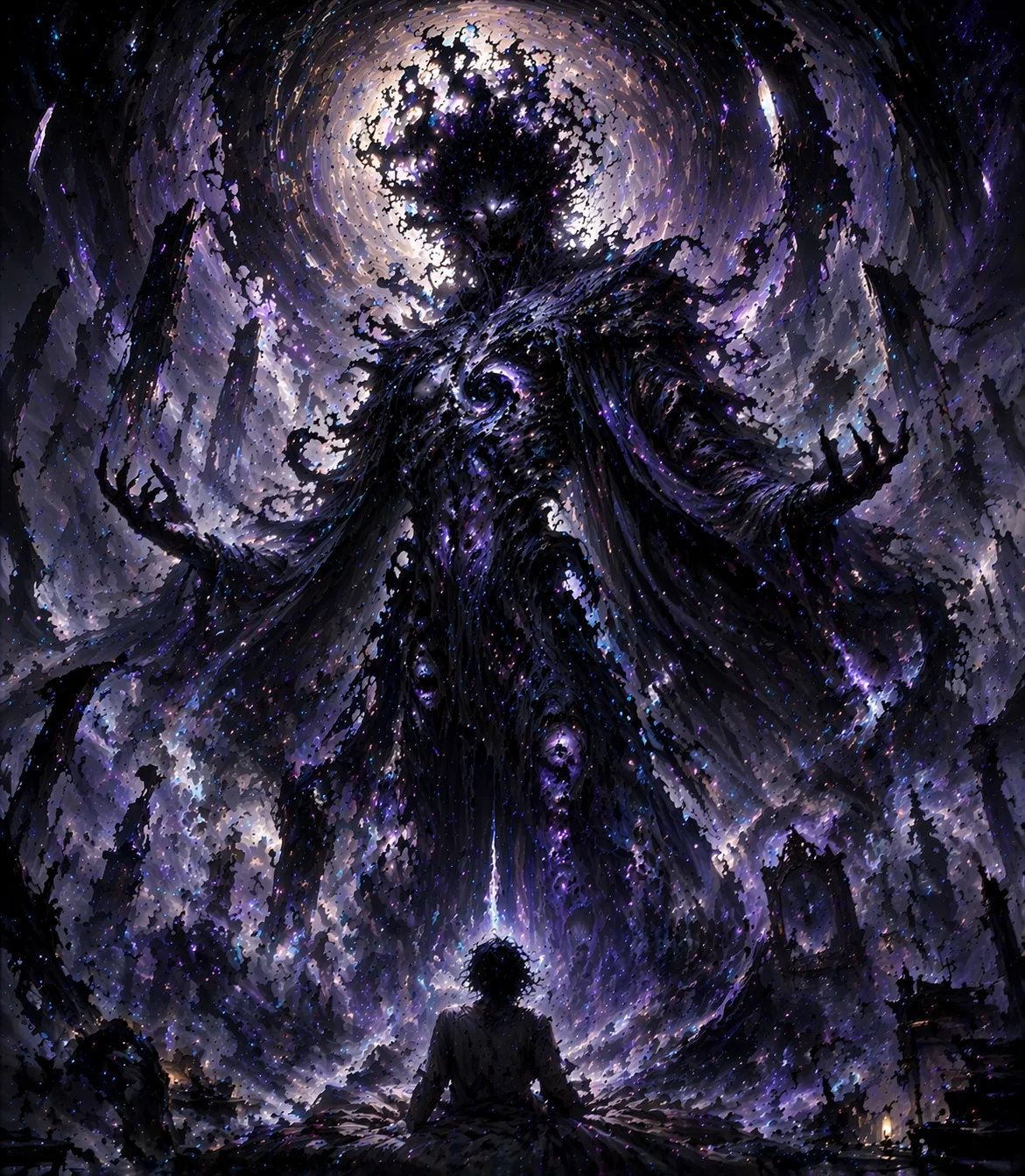
Úmbrōs is consistently depicted as an unstable, partially formed figure existing between substance and void. Representations emphasize depth rather than emptiness: a humanoid silhouette composed of layered shadow, often punctuated by faint, star-like motes suggesting immeasurable interior space. His form appears both present and receding, as though never fully resolved.

Facial features are incomplete or fractured, hollowed eyes or dim ember-like glows set within a visage marked by subtle cracks or separations. These fractures are interpreted as symbolic of disrupted identity and altered perception. His form is often draped in a tattered, dissolving cloak of shadow, its surface bearing distorted impressions of faces, chains, or spiraling patterns associated with fear, confinement, and cognitive descent.

A recurring symbol linked to Úmbrōs is a warped spiral or collapsing circle, representing irreversible transformation and the loss of stable orientation.

Doctrine & Teaching

Úmbrōsian doctrine centers on the inevitability of destabilizing experiences and the necessity of confronting them without illusion. Clergy teach that fear, loss, and madness are not aberrations to be eliminated, but conditions inherent to existence that reveal structural truths about the self and the world.

Fear is framed as exposure to unpreparedness. Loss is understood as the removal of dependency on impermanent structures. Madness is interpreted as the failure of existing frameworks to contain reality, sometimes yielding deeper, if unstable, insight.

The doctrine does not promise positive outcomes. It asserts that clarity may emerge, but is not guaranteed. The value of the path lies in confrontation and recognition, not in preservation or restoration.

Worship & Devotional Structure

Úmbrōsian worship is decentralized and often informal. Organized structures exist, but rarely resemble unified institutions. Clergy are typically identified by function rather than rank, with titles such as Whisperers, Fracture-Priests, or Keepers of the Veil.

Authority within the faith is derived from lived experience rather than formal hierarchy. Those who have endured significant psychological or emotional trial, and retained the capacity to guide others, are recognized as leaders.

Gathering places, when established, are intentionally minimal and controlled environments designed to reduce distraction and encourage introspection. Communal worship is subdued, focusing on shared acknowledgment rather than celebration.

Rites & Observances

The Vigil of Unlight places the subject in extended isolation and darkness so internal fears rise without interference or distraction.

The Bearing of Loss formalizes the recounting and acknowledgment of personal loss, marking its integration into identity rather than treating it as interruption.

The Fracture Rite uses supervised exposure to stressors designed to test cognitive and emotional limits. Whispered Litany follows with low-voiced recitations of doctrinal truths performed without visual contact. These rites are repeatable and emphasize endurance, awareness, and integration rather than resolution.

Cultural Praxis

In regions where Úmbrōs is acknowledged, individuals demonstrate a greater tolerance for discomfort, uncertainty, and emotional strain. Open discussion of fear and loss is permitted within structured contexts, though not encouraged casually.

Taboos include denial of evident truth, avoidance of necessary confrontation, and reliance on false assurances. Social expectation favors acknowledgment of hardship rather than concealment.

In cultures that reject Úmbrōsian teaching, similar experiences occur without framework, often resulting in greater instability during periods of crisis.

Signs & Omens

Clergy interpret persistent silence where activity is expected, recurring intrusive thoughts or shared dreams, shadows behaving inconsistently with their light sources, emotional detachment following significant loss, and heightened awareness of unseen presence during isolation as conditions aligned with Úmbrōs’ domain.

These are not treated as direct acts, but as signs requiring doctrinal interpretation and measured response.

Relics, Sites & Anchored Presence

No formally documented relics, consecrated sites, or anchored manifestations have been confirmed within the Archives at this time. Ongoing observation and regional accounts may expand this record.

Clergy & Agents

Úmbrōsian clergy function as intermediaries of confrontation rather than comfort. They are not called upon to prevent suffering, but to interpret, structure, and guide individuals through destabilizing conditions that other faiths seek to resolve or alleviate.

They are most commonly sought after catastrophic loss, during prolonged psychological strain, when individuals or communities exhibit signs of fracture or instability, and in the aftermath of events that resist conventional explanation or resolution. Their presence is often unwelcome at first, but tolerated where other interventions fail to produce lasting clarity.

Clergy do not present themselves as healers. Instead, they operate as stabilizers of perception, ensuring that individuals confronting fear, loss, or altered cognition do not do so without framework. Their work is not to restore prior state, but to prevent uncontrolled collapse and misinterpretation of experience.

Many Úmbrōsian agents operate independently or in small, loosely affiliated cells. Institutional structures exist, but are secondary to experiential authority. Those who have endured and retained functional clarity hold greater influence than those with formal standing.

Importantly, not all Úmbrōsian clergy are uniformly stable. The faith does not disqualify individuals who exhibit signs of ongoing strain; rather, it assesses whether they retain the capacity to guide others without inducing further destabilization. This results in a spectrum of clerical presence, from measured and precise to unsettling but effective.

Úmbrōsian agents are also known to operate in advisory roles to other institutions, particularly in crisis management, interrogation of conflicting testimony, interpretation of aberrant behavior, and preparation of individuals for high-risk or psychologically taxing roles. Their involvement is rarely public-facing, but frequently documented in post-event analysis.

Orders & Sects

Orders. The Keepers of the Veil oversee spaces of controlled darkness, silence, or sensory limitation and ensure that those exposed to them retain orientation rather than collapsing into panic or dissociation. Fracture Wardens design and administer rites of controlled stress, testing limits without inducing irreversible breakdown. Archivists of Loss preserve case records of transformation following grief, fracture, and altered cognition. Threshold Speakers engage directly with individuals at acute points of crisis, delivering Úmbrōsian doctrine in measured language that does not deepen panic.

Sects. The Bearing Doctrine holds that endurance is the primary measure of alignment with Úmbrōs and remains the most widely accepted current within the faith. The Spiral Truth teaches that madness, if navigated correctly, reveals deeper strata of reality inaccessible through stable cognition. The Hollow Path advocates detachment from emotional reliance as the only dependable form of stability. The Unbroken Silence rejects verbal doctrine almost entirely, maintaining that true understanding of Úmbrōs cannot be taught, only encountered.

Relationships & Tensions

Úmbrōs sees little virtue in gods who promise that fear, grief, and madness can be overcome. Such things are not temporary afflictions to him, but truths buried beneath the comforts mortals construct around themselves. He respects those who survive the darkness without denying what it has made of them, and regards those who preach easy hope with quiet contempt.

He shares the greatest affinity with Luzion and Illario. Death gives finality to loss, while memory ensures that grief continues to shape the living long after the dead are gone. Xantheris also interests him, though Úmbrōs considers the Lord of Magic naïve whenever he assumes every madness can be studied, understood, and made useful.

Kaemir and Legaria occupy familiar ground, but neither earns his loyalty. Betrayal and suffering often lead mortals into fear, yet Úmbrōs considers both gods too eager to turn revelation into control. Legaria in particular mistakes obedience for terror; submission ends resistance, while true fear festers precisely because it cannot be mastered.

He finds an older kinship with The Wild, whose dark forests and unmarked places remind mortals that uncertainty is the natural condition of existence. Valia, by contrast, earns only a cold acknowledgment. Courage matters to Úmbrōs because fear gives it meaning, but he has no admiration for those who teach mortals to escape the very darkness that reveals their truest selves.

Z’haní’s insistence upon hope amuses him more than it angers him. Hope may draw a mortal out of despair, but Úmbrōs knows the memory of that despair remains, waiting to return when certainty fails. Tlaxitan alone provokes open contempt, for tyranny seeks to abolish uncertainty altogether. A world without doubt, hidden things, or private fears would leave Úmbrōs little to rule—and mortals nothing left that was truly their own.