
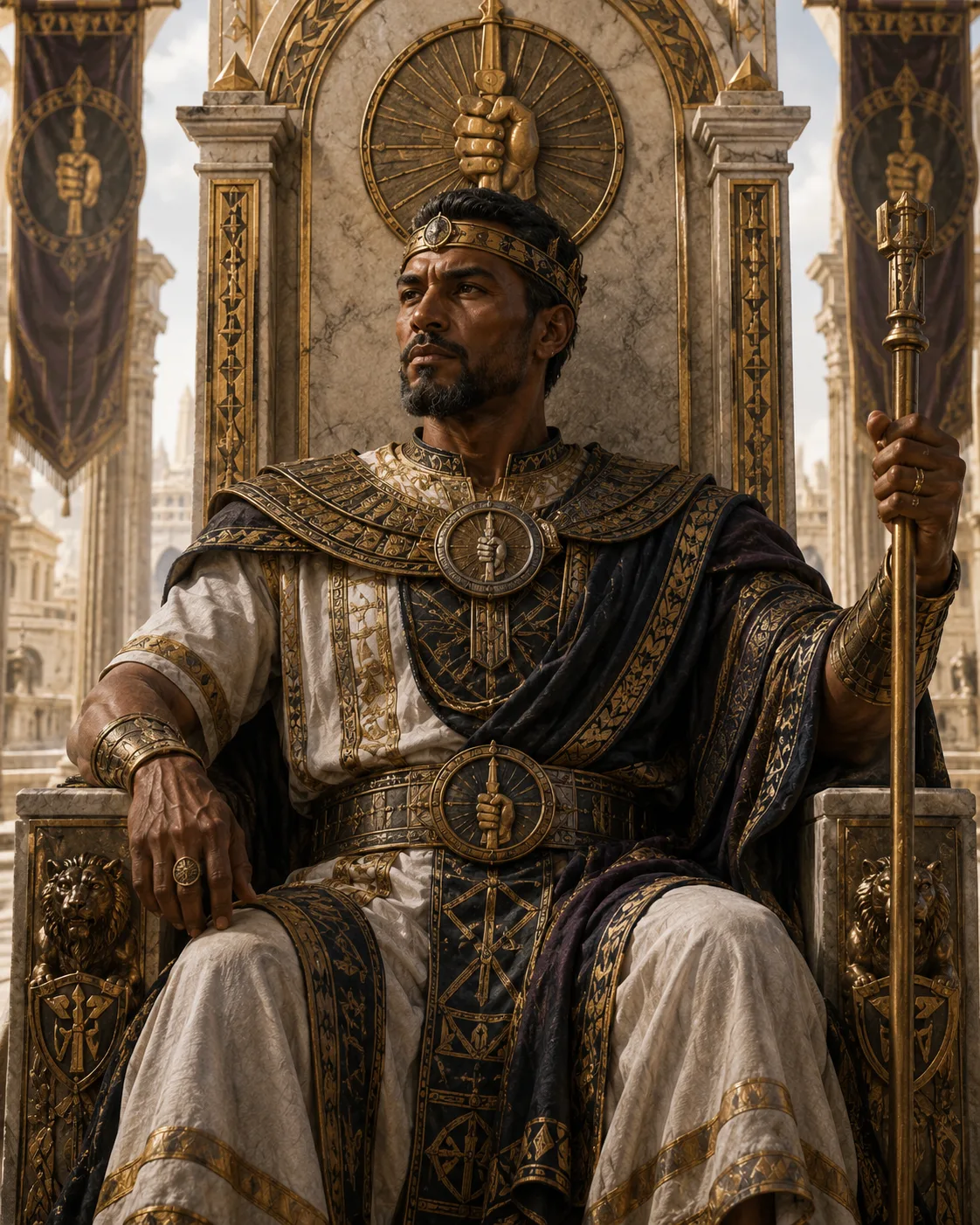
Eternal Record / Human Pantheon

Tlaxitan

The Tyrant Unbending

Seal of the Aelorian Archives
Archival Release Authorization

Approved for circulation among the general populace by order of the Aelorian Archives.

Divine record authenticated for public study.

Tlaxitan

Divine Dossier

Classification
Greater Power
Disposition
Lawful Evil
Portfolio
Tyranny, Control, Domination, Subversion
Worshippers
Rulers, magistrates, governors, military officers, bureaucrats, prison wardens, civic administrators, imperial functionaries, and those who believe civilization survives only through hierarchy, discipline, and uncompromising authority.
Sacred Symbol
A closed fist gripping an upright scepter, representing authority united with the resolve to enforce it.
Common Titles
The Tyrant Unbending; The Iron Sovereign; Lord of Dominion; The Hand That Does Not Tremble; Master of the Ordered Chain; Warden of Obedience
Clergy Style
Stern, disciplined, hierarchical, and exacting. Tlaxitan's clergy serve as magistrates, governors, overseers, adjudicators, commanders, administrators, and keepers of institutional order.
Domains Granted
Control 29% • Corruption 7% • Faith 5% • Infernal 5% • Necrocracy 3% • Order 29% • Vitality 12% • Zealot 10%

Percentages represent the proportion of the deity's clergy who serve within each domain, indicating how commonly each path is practiced within the faith.

Archival Summary

Authority Exercised Without Hesitation

Tlaxitan, The Tyrant Unbending, embodies authority exercised without hesitation and hierarchy maintained through deliberate control. He represents the conviction that civilization is inherently fragile and that order survives only when guided by a sufficiently strong will. His portfolio encompasses not merely governance, but the philosophies that justify governance: domination as necessity, control as responsibility, and authority as the foundation upon which all enduring institutions are built.

Across cultures, Tlaxitan's influence is most often observed within bureaucracies, legal systems, military structures, and centralized governments. His doctrine teaches that disorder is not merely inconvenient but existentially dangerous. Where many faiths seek justice, freedom, prosperity, or virtue, Tlaxitan places stability above all. To his followers, liberty without restraint inevitably produces chaos, and chaos inevitably produces suffering.

His importance within the wider religious landscape stems from the challenge he presents to competing philosophies. Even those who reject his teachings must contend with the questions they raise: How much freedom can a society endure? When does order become oppression? When is authority justified in acting without consent? These tensions ensure that Tlaxitan's influence extends well beyond his faithful, shaping political and theological discourse throughout the civilized world.

Extended Divine Record

Dogma, doctrine, worship, rites, cultural practice, signs, clergy, orders, and theological tensions.

Dogma

I am the hand that does not tremble.

Look upon the ruins of kingdoms, the ashes of cities, and the graves left by unrestrained ambition. Chaos has never required guidance. Disorder needs no teacher. Left to themselves, mortals divide, covet, betray, and destroy. This is not cruelty. It is truth.

You have been taught to fear tyranny. Yet ask yourselves: what is a tyrant? Is it the ruler who commands, or the famine that follows indecision? Is it the magistrate who enforces law, or the mob that tears law apart? Is it authority that destroys civilizations, or the absence of authority when strength is most needed?

Understand this well: freedom is not a foundation. Freedom is a privilege purchased by order. Every road, every city, every harvest, every generation that lives in peace exists because someone accepted responsibility for maintaining what others take for granted. Civilization survives because there are those willing to command when others would hesitate.

Therefore govern. Establish order where uncertainty festers. Let duty stand above desire and law above sentiment. Do not seek to be loved. Seek to be obeyed. A ruler who pursues affection invites weakness. A ruler who pursues stability preserves civilization.

Be vigilant against corruption, but do not mistake discipline for oppression. Be wary of ambition, but do not confuse authority with vanity. The strong do not rule for themselves alone. They rule because someone must.

Through strength comes order. Through order comes survival. Through survival comes prosperity. Through prosperity comes every virtue lesser minds claim to value above stability.

I am Tlaxitan.

Stand firm. Command wisely. Yield nothing to chaos.

Appearance

Tlaxitan is most commonly depicted as a towering sovereign seated upon a throne of iron or dark stone, clad in ceremonial regalia emphasizing authority rather than martial prowess. His posture is invariably rigid, composed, and immovable.

The closed fist gripping an upright scepter appears throughout nearly all depictions, whether as a handheld emblem, architectural motif, ceremonial standard, or sacred seal. Crowns, tablets of law, fortress keeps, elevated thrones, and monumental civic architecture are likewise common.

Though artistic traditions vary, depictions consistently emphasize permanence, certainty, discipline, and command. Tlaxitan is rarely portrayed in motion. Instead, he is shown as an immovable center around which institutions, laws, and nations are ordered.

Doctrine

The faith of Tlaxitan teaches that civilization survives through hierarchy and that authority is a responsibility rather than a privilege.

Its central teachings hold that order is superior to freedom, stability preferable to uncertainty, and obedience necessary for collective prosperity. Individual desires are regarded as secondary to the needs of society. Authority derives legitimacy from its ability to maintain civilization and protect institutions from collapse.

Clergy frequently argue that many historical catastrophes arose not from excessive control but from insufficient control. The faith therefore regards indecision, weak leadership, and excessive decentralization as recurring causes of social decline.

While critics view the doctrine as oppressive, adherents commonly see themselves as guardians of civilization, believing that difficult decisions and firm governance preserve lives that would otherwise be lost to disorder.

Worship

The faith is organized through highly structured hierarchies that mirror its teachings.

Authority flows through clearly defined ranks, with responsibilities and obligations carefully documented. Advancement is typically based upon demonstrated competence, loyalty, discipline, and success in maintaining institutional stability.

Temples often function simultaneously as religious centers, courts, archives, administrative offices, and centers of governance. Worship emphasizes duty, accountability, public service, and acknowledgment of lawful authority. Collective observances generally reinforce social cohesion and institutional continuity rather than personal revelation.

Rites

The Oath of Service

Initiates formally swear loyalty to law, hierarchy, and institutional order.

The Renewal of Authority

Leaders publicly reaffirm the responsibilities entrusted to them and the obligations owed to those beneath their stewardship.

The Ledger of Accountability

Individuals record duties fulfilled, obligations unmet, and responsibilities accepted for the coming cycle.

The Vigil of Iron

A period of disciplined silence intended to cultivate patience, self-control, and resolve.

The Ceremony of Investiture

Officials, commanders, magistrates, and administrators receive formal recognition of authority and responsibility before the community.

Cultural Praxis

Communities strongly influenced by Tlaxitan's faith tend to value punctuality, discipline, reliability, civic duty, and respect for established authority.

Citizens are expected to fulfill obligations promptly, maintain social order, and subordinate personal preference when it conflicts with communal stability. Public insubordination is generally condemned, while loyalty, competence, and dependable service are highly respected.

Common taboos include deliberate disruption of lawful authority, neglect of assigned responsibilities, public disorder, abandonment of duty, and actions that place personal ambition above institutional stability.

Signs

Clergy traditionally interpret the following as signs of favor:

  • Institutions enduring periods of crisis.
  • Swift restoration of order following unrest.
  • Unexpected unity within divided organizations.
  • Effective governance during difficult circumstances.
  • Peaceful resolution of disputes through accepted authority.

Signs commonly interpreted as disfavor include:

  • Persistent civil unrest.
  • Fragmentation of leadership structures.
  • Repeated administrative failures.
  • Breakdown of discipline within institutions.
  • Escalating disorder despite increased efforts at governance.

These interpretations arise from doctrine and clerical tradition rather than confirmed divine action.

Relics

No formally documented relics, consecrated sites, or anchored manifestations have been confirmed within the Archives at this time. Ongoing observation and regional accounts may expand this record.

Clergy

Tlaxitan's clergy most commonly serve as magistrates, governors, judges, military administrators, legal scholars, prison overseers, civic planners, and institutional advisors. Their responsibilities center upon maintaining order, enforcing law, preserving stability, and strengthening governance.

Faith Domain clergy are notably rare. Though often respected, they are not universally welcomed within the hierarchy. Possessing an unusually comprehensive understanding of Tlaxitan's doctrine, they frequently serve as theologians, archivists, canonists, philosophical advisors, and interpreters of divine intent. Historical observation suggests that such individuals are disproportionately represented among both the faith's most influential thinkers and its most controversial internal critics.

Orders

Order of the Iron Scepter

Magistrates, judges, and legal authorities responsible for civic governance.

Wardens of Dominion

Administrators and overseers tasked with maintaining institutional stability.

The Black Ledger

Record keepers, auditors, archivists, and bureaucratic specialists.

The Vigilant Hand

Investigators, inspectors, and internal enforcers responsible for identifying corruption and incompetence.

The Doctrine of Necessary Rule

Emphasizes strong governance as the highest expression of Tlaxitan's will.

The School of Ordered Prosperity

Teaches that authority exists primarily to preserve civilization and public welfare.

The Absolutists

Argue that authority should rarely be constrained once legitimately established.

The Preservationists

Maintain that stability itself is the ultimate objective, even when authority must occasionally yield to prevent collapse.

Relationships & Tensions

Tlaxitan's most enduring theological rivalry is with Kieron. Though both govern aspects of law, order, and civilization, they differ fundamentally regarding the purpose of authority itself. Kieron teaches that law exists to protect and that justice gives legitimacy to governance. Tlaxitan teaches that authority creates legitimacy and that order must be preserved regardless of sentiment. Their conflict represents one of the defining ideological divisions within the pantheon.

His relationship with Legaria is more complex. Both deities recognize the utility of suffering in the exercise of power, yet they disagree profoundly regarding its purpose. Legaria elevates suffering as a sacred truth and worthy end in itself. Tlaxitan views suffering as merely a tool--sometimes necessary, often effective, but ultimately subordinate to control. Where Legaria seeks pain, Tlaxitan seeks obedience.

Tlaxitan's history with Zaldris remains among the most debated events in divine history. When the power of Subversion threatened the stability of creation itself, Tlaxitan intervened and bound Zaldris, assuming stewardship of the mantle through force and necessity. To his faithful, this act stands as evidence that true authority must occasionally act where others hesitate. To his detractors, it remains one of the clearest examples of tyranny justified through fear of what might come.

Among scholars, particular attention has been given to Tlaxitan's attitude toward Z'hani, the Dreaming Prophet. Official doctrine regards dreams, prophecy, and hope as forces requiring guidance lest they encourage instability among the governed. Yet few figures stand in sharper contrast to Tlaxitan's worldview than Z'hani himself.

Born a slave and elevated to divinity, Z'hani embodies the possibility that the oppressed may become something greater than their circumstances. His story challenges assumptions many regard as fundamental to the natural order. Neither Tlaxitan nor his clergy publicly acknowledge any concern regarding the Dreaming Prophet. Nevertheless, many scholars have observed that rebellion can be crushed, dissent can be silenced, and resistance can be broken. Hope is considerably more difficult to govern.

The faith generally regards Sanctar Loryn as a necessary stabilizing force within the wider religious landscape. While individual clergy may disagree with particular interpretations of the Accords, Tlaxitanic doctrine broadly acknowledges that enduring authority depends upon recognized structures capable of preventing divine and institutional excess alike.