


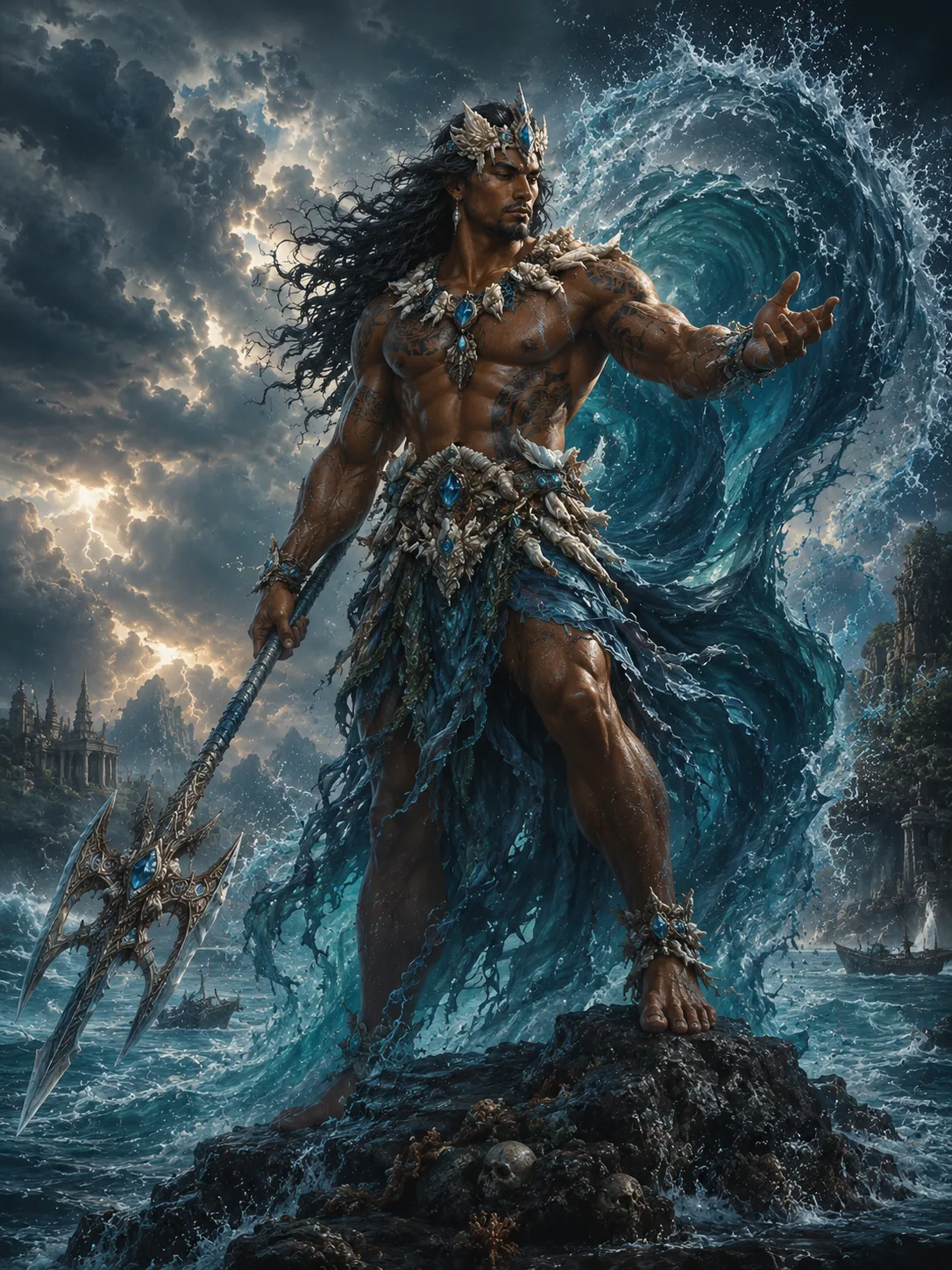
Archival Summary
The Motion That Refuses Stillness
Morgdhav is understood across maritime and riverbound cultures as the unified expression of water and sky in motion: tide, storm, current, rain, and shifting wind interpreted not as separate forces, but as interdependent movements within a single governing pattern. To those who live by coastlines or depend upon navigable waters, Morgdhav is less a singular presence within the world than the structure through which change itself becomes legible.
His teachings arose not from abstraction, but from repeated encounter with conditions that cannot be simplified. Sailors, traders, and riverfolk reached the same conclusion generation after generation: no one force governs the sea. Tide alters shore, wind reshapes tide, storm answers both, and river feeds them all. Morgdhav became the name given to that interdependence because it is consistently observed, even when it is never fully mastered.
Within Morgdhavian thought, calm is not safety, only temporary alignment. Imbalance is not failure, but pressure gathering toward correction. Those who follow him do not ask the sea to become kinder. They learn to read what is already in motion, to act within it, and to accept the cost of misjudgment without calling it malice.
He is not chiefly revered as guardian nor feared as punisher. He is treated as reality demanding interpretation: a presence that does not alter itself for mortal comfort, but can be survived, understood, and respected by those willing to see clearly.