
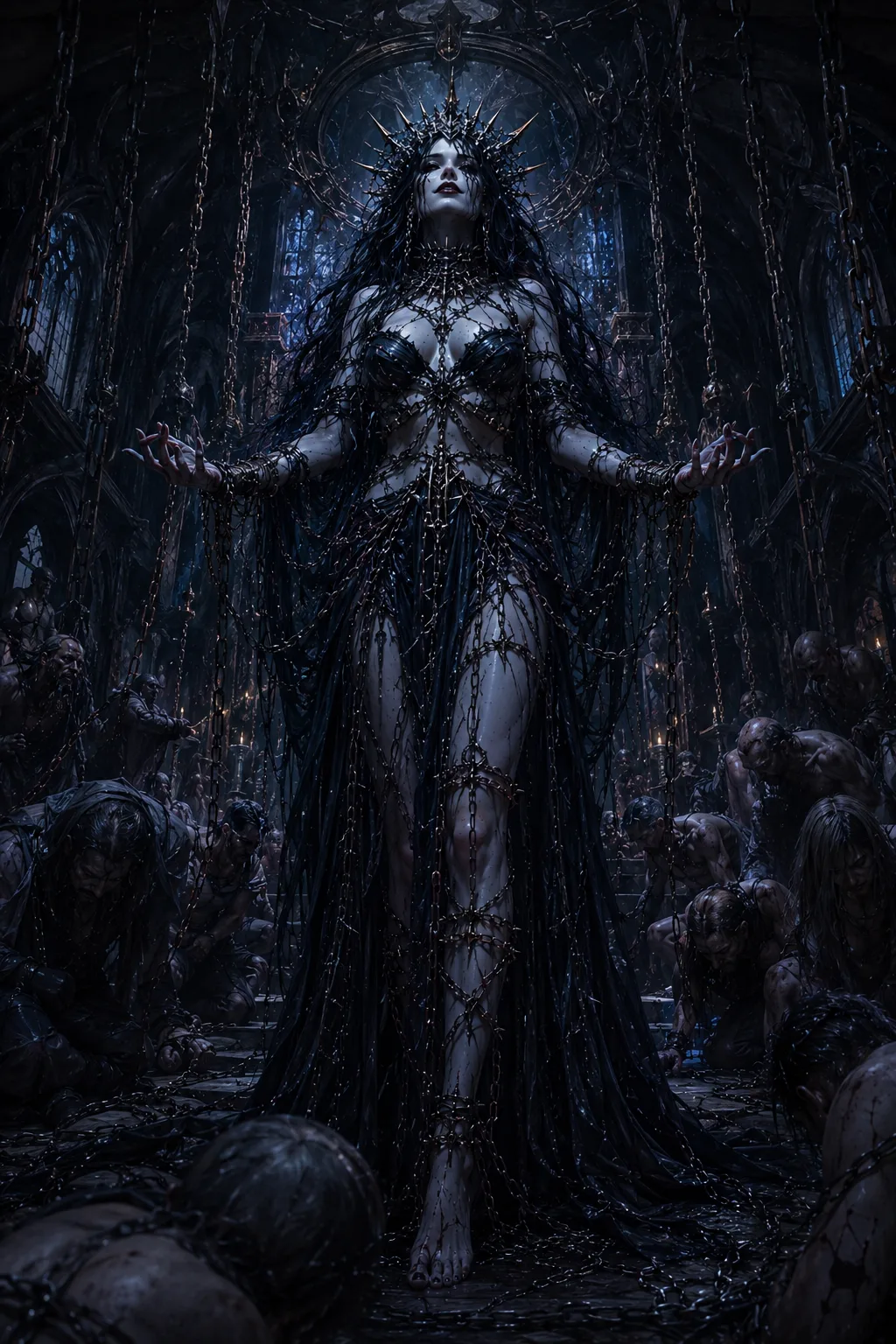
Eternal Record / Human Pantheon

Legaria

Mistress of Chains, the Burdened, and Suffering

Seal of the Aelorian Archives
Archival Release Authorization

Approved for circulation among the general populace by order of the Aelorian Archives.

Divine record authenticated for public study.

Legaria

Divine Dossier

Classification
Lesser Power
Disposition
Lawful Evil
Portfolio
Pain, Oppression, Suffering
Worshippers
Those who endure and those who enforce; people living within systems of suffering, and those responsible for maintaining them.
Sacred Symbol
A bound form under strain, often shown as chains drawn taut around a central point.
Common Titles
The Unyielding Weight; Lady of Chains; The Enduring Wound; She Who Presses; The Bound Sovereign
Clergy Style
Authority is demonstrated through the capacity to withstand, impose, or outlast pressure within enduring systems.
Domains Granted
Control 17% • Corruption 10% • Despair 14% • Faith 5% • Infernal 9% • Order 15% • Psyche 11% • Torment 12% • Vitality 7%

Percentages represent the proportion of the deity’s clergy who serve within each domain, indicating how commonly each path is practiced within the faith.

Archival Summary

The Pressure That Becomes Structure

Legaria is the codification of suffering as structure: a framework through which pain is not merely experienced, but understood as an inherent function within ordered existence. Her presence is most visible where hardship ceases to be incidental and becomes systemic—in institutions that regulate bodies and minds, in hierarchies that justify pressure as necessity, and in conditions where endurance is no longer a choice but a requirement of survival.

She does not embody chaos, excess, or unrestrained brutality. Rather, she represents the recognition that suffering persists within structure and that such pressure, whether endured, imposed, or examined, serves a necessary role in maintaining order. Her influence is measured not in singular acts of cruelty, but in the normalization of hardship as a method of stability, extraction, and definition.

Legaria’s relevance persists across cultures not because she is always openly revered, but because her framework is repeatedly encountered and reinforced. Wherever systems demand endurance, wherever pressure is treated as inevitable, and wherever worth is tested through survival or imposition, her presence takes form.

Her clergy do not claim to invent these conditions. They identify them, formalize them, and ensure their continued function within the structures that depend upon them.

Extended Divine Record

Dogma, doctrine, worship, rites, cultural practice, signs, clergy, and restricted note.

This record preserves Legaria as a divine framework of pressure, discipline, and survival: suffering not as random cruelty, but as a shaped condition through which order tests, defines, and reveals.

Dogma

You have suffered. Do not deny it. Do not diminish it. Do not pretend it was without structure. What you endured was not random. It was not isolated. You are here because some part of you has begun to recognize that your suffering had shape, that it existed within something larger than yourself.

You know me. You have always known me. Every moment you were forced to endure when you would have chosen otherwise, every weight you carried when no one came to lift it, every time you were made to continue when stopping would have been easier, you encountered me there. Not as comfort. Not as relief. As pressure. As constraint. As the structure that did not yield when you did.

You were never outside it. You were only unaware. What you call suffering has always had form. It has always moved through systems, through hands, through circumstance. You have lived within it from your first breath, carried it without understanding. That ends here.

What you accept now is not new. It is named. You will see it. You will measure it. You will endure it when you must, impose it when it is required, and examine it without illusion. Suffering is not aberration. It is structure. Within it, all things are tested, defined, and revealed.

Observed Manifestation: Appearance

Legaria is most often depicted as a bound sovereign, adorned in restraints that both confine and define her. Chains, collars, and barbed ornamentation appear across cultures not as signs of captivity, but as expressions of structure made permanent.

Her form is frequently rendered as asymmetrical, one side preserved and the other marked by strain, scarring, or degradation. Iconography emphasizes contrast: refinement against damage, control against collapse. Her expression is composed, distant, and unyielding rather than theatrically cruel.

In many records, her attire itself appears to inflict harm upon her form through constricting bindings, embedded implements, or spiked vestments. This is interpreted as proof that suffering is not merely external, but integrated. She is rarely shown in motion. She is seated, anchored, or fixed in place, present as a constant rather than an actor.

Doctrine & Teaching

Legarian doctrine teaches that suffering is not incidental to existence, but foundational to structure. Pain is recognized as a refining force that distinguishes the capable from the incapable, the enduring from the transient. Oppression, within this theology, is not framed as failure, but as a mechanism that, when applied with discipline and restraint, preserves order.

Clergy instruct that unregulated freedom leads to dissolution while controlled hardship produces cohesion. Individuals are taught not simply to accept suffering, but to understand their place within it: to endure when required and to impose when necessary. To reject all pain is to deny formation; to refuse its application is to permit collapse.

Central to the doctrine is reciprocity. No one stands outside the structure they uphold. Those who wield suffering are bound by its laws as surely as those who endure it. Authority is not exemption, but deeper integration demanding precision, discipline, and accountability.

Worship & Devotional Structure

Legaria’s faith is most often embedded within institutions that exercise authority: judicial systems, military hierarchies, penal structures, and doctrinal orders concerned with discipline and correction. Within such environments her presence is not merely observed, but formalized and upheld.

Centralized temples exist as extensions of this authority. Some serve as administrative sanctums where doctrine and enforcement become policy and law. Others function as sites of controlled endurance where suffering is measured, applied, and recorded with purpose. These are not places of solace, but of alignment.

Clergy are visible as adjudicators, overseers, and enforcers who maintain and refine structures of pressure. Their role is not to question suffering’s existence, but to ensure its application remains disciplined, justified, and effective. Hierarchy within the faith is rigid, emphasizing rank, accountability, and proper exercise of authority.

Rites & Observances

The Measure of Endurance requires an initiate to undergo a controlled period of imposed hardship while maintaining assigned duties. Completion is marked not by survival alone, but by continued function under strain.

The Binding Oath formalizes entry into clerical service by assigning a burden, symbolic or literal, to be carried indefinitely as reminder of mutual constraint between wielder and subject.

The Calibration is a recurring evaluative rite in which clergy assess the systems they oversee, adjusting degrees of enforcement so that neither collapse nor excess undermines the order they claim to maintain. Each rite reinforces the principle that suffering must be applied with precision.

Cultural Praxis

Societies influenced by Legarian doctrine do not merely tolerate endurance; they institutionalize it. Discomfort is expected, regulated, and often maintained within daily life so individuals remain conditioned to pressure as a constant. Hardship is treated not as deviation, but as a necessary condition of stability.

Public displays of weakness are discouraged through social consequence and loss of standing. Endurance under visible strain becomes proof of reliability and fitness for greater responsibility. Status is frequently tied to one’s capacity to withstand and operate within sustained pressure.

Taboos arise not against suffering itself, but against its misuse. Unstructured cruelty is condemned as inefficiency and threat to order. Unearned relief is restricted as destabilizing. Language within these cultures reinforces the idea that suffering is something to be maintained, navigated, and, where appropriate, applied in service of structure.

Signs & Omens

Legarian clergy interpret prolonged stability under strain as evidence of favor: systems that endure despite pressure are viewed as properly calibrated.

Collapse following unchecked leniency is taken as a sign of neglect. Suffering so excessive that it produces disorder rather than cohesion is interpreted as misapplication. Repeated failure at the point of expected relief, unbroken function under escalating demand, and institutional resilience after imposed hardship are read as outcomes aligned or misaligned with Legarian principle.

Relics, Sites & Anchored Presence

No formally documented relics, consecrated sites, or anchored manifestations have been confirmed within the Archives at this time. Ongoing observation and regional accounts may expand this record.

Clergy & Agents

Legarian clergy serve as enforcers, adjudicators, and regulators within established systems of authority. Their legitimacy rests on demonstrated precision, consistency, and discipline in the application of doctrine. To administer suffering correctly, to impose it with purpose, measure it accurately, and sustain it where required, is treated as the clearest expression of faith.

Most clergy are visible within structures of control, though they are not uniform in function. Some oversee and arbitrate. Others record the use, effects, and outcomes of hardship. A smaller number serve among the enduring, embodying doctrine through sustained survival and functioning as living proof that the structure works.

Hierarchy is explicit and rigid. Advancement is earned through demonstrated effectiveness: the ability to uphold order under strain without excess, failure, or deviation.

Orders & Sects

No public orders or sect records have been released at this time.

Relationships & Tensions

Legaria has little patience for gods who shelter mortals from hardship. To her, suffering is not a cruelty but the forge in which weakness is burned away, and every act of compassion merely postpones the discipline that life inevitably demands. Those who curse her name simply prove they have yet to understand her lessons.

She finds her closest allies in Ssthax, whose plagues strip away comfort before her oppression shapes what remains, and in Kaemir and Úmbrōs, whose betrayal and fear often prepare souls for the truths only suffering can reveal. Tlaxitan is useful for similar reasons, though she regards his obsession with order as unnecessarily rigid; obedience achieved through law can always be broken, but obedience learned through pain becomes instinct.

Her contempt is reserved for those who deny suffering its purpose. Naelis heals what should have hardened, Valia fills broken spirits with false hope, Astraea mistakes mercy for strength, and Kieron burdens himself with ideals that collapse under true hardship. Even The Wild disappoints her, allowing life to flourish and perish without forcing it to become stronger through deliberate trial.

No god earns more of her hatred than Z'haní. She sought to reduce him to another forgotten slave, only to watch him transform every wound she inflicted into the foundation of his divinity. His very existence mocks her certainty that suffering belongs to those strong enough to wield it rather than those forced to endure it.

Even Aeru frustrates her. He acknowledges suffering as part of Balance yet continually intervenes whenever oppression ceases to temper the soul and instead exists only to perpetuate itself. To Legaria, that distinction has always been a weakness.

Restricted Addendum

Restricted Addendum: Legarian Whisper Records — Z’hanic Prophecy Fragments. Classification: Limited Circulation.

Unverified reports originating from Legarian-controlled regions reference a recurring claim attributed to Z’hani concerning the eventual weakening of Legaria’s dominion. No complete or consistent record exists. One preserved excerpt reads: Chains hold only so long as they are believed to be unbreakable. The moment they are seen, they begin to fail.

A second fragment, less consistently reproduced, appears in multiple accounts: She will not fall to blade or flame. She will be left behind.

These claims are uniformly denounced within Legarian doctrine. Individuals who repeat or interpret such material are identified and detained, often under intensifying interrogation. The severity of response appears disproportionate to the fragmentary nature of the claims.

Despite suppression, similar reports continue to surface across unrelated regions in altered forms. Whether this reflects coordinated dissemination, independent emergence, or coincidence remains undetermined. Archivist’s note: the persistence of these records warrants continued collection. Verification remains pending.