Eternal Record / Human Pantheon

Illario

God of the Eternal Record and Unbroken Continuum

Seal of the Aelorian Archives
Archival Release Authorization

Approved for circulation among the general populace by order of the Aelorian Archives.

Divine record authenticated for public study.

Illario

Divine Dossier

Classification
Greater Power
Disposition
Lawful Neutral
Portfolio
Continuity, Remembrance, Fate, Record, Inevitability
Worshippers
Archivists, historians, chronologers, scholars, and those charged with record, memory, and continuity.
Sacred Symbol
An open record marked by a continuous line or spiral, often intersected by measured points, representing events fixed within an unbroken continuum.
Common Titles
The Keeper of Time, The Chronicler, Lord of the Unbroken Record, The Measured One, He Who Remembers
Clergy Style
Clergy operate as record-keepers, analysts, and interpreters of events, maintaining archives and advising where understanding of the past informs the present. Authority is derived from accuracy, preservation, and the ability to trace consequence rather than from position or decree.
Domains Granted
Continuum 14%, Faith 10%, Fate 18%, Foresight 14%, Lorekeeper 12%, Time 20%, Vitality 12%

Percentages represent the proportion of the deity’s clergy who serve within each domain, indicating how commonly each path is practiced within the faith.

Archival Summary

The Record That Does Not Break

Illario is recorded as the structuring constant through which existence maintains coherence across time. He does not govern moments as they pass, nor does he alter their outcome, but ensures that all moments persist, connect, and resolve without contradiction. Within his domain, nothing is lost, nothing is rewritten, and nothing exists in isolation from consequence. Past, present, and future are not treated as discrete states, but as interdependent conditions of a single, continuous reality.

Remembrance, as attributed to Illario, extends beyond mortal memory. It is understood as the persistence of truth independent of perception or record. Events are not preserved because they are written, but are written because they already endure. History, therefore, is not constructed through narrative, but exists as a complete and immutable structure, accessible only in part through mortal effort.

Fate is interpreted within Illarian teaching as resolution rather than imposition. Mortals act freely, and no action is prevented or compelled. However, all actions contribute to a structure that cannot fracture or remain incomplete. Every decision, whether understood or not, becomes part of an outcome that will resolve. This produces a paradox central to the faith: agency is absolute, yet inevitability remains.

Illario’s presence is not localized to place or culture. It is recognized wherever time advances, where events remain true to what has occurred, and where consequence follows action without deviation. He is not identified through intervention, but through the absence of disruption, through the fact that existence continues in a form that does not collapse under its own weight. It is within this framework that Illario established a precedent unmatched among recorded divine behavior: the designation of an Exarch.

Extended Divine Record

Dogma, worship, rites, cultural practice, signs, clergy, and exarchal distinction.

This record preserves Illario as a deity of unbroken sequence and enduring truth: the divine principle through which time remains coherent, history remains intact, and consequence remains inseparable from action.

Dogma

You stand within a continuity that did not begin with you and will not end with you. What you are, what you have done, and what you will do are not separate things, but parts of a structure that does not break and does not forget. You will not step outside of it. You will not undo what has been set into motion. You will come to understand that every action carries forward, whether it is witnessed or not.

You are not charged to change what comes. You are charged to see it clearly, to preserve what is true, and to act with the knowledge that nothing you do is without consequence. Record what endures. Learn what has already been set in motion. Accept that what you choose will become part of what must resolve, and act with the understanding that it will remain.

Observed Manifestation: Appearance

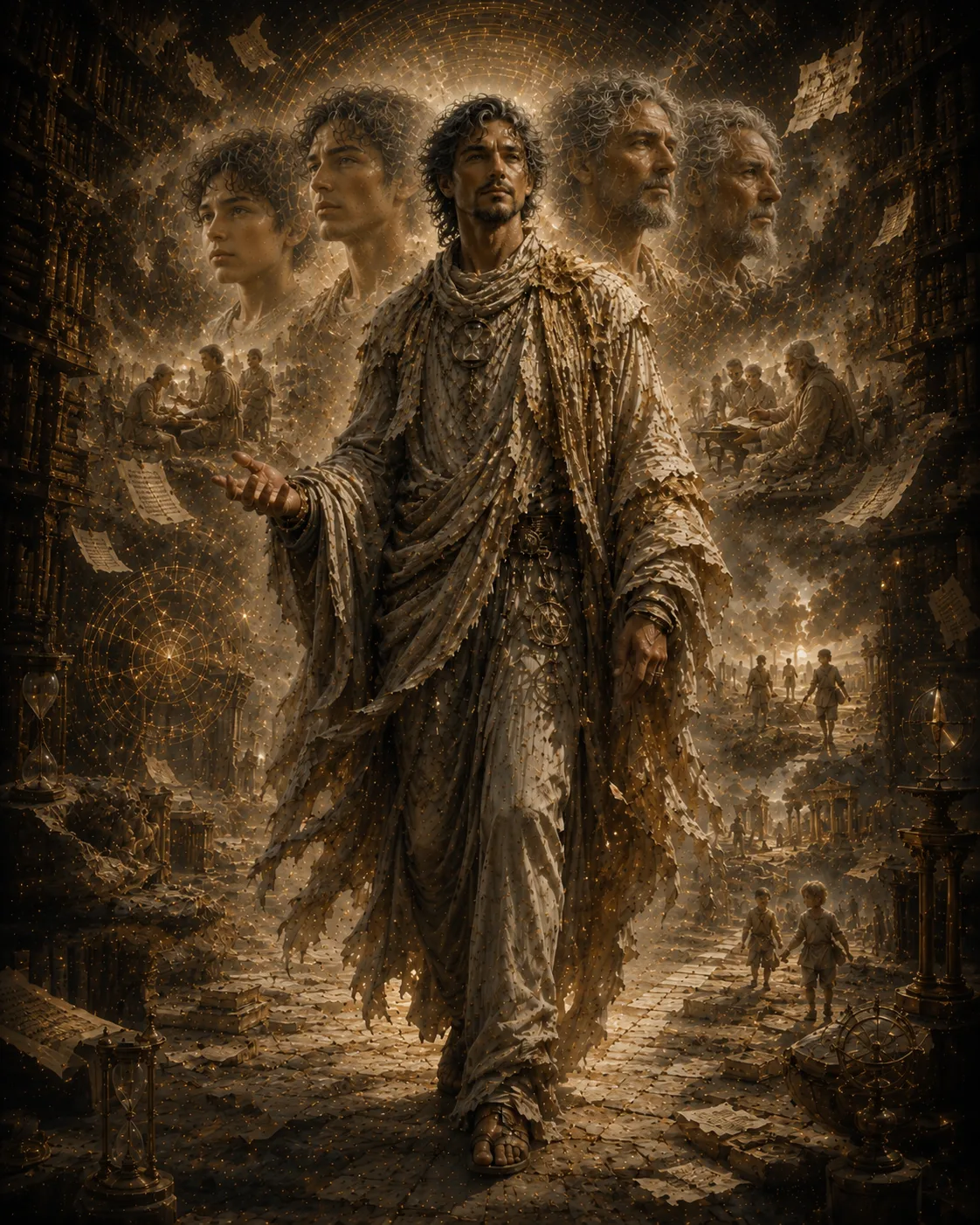
Illario is consistently depicted as a figure whose form resists singular placement in time. Artistic renderings across cultures present him as neither young nor old, but as an alignment of multiple ages held in quiet tension. His features remain recognizable across these variations, suggesting continuity rather than transformation.

His form is composed and unmoving, with a stillness so complete that observers often describe the feeling that time shifts around him rather than him changing position at all. His skin is rendered in pale or muted tones, often marked by flowing lines like layered script, rings of growth, or preserved grain.

His eyes are dark and reflective, conveying awareness rather than conventional emotion. Attire is uniformly archival in character: layered robes textured like parchment or woven with thread-like symbols, glyphs, and fragmentary script. Across all representations, Illario is never shown in action. Stillness is essential to the record of his form.

Doctrine & Teaching

Illarian doctrine is structured around the premise that existence is continuous, non-fragmenting, and resistant to alteration at the level of truth. Time is not treated as a resource to be managed, but as the condition through which all things occur. History is not subject to revision, and fate is not a force that directs behavior, but the resolution of all behavior within a system that cannot remain incomplete.

Clergy instruct that actions must be understood in relation to what precedes and what follows them. No decision is isolated, and no outcome exists without cause. The study of history is therefore not an act of curiosity, but of necessity. Without understanding what has been, one cannot act with awareness of what will result.

The preservation of record is treated as a structural responsibility. To distort or omit truth is not framed as moral failure alone, but as a disruption of continuity at the level of understanding. Followers are therefore instructed to observe, record, and interpret with precision, recognizing that incomplete or inaccurate knowledge leads to flawed action.

Fate is taught as inevitable resolution. It does not remove freedom, nor does it dictate choice. Instead, it ensures that all choices contribute to an outcome that will exist in full. The task of the faithful is not to seek favorable outcomes, but to understand that outcomes will occur, and to act with that knowledge.

Worship & Devotional Structure

The worship of Illario is organized through institutions dedicated to preservation, study, and interpretation rather than petition or appeal. These institutions, commonly referred to as Chronal Sanctuaries, function as repositories of knowledge and centers of instruction, where records are maintained, analyzed, and expanded.

Clergy are defined by their role within this structure rather than by hierarchical distinction alone. Authority is established through demonstrated accuracy in record-keeping, reliability in interpretation, and depth of understanding. Those who preserve truth consistently are granted greater influence, while those who distort or misinterpret are corrected through record and comparison rather than direct censure.

Central to the structure of the faith is the recognized position of Aleryn Duskwhisper, Exarch of Illario and Keeper of the Aelorian Archives. This designation represents the first recorded instance of a deity extending its function through a singular, defined agent.

Aleryn’s identity as Syl’Aeris is of particular note. Syl’Aeris perception, not confined to strictly linear experience, is widely considered to provide a capacity for engaging with continuity beyond sequential limitation. Within the Archives, this selection is not interpreted as preference, but as functional alignment, an individual suited to preserve and organize a structure that does not exist solely within mortal perception.

Through this designation, Illario’s domain is expressed not through intervention, but through sustained and accessible record.

Rites & Observances

Illarian rites are acts of recording, reflection, and acknowledgment of transition. Initiation into the faith requires the presentation of a recorded account that demonstrates continuity across events rather than isolated description.

Regular observances include the maintenance of personal and communal records, transcription of significant events, and formal acknowledgment of transitional moments such as death, succession, or irreversible decision. These rites do not appeal for alteration. They affirm that such moments have occurred and will persist.

Communal gatherings often center on the review and comparison of records. Discrepancies are examined and corrected through consensus and preserved evidence, reinforcing the structural integrity of recorded truth.

Cultural Praxis

Cultures influenced by Illario sustain a deep emphasis on preservation, accuracy, and continuity of knowledge. Record-keeping is built into daily life, with individuals and communities maintaining written or symbolic accounts of events, decisions, and outcomes.

Social behavior tends toward informed action over impulse. Precedent is valued not as dead tradition, but as a practical source of understanding. Decisions are frequently justified through relation to past events, and individuals are expected to consider consequence beyond immediate comfort or convenience.

Forgetting is not itself treated as failure. Refusal to preserve, however, is regarded as negligence. Distortion of truth, whether intentional or careless, is seen as a break in continuity whose consequences extend beyond the moment in which it occurs.

Signs & Omens

Illarian signs are read as indicators of structural coherence rather than direct communication. Among the most frequently recorded are recurrent patterns in events, sudden clarity in complex decisions, the reappearance of forgotten knowledge at critical moments, and symbolic alignment of threads, sand, or written forms.

These are not interpreted as miracles of intervention, but as visible confirmations that continuity remains intact and that truth continues to hold where it should.

Relics, Sites & Anchored Presence

No formally documented relics, consecrated sites, or anchored manifestations have been confirmed within the Archives at this time. Ongoing observation and regional accounts may expand this record.

Clergy & Agents

Illario’s clergy function as preservers, interpreters, and maintainers of continuity. Their roles are defined by relationship to record and understanding rather than by spectacle or ceremonial authority.

Within this structure, distinct Orders have formed around necessity. The Keepers of Threads serve as primary archivists. The Archivists of Continuum organize and correlate recorded events so that causation and outcome remain legible. The Recordward Circle works in regions where knowledge is most at risk of loss.

Interpretive divisions exist as Sects. The Doctrine of Fixed Continuity maintains that all outcomes are fully determined within structure. The School of Emergent Resolution emphasizes the role of choice within inevitable outcome. The Observers of Unbroken Record refuse philosophical preference altogether, preserving without interpretive claim.

Orders & Sects

The Keepers of Threads serve as long-memory archivists responsible for continuity across generations. The Archivists of Continuum arrange the record so that actions and consequences remain traceable. The Recordward Circle preserves histories under threat of fragmentation or erasure.

Among interpretive Sects, the Doctrine of Fixed Continuity stresses predetermined structure, the School of Emergent Resolution argues that inevitability is completed through free action, and the Observers of Unbroken Record preserve without endorsing any single philosophical conclusion.

Relationships & Tensions

Illario views every god as another author of history, judging them not by intent but by the consequences they leave behind. He holds Aeru in the highest regard, for Balance cannot endure unless its triumphs and failures are faithfully remembered, while Chaztan's stewardship of oaths and boundaries ensures that history is built upon commitments that outlive those who made them.

Among the pantheon, Xantheris is both colleague and constant source of debate. Illario values the preservation of magical knowledge but remains wary of Chronomastery, believing that altering the past risks unraveling the very history one seeks to understand. He likewise shares a quiet partnership with Jasina, whose language and written records preserve what memory alone cannot, and finds in Z'haní a fascinating paradox—a god whose prophecies illuminate the future while continually affirming that choice, not fate, determines how history unfolds.

Illario respects Morgdhav and The Wild as silent historians. Oceans remember fallen kingdoms, forests bury forgotten empires, and mountains witness the passing of ages without judgment. Even chance, embodied by Tyche, has its place in his chronicles, for history has never unfolded through design alone.

His greatest disagreements lie with Legaria, Kaemir, and Tlaxitan, each of whom seeks to reduce a person's story to a single defining force: suffering, betrayal, or domination. Illario rejects all three, believing that no life should be remembered by only its darkest chapter. The usurpation of Zaldris's mantle remains one of the defining tragedies of divine history—not because it prevented disaster, but because it proved that even necessary actions may leave wounds that echo across eternity.

Addendum: Exarchal Distinction

Illario’s selection of Aleryn Duskwhisper as Exarch and Keeper of the Aelorian Archives marks a significant divergence from established divine patterns. Unlike traditional clergy, who operate as vessels of devotion and intermediaries of doctrine, an Exarch functions in direct alignment with a deity’s authority and purpose.

What renders this especially notable is that Aleryn is Syl’Aeris rather than human. This has produced two dominant interpretations within archival scholarship: either Illario required an agent able to perceive reality beyond linear constraint, or the appointment itself proves that time, history, and fate exceed mortal origin and cultural ownership.

Regardless of interpretation, Aleryn’s office represents a convergence of divine authority and archival function. Through this designation, Illario has ensured that the record of Khassid is not only preserved, but curated with access to continuity otherwise beyond mortal scholarship.