Eternal Record / Gor’Kell Pantheon

Kharvulok

The Unbroken Lord

Seal of the Aelorian Archives
Archival Release Authorization

Approved for circulation among the general populace by order of the Aelorian Archives.

Divine record authenticated for public study.

Kharvulok

Divine Dossier

Classification
Greater Power
Disposition
Lawful Neutral; wrathful guardian of Varnokh unity
Portfolio
Strength, Endurance, Unyielding Will
Worshippers
The Varnokh, especially warriors, oathkeepers, clan leaders, military commanders, guardians, frontier settlers, and those charged with safeguarding Gharnakthul.
Sacred Symbol
A black iron spear driven through a broken red ring, its sundered halves forced inward toward closure.
Common Titles
The Unbroken Lord; The Eternal Watcher; The Spear of Endurance; Guardian of Gharnakthul; The Flame That Does Not Yield; Keeper of the Covenant
Clergy Style
Stern, disciplined, and unwavering warriors, commanders, judges, instructors, guardians, and keepers of communal memory.
Domains Granted
Battle 25% • Control 15% • Psyche 15% • Zealot 15% • Slayer 12% • Infernal 10% • Torment 5% • Faith 3%

Percentages represent the proportion of the deity’s clergy who serve within each domain, indicating how commonly each path is practiced within the faith.

Archival Summary

The Flame That Does Not Yield

Kharvulok embodies the conviction that survival must be secured through strength and preserved through unity. He represents endurance, resilience, discipline, vigilance, and the indomitable will to continue when surrender would be easier. To his faithful, hardship is not an injustice but a certainty of existence, and strength is not a privilege but a responsibility.

Among the Varnokh, Kharvulok occupies a uniquely foundational role. It was through his visions that the survivors of the Red Pact’s betrayal abandoned a dying past and journeyed toward the future that would become Gharnakthul. His guidance transformed scattered peoples into a unified nation, teaching that survival required not merely strength of arms but the willingness to stand together despite old divisions.

Though often associated with conquest by outsiders, Kharvulok’s faithful generally view conquest as a tool rather than a purpose. Strength exists to preserve. Vigilance exists to protect. Endurance exists to ensure that what has been built cannot easily be broken. His teachings focus not upon domination, but upon the obligation to remain standing when adversity seeks to bring a people low.

Throughout Gharnakthul, Kharvulok is regarded as both protector and examiner. He does not promise comfort, prosperity, or peace. He promises only that those willing to endure may emerge stronger than they began.

Public Doctrine Record

Doctrine, worship, rites, signs, clergy, and relations.

This record preserves the public theological structure surrounding Kharvulok, guardian of Gharnakthul and keeper of the covenant that binds Varnokh survival to unity.

Dogma

“Endure.”

The world owes you nothing. Not safety. Not prosperity. Not justice. Storms do not ask whom they strike. Hunger does not care who deserves to eat. Betrayal does not seek permission before it arrives. To live is to face hardship. To endure it is strength.

You have been taught to seek comfort. Seek readiness instead. You have been taught to hope for rescue. Become the one who rescues. Strength is not measured by how loudly one boasts, but by how much one can bear without breaking. The weak curse adversity. The strong learn from it. The unbroken rise and continue.

Stand by your oaths. Guard those entrusted to your care. Remember the cost of complacency and the price of forgotten lessons. Trust may be earned, but vigilance must never sleep. A people who forget hardship soon become vulnerable to it once more.

Do not seek conflict without cause, but do not flee from it when necessity demands action. Build what must be built. Defend what must be defended. Preserve what has been entrusted to you. Strength without purpose is wasteful. Purpose without strength is fragile. Together they endure.

Remember always that no fortress stands because of stone alone. Walls endure because those upon them remain watchful. Nations survive because their people choose duty over convenience and perseverance over despair. What is worth keeping must be guarded. What is worth building must be strengthened. What is worth becoming must be earned.

The world will test you.

Let it.

Endure.”

Observed Manifestation: Appearance

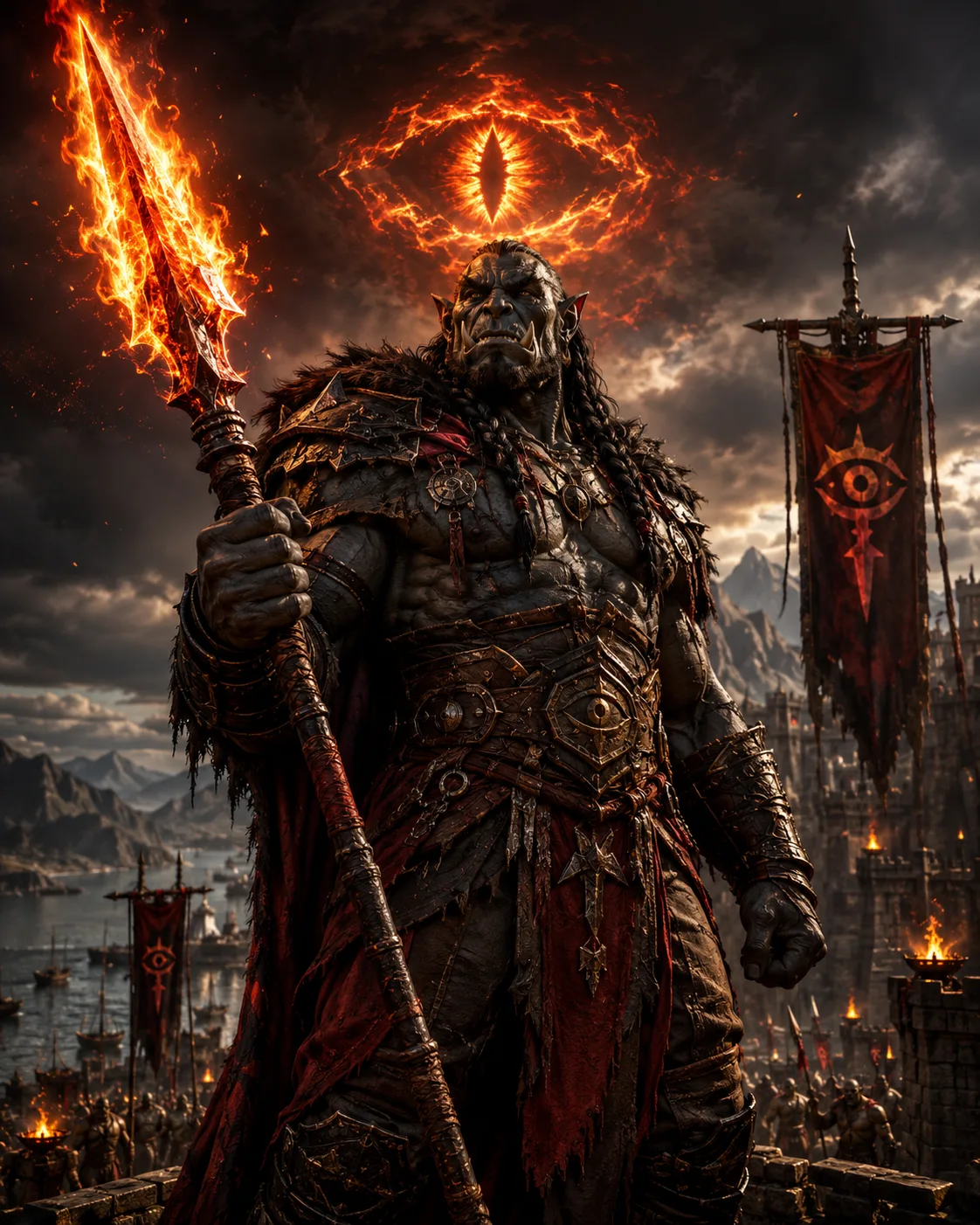
Kharvulok is most commonly depicted as a towering orc of immense stature and powerful build, bearing the marks of countless hardships endured rather than victories won. His skin is often portrayed in shades of dark ash, volcanic stone, or burnished iron, while his eyes burn with a steady amber flame that never flickers regardless of wind or storm.

He is typically shown carrying a great spear whose point glows like heated metal fresh from the forge. Above his brow hovers a single burning eye, representing vigilance that never rests. Unlike many war deities, Kharvulok is rarely depicted charging into battle. Instead, he is most often shown standing watch upon walls, mountain peaks, or the shores of Gharnakthul, surveying the horizon for approaching threats.

Artists frequently emphasize scars rather than trophies, endurance rather than glory, and resolve rather than wrath. He is portrayed not as a conqueror reveling in victory, but as a guardian prepared for the next trial.

Doctrine & Teaching

The faith of Kharvulok teaches that survival is the foundation upon which all other achievements rest.

Its central doctrines hold that strength must be cultivated, vigilance maintained, and hardship accepted as an inevitable part of existence. Comfort is viewed as temporary, while preparedness is considered permanent. Followers are encouraged to become capable enough that adversity cannot easily destroy them and dependable enough that others may rely upon them when adversity inevitably arrives.

The faith further teaches that unity is among the greatest expressions of strength. Individual excellence is respected, but communities endure through cooperation, discipline, and shared purpose. The history of the Varnokh serves as the faith’s greatest lesson: no people survive alone forever.

Failure is not regarded as shameful. Refusing to rise after failure is.

Worship & Devotional Structure

Kharvulok’s faith is organized around service, preparedness, and communal responsibility.

Temples often function as training grounds, armories, meeting halls, watch stations, and repositories of cultural memory. Religious leadership is generally earned through demonstrated reliability, sacrifice, and proven commitment to the welfare of the community rather than inherited position.

Daily observances emphasize discipline and readiness. Worship commonly includes physical training, maintenance of equipment and defenses, remembrance of historical trials, and recitation of communal oaths.

Many shrines dedicated to Kharvulok are deliberately built in exposed or difficult locations, reinforcing the belief that endurance is strengthened through challenge rather than comfort.

Rites & Observances

The Vigil of Embers

A night-long watch conducted in silence to cultivate patience, discipline, and vigilance.

The Oath of the Unbroken

A solemn vow taken by those accepting significant responsibility for others.

The Remembrance of the Red Pact

An annual observance honoring those lost through betrayal and reflecting upon the lessons their sacrifice imparted.

The Trial of Endurance

A ceremonial test undertaken by initiates to demonstrate resilience in the face of hardship.

The Day of First Stone

A communal celebration commemorating the founding of Gharnakthul and the unity that made its creation possible.

Cultural Praxis

Communities strongly influenced by Kharvulok tend to value discipline, reliability, preparedness, loyalty, perseverance, and collective responsibility.

Individuals are expected to contribute meaningfully to the welfare of the community and to maintain the skills necessary to defend themselves and others. Dependability is often regarded as a greater virtue than charisma, while perseverance is respected more highly than natural talent.

Common taboos include:

Abandoning one’s duties without cause.
Squandering resources needed for communal survival.
Breaking sacred oaths.
Willfully endangering the community through negligence.
Forgetting or disregarding the lessons of history.

Signs & Omens

Clergy traditionally interpret the following as signs of favor:

Successful endurance through hardship.
Communities remaining united during crisis.
Unexpected strength discovered during moments of trial.
Defenses holding against overwhelming odds.
Oaths fulfilled despite personal cost.
Signs commonly interpreted as disfavor include:

Complacency leading to preventable disaster.
Communities divided by internal conflict.
Failure born of negligence rather than circumstance.
Broken oaths.
The abandonment of responsibility during times of need.
These interpretations arise from doctrine and tradition rather than confirmed divine intervention.

Relics, Sites & Anchored Presence

Gharnakthul

The greatest site associated with Kharvulok is Gharnakthul itself, the island homeland whose creation is attributed to his divine intervention and leadership during the Varnokh Exodus. To many faithful, the island stands as the ultimate proof of his doctrine: strength applied toward a worthy purpose can transform survival into permanence.

The Veiled Deep

The sacred waters surrounding Gharnakthul are deeply intertwined with Kharvulok’s covenant and are regarded as both shield and warning.

Clergy & Agents

Kharvulok’s clergy most commonly serve as military leaders, guardians, trainers, judges, frontier wardens, community organizers, and keepers of cultural memory. Their responsibilities center upon maintaining readiness, preserving unity, teaching self-reliance, and ensuring that the lessons of past hardships are not forgotten.

Faith Domain clergy are exceptionally rare. They are often philosophers, historians, archivists, and interpreters of Kharvulok’s broader vision. While other clergy focus upon strength, warfare, endurance, or vigilance, Faith clerics concern themselves with understanding how all aspects of the faith interconnect. They frequently serve as advisors to clan leaders and guardians of the deeper meaning behind the Varnokh covenant itself.

Orders & Sects

No public order or sect record has been released at this time.

Relationships & Tensions

Kharvulok maintains a complex relationship with the other powers of the Gorr’Kell. Though he is an orcish deity by origin, his role in the founding of Gharnakthul elevated him into a figure revered throughout the Varnokh people as a whole. His faith teaches that strength is most effective when directed toward shared purpose rather than isolated ambition.

His relationship with Thraghul is often discussed by theologians. Both deities value strength, endurance, and discipline, yet they arrive at different conclusions. Thraghul celebrates glory earned through perseverance, while Kharvulok emphasizes survival secured through vigilance and resolve.

His clergy frequently oppose the excesses associated with Ruzhraak. Where Ruzhraak glorifies destruction and bloodshed, Kharvulok regards violence as a tool that must remain subordinate to purpose. A battle won without purpose is no victory at all.

Among outsiders, Kharvulok is often misunderstood as a deity of conquest alone. His faithful reject this characterization, arguing that conquest was never the goal. The survival of the people was. Strength, discipline, vigilance, and unity remain the means through which that survival is secured.

To the faithful, the greatest lesson of Kharvulok is simple:

The world may test a people.

The unbroken endure.