Eternal Record / Dûn-Karr Pantheon

Fayra Hearthflame

The Hearthmother of Hearth, Family, and Unity

Seal of the Aelorian Archives
Archival Release Authorization

Approved for circulation among the general populace by order of the Aelorian Archives.

Divine record authenticated for public study.

Fayra Hearthflame

Divine Dossier

Classification
Intermediate Power
Pantheon
Dûn-Karr
Disposition
Neutral Good
Portfolio
Hearth, Family, Unity
Worshippers
Parents, children, spouses, elders, household stewards, cooks, innkeepers, caregivers, healers, midwives, mediators, foster families, clan leaders, refugees, settlers, and those responsible for maintaining the safety and continuity of a household or community. Also invoked by families seeking reconciliation, individuals establishing new homes, communities rebuilding after disaster, and those creating bonds of kinship beyond blood.
Sacred Symbol
A golden flame rising from a broad stone hearth, with a dark ember resting at its center. The flame represents the home kindled upon Khassid, while the ember signifies the lost world of the Barazûn, preserved through memory and continued life. Variants include two hands sheltering a coal, a flame enclosed by an iron ring, a golden hearth beneath a rising sun, or grey ash surrounding a single living ember.
Common Titles
The Hearthmother; The Rekindled Flame; She Who Made Home Again; Keeper of the Common Fire; Mother of the Second Hearth; The Golden Ember; Lady of Bread and Stone; She Who Gathers the Scattered; Guardian of Hearth-Kin; The Warmth Beneath the Mountain
Clergy Style
Practical, protective, attentive, and deeply involved in household and communal life. Fayran clergy approach worship through caregiving, hospitality, mediation, food preparation, protection, settlement building, and the preservation of family traditions. They teach reconciliation where repair remains possible, separation where continued proximity causes harm, and the creation of new bonds where those of blood have failed.
Domains Granted
Faith 20% • Vitality 18% • Seasons 15% • Bulwark 15% • Sunrise 12% • Passion 10% • Fire 10%

Percentages represent the proportion of the deity’s clergy who serve within each domain, indicating how commonly each path is practiced within the faith.

Archival Summary

The Hearth That Followed the Exiles

Fayra Hearthflame is the Dûn-Karr goddess of hearth, family, and unity, and the divine power through whom the Barazûn learned that a home may be rebuilt without denying the one that was lost.

The Dûn-Karr were worshipped upon the Barazûn homeworld before its destruction. When that world died, its gods died with it, though the Barazûn believed only that they had fallen silent. Their continued worship, carried across the Firmament and maintained upon Khassid, eventually rekindled the Dûn-Karr within their new world.

Fayra answered in 1,078 PCE, six years after Beldrun Emberforge. Her return was marked by intimate miracles: a hearth that refused to grow cold, a fevered child who recovered during the night, and ashes carried from the first world flaring gold upon a stone quarried from Khassid.

These signs established the central teaching of her faith. Home is not merely a structure, homeland, or inheritance. It is a covenant maintained through care, memory, responsibility, and the willingness to build again. Blood may establish ancestry, but family is sustained through obligation, protection, and continued participation in the life of the household.

Fayra is therefore not simply a goddess of domestic comfort. Her hearth represents ordered warmth: fire contained, tended, shared, and defended. Her doctrine distinguishes unity from forced obedience, forgiveness from the removal of consequence, and kinship from the mere fact of common blood.

Among the Barazûn, her rekindling marked the transition from survival to belonging. Beldrun proved that the sacred forge still burned. Fayra proved that a hearth could burn beside it.

Extended Divine Record

Dogma, worship, rites, signs, clergy, and relations.

Dogma, appearance, doctrine, worship, rites, cultural praxis, signs and omens, relics, clergy, orders and sects, and theological tensions.

Dogma

“You ask where your home has gone.

You look behind you and see stone broken, doors buried, and halls that no longer stand beneath any sky. You believe that because the place is gone, the home is gone with it.

It is not.

A fire is not a hearth merely because it burns. A table is not a family merely because many sit beside it. Home begins when one life accepts responsibility for another.

It begins when food is divided rather than guarded. When the strong lift what the weary cannot. When a child is taught what came before, and an elder is still given a place when their hands can no longer perform the labor that once defined them.

Blood may bring you to a household. Blood does not excuse you from serving it.

You will be told that family must remain united at any cost. Be wary of those words. Unity without truth is concealment. Unity without justice is captivity. Unity that demands the wounded remain within reach of the one who harmed them is not my unity.

Repair what may be repaired. Name the harm. Accept responsibility. Make restitution before demanding trust.

But do not confuse an open door with an unguarded threshold. The cruel possess no sacred right to remain beside the fire they poison. Family is not destroyed when harm is named. Family is destroyed when harm becomes its custom.

Carry the ashes of what came before. Speak the old names. Teach the old songs. Remember the hands whose work made yours possible.

Then build.

Do not turn memory into a tomb in which the living must dwell. Your ancestors endured so that you might continue, not so that you might spend your life facing backward.

Welcome the child who bears no likeness to you but accepts the obligations of your house. Welcome the friend who remained when blood departed. Welcome the exile who has forgotten what safety feels like.

Unity is not the absence of disagreement. It is the refusal to let disagreement make strangers of those who still owe one another honesty and care.

Feed those who hunger. Shelter those entrusted to you. Guard the threshold. Keep a place for the returning, but never sacrifice the living merely to preserve an empty chair.

You are not required to rebuild the world that was lost.

You are required to make a home in the world that remains.

Tend the flame.”

Observed Manifestation: Appearance

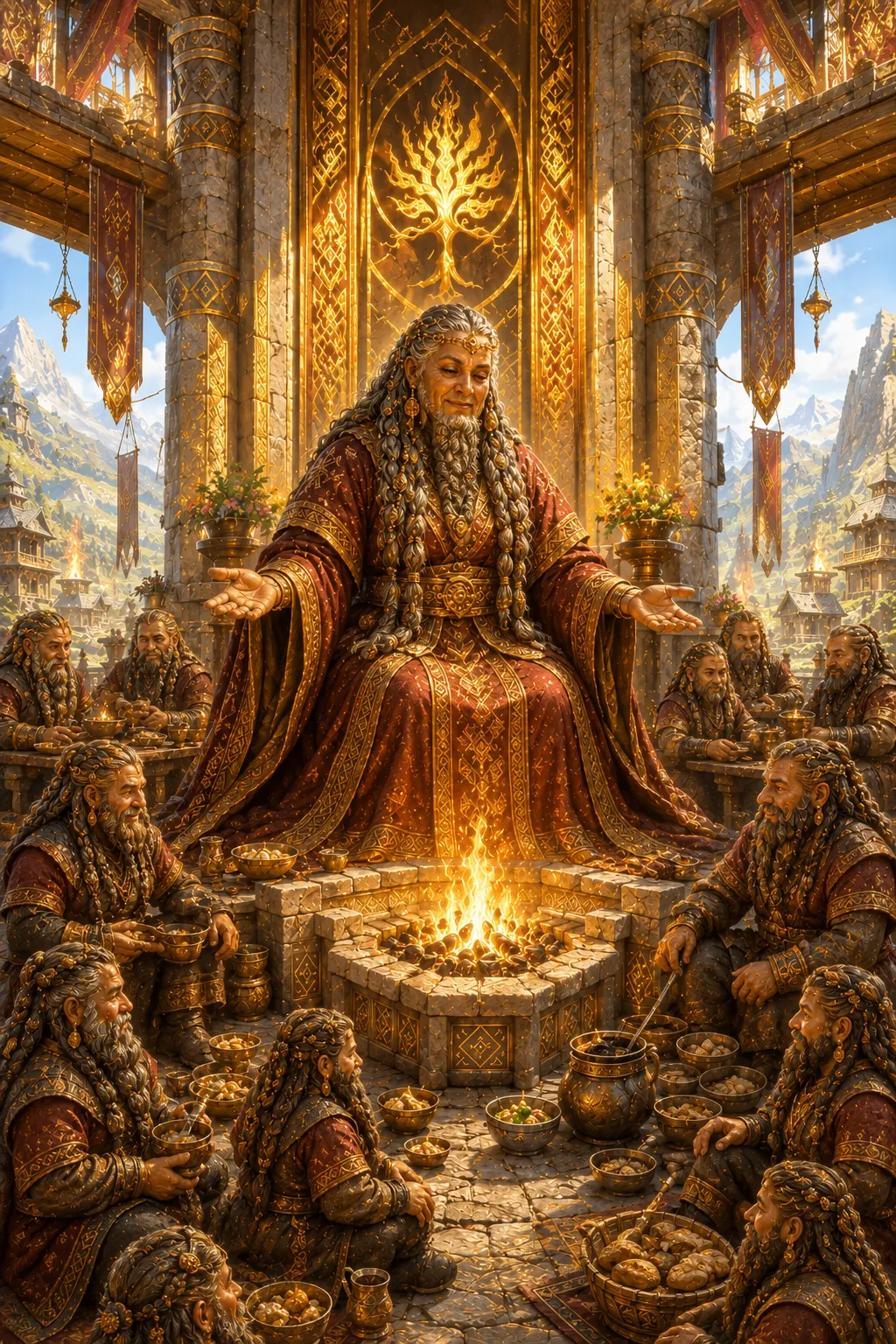
Fayra most often appears as a mature Barazûn woman of powerful build, bearing the authority of a matriarch, settlement founder, and keeper of many generations.

Her skin resembles dark stone warmed from within, with faint golden light visible beneath it. Her eyes are deep amber, brightening like banked coals when she heals, protects, or welcomes another into her presence. Her hair is worn in heavy braids decorated with iron rings, copper wire, carved stones, and fragments said to represent households and lineages carried through loss.

She possesses a full, carefully groomed beard, commonly divided into several ornate braids and adorned with gold, bronze, and hearthstone beads. Fayran images treat the beard as a mark of dignity, age, beauty, and divine continuity rather than masculinity.

Her garments resemble the formal clothing of a Barazûn household matriarch, though worked with materials beyond mortal craft: red cloth that moves like slow flame, gold embroidery that changes with the viewer’s ancestry, and iron clasps warm to the touch.

She is frequently depicted seated near a great communal hearth rather than upon a throne, surrounded by families, elders, children, travelers, and those rebuilding after loss. In manifestations of divine anger, nearby doors close of their own accord, hearthfires rise without consuming fuel, and every threatened person feels the certainty that something ancient now stands between them and harm.

Doctrine & Teaching

Fayran doctrine teaches that the hearth is the first covenant of settled life. Fire becomes sacred when it is contained, tended, shared, and used to sustain others. In the same way, a group becomes a family when its members accept responsibility for one another.

Blood kinship is honored but not treated as absolute. It establishes ancestry and inherited obligation, but not unquestioned authority. Adoption, fosterage, marriage, sworn kinship, and long service may create bonds as sacred as birth. Those received formally into a household are not regarded as lesser members of it.

Unity is understood as maintained relationship rather than uniformity. Disagreement does not destroy a family or community. Falsehood, exploitation, concealed cruelty, and the refusal to accept responsibility are considered greater threats.

Reconciliation is encouraged where acknowledgment and repair remain possible. The faith teaches that forgiveness does not erase consequence, and no injured person is required to restore access, trust, or intimacy merely because an apology has been offered.

Hospitality is sacred, but so is the threshold. The host bears responsibility for those already inside. A household may welcome the stranger while refusing entrance to one who threatens its peace or safety.

The Barazûn loss of their first world remains central to Fayran theology. Memory must be preserved, but memory must serve continuation. The old hearth is honored through the building of the new.

Worship & Devotional Structure

Fayra is worshipped primarily in homes, communal kitchens, settlement halls, inns, shelters, infirmaries, and places where food is prepared and shared.

Her temples are commonly called Hearthhalls. Their central feature is an active communal fire rather than an elevated altar. Kitchens, guest chambers, nurseries, infirmaries, mediation rooms, and emergency storehouses usually occupy more space than formal sanctuaries.

Household worship is generally simple. The first flame of the day may be lit with the words, “Old ember, new flame. What was carried, let it continue.” A portion of the first meal is set aside and later given to a child, elder, visitor, animal, or person in need.

Evening observances often include the naming of absent household members. The absent may be traveling, estranged, imprisoned, missing, or dead. The rite does not promise their return; it affirms that absence is not the same as forgetting.

Fayra is especially invoked during marriage, adoption, birth, illness, migration, settlement building, reconciliation, and reconstruction following war, fire, collapse, or displacement.

Rites & Observances

The Kindling of the New Hearth
Performed when a household, marriage, settlement, or enduring communal residence is established. Each participant brings a piece of fuel or stone and names the obligation they accept toward the others. The fire is then kindled from an existing household or communal hearth where possible.

The Binding of Hearth-Kin
The principal rite of adoption and chosen kinship. The person entering the household places both hands upon its hearthstone while existing members declare the duties they accept toward them. A new iron ring is added to the household chain and is not distinguished from those representing members joined by blood.

The Bread Before Speech
Conducted before serious mediation. Participants divide a simple loaf before discussion begins, acknowledging that those present remain members of a shared community even while divided. The rite requires honest speech, but does not require reconciliation.

The Mending of the Circle
Performed after betrayal, estrangement, or a serious breach of trust. The person seeking restoration must name the harm, accept responsibility, and demonstrate repair. A cracked iron ring is heated and joined, with the repaired seam intentionally left visible.

The Closing of the Door
A solemn rite of protective separation used when a household member has become persistently violent, coercive, or destructive. Their place in ancestry is not erased, but their access to the household is formally restricted or ended.

The Night of Golden Ash
The principal annual observance of Fayra’s rekindling. Household fires are reduced to a single ember while families recount migration, adoption, death, rebuilding, and other events through which the household took its present form. At sunrise, the hearth is rekindled and the first meal is shared with someone beyond the immediate family.

Cultural Praxis

Fayran influence is strongest in Barazûn household structure, adoption customs, elder care, settlement planning, and communal provisioning.

Many households maintain a hearth-chain composed of engraved metal rings representing members, marriages, adoptions, joined families, and periods of separation. Damaged rings are repaired or preserved rather than discarded, reflecting the belief that a broken relationship remains part of a household’s history even when it cannot be restored.

Architecture shaped by Fayran practice places kitchens, common tables, guest rooms, and rooms for the sick near the structural center of the dwelling. A wealthy household is judged less by decoration than by whether it can shelter, feed, and protect those entrusted to it.

Adopted children are not generally expected to surrender the names, traditions, or ancestry of their first families. The receiving household assumes responsibility for preserving whatever may honorably continue.

Fayran doctrine has also influenced attitudes toward communal labor. Barazûn holds often maintain shared meals, emergency stores, and care for the families of injured or deceased workers. Such practices are viewed not as charity but as the fulfillment of mutual obligation.

Cultural tension arises when the language of family and unity is used to silence dissent, preserve harmful authority, or demand loyalty without reciprocal care. Fayran reformers frequently remind traditionalist households that the hearth exists to sustain those around it; it is not a furnace into which they may be sacrificed.

Signs & Omens

Fayran signs are recognized through warmth, shared provision, thresholds, and unexpected endurance.

A fire remaining warm beyond the life of its fuel may signify protection, especially during illness, siege, winter, or mourning. Grey ash flashing briefly gold is associated with rebuilding, adoption, migration, or the continuation of a household after loss.

Morning light entering an underground or windowless chamber may indicate hope after prolonged grief. Several flames leaning toward the same person are sometimes interpreted as a call to offer welcome, protection, or reconciliation.

Warning signs include a hearth that burns without warmth, smoke entering a room despite a clear chimney, a household flame dividing into separate colors, or cracks spreading through a hearthstone during an oath.

No domestic anomaly is accepted as divine communication without practical examination. Fayran clergy inspect chimneys, stores, foundations, illness, and ordinary causes before assigning sacred meaning. Such investigation is itself regarded as proper service to the goddess.

Relics, Sites & Anchored Presence

The First Hearthstone is believed to be the stone upon which Fayra’s first answering was recognized in 1,078 PCE. It remains faintly warm under all conditions, and fires kindled upon it burn gold at the edges without producing smoke.

The Ash of Two Worlds is preserved within a sealed iron vessel and is said to contain ash from both the Barazûn first world and the earliest Fayran hearth upon Khassid. It is used during the foundation of major settlements and sanctuaries.

The Chain of the Gathered is composed of rings contributed by households that survived disaster, exile, division, or threatened extinction. Sections are sometimes carried by rescuers, healers, and those serving displaced communities.

The Bowl of the Last Portion is a broad copper vessel that provides one additional serving after its contents appear exhausted. It does not create abundance, but ensures that one person who would otherwise go unfed receives a share.

Places where households or communities successfully rebuilt after apparent destruction may be designated Hearthsites. Such places are protected only while they continue to serve the living; Fayran clergy will not preserve a sacred structure at the expense of the people it was meant to shelter.

Clergy & Agents

Clergy of Fayra serve as household priests, healers, mediators, cooks, refuge-keepers, midwives, adoption witnesses, settlement stewards, and defenders of those threatened within their homes.

Faith clergy maintain household rites, marriages, adoptions, memorial practices, and theological instruction. Vitality clergy care for the sick, injured, pregnant, elderly, and exhausted, often organizing communal caregiving so that responsibility does not destroy a single caretaker.

Seasons clergy oversee transitions including birth, maturity, marriage, migration, aging, death, departure, and return. Bulwark clergy protect homes, shelters, kitchens, and refugee settlements, and are frequently involved in removing dangerous individuals from households.

Sunrise clergy assist communities rebuilding after catastrophe or displacement. Passion clergy address love, loyalty, grief, anger, resentment, and reconciliation. Fire clergy maintain sacred hearths, bless places of cooking and gathering, and teach the distinction between sustaining flame and uncontrolled destruction.

Agents of the faith may include non-clerical cooks, builders, foster parents, physicians, innkeepers, rescue workers, household advocates, and guards trained to defend civilian refuges.

Fayran clergy are widely trusted but not universally welcomed. Powerful households sometimes accuse them of interference when they investigate neglect, coercion, forced marriage, inheritance abuse, or violence concealed behind claims of family unity.

Orders & Sects

Orders — Function-Based

The Keepers of the First Hearth preserve accounts of the Crossing, the divine silence, Fayra’s rekindling, household genealogies, adoption records, and histories of Barazûn settlement.

The Wardens of Stone and Flame protect occupied structures during siege, fire, collapse, and civil disorder. Their first duty is the preservation of life rather than property.

The Open Table maintains public kitchens, travelers’ halls, emergency stores, and shelters for the displaced.

The Menders of the Circle serve as mediators in household disputes, estrangement, adoption, inheritance conflict, and reconciliation after wrongdoing.

The Golden Ash Custodians accompany displaced communities and assist in preserving traditions while establishing functional homes in new lands.

Sects — Belief-Based

The Old Ash holds that Fayra’s truest rites are those preserved from the Barazûn first world and resists changes that might weaken ancestral continuity.

The New Stone teaches that the Barazûn must accept Khassid fully as home and that continuity cannot depend upon reproducing a dead world.

The Living Line emphasizes adoption, chosen kinship, mixed households, and the teaching that sustained care creates family more reliably than blood alone.

The Guarded Hearth places strong emphasis upon boundaries, protection, and the right to remove those who exploit or endanger the household.

The Open Door teaches that every stable household bears some responsibility toward refugees, strangers, and those without kin, though its members disagree over how far hospitality should extend.

Relationships & Tensions

Fayra maintains her closest theological association with Beldrun Emberforge. Beldrun represents the sacred labor through which the Barazûn endured, while Fayra governs the household and community for whose sake that labor is performed. Their churches frequently cooperate in settlement building, reconstruction, and the maintenance of Barazûn cultural life. Tension arises when craft, production, or duty is treated as more important than the people those things are meant to sustain.

Her relationship with Norvok Ironshroud is solemn and complementary. Fayra preserves the place of the dead within household memory, while Norvok ensures that ancestry does not become an unhealthy refusal to release those who have passed. Fayran funerary customs often begin at the hearth before the dead are entrusted to Norvok’s keeping.

Fayran clergy work closely with the followers of Thalmir Runehold in preserving genealogy, household law, adoption records, and histories of the Crossing. Fayrans nevertheless resist the claim that formal inscription creates legitimacy. A family may exist before any archive recognizes it, and an unjust custom does not become sacred merely because it has been recorded for generations.

Harrak Stoneward’s clergy defend the walls surrounding the hearth, while Morgrin Fireguard protects the wider community through honorable force. Fayrans honor both functions but caution that protection may become domination when walls imprison those within or military duty is used to excuse neglect of the households left behind.

Relations with Korvra Hearthgold concern inheritance, household resources, prosperity, and the obligations created by wealth. The two churches cooperate in maintaining communal stores and family estates, but disagree when property rights are used to deny food, shelter, or support to those whom a household has accepted as its own.

Fayra’s clergy frequently seek the aid of Dralina Emberbraid when reconciliation requires judgment, formal consequence, or the protection of an injured party. Dralina establishes what justice demands; Fayra determines whether a relationship may continue after justice has been done.

Ardena Stoneharp preserves the songs, meals, genealogies, and stories through which Barazûn households remember themselves. Tolgrin Ironflare governs those who leave established halls to explore, migrate, or seek new lives. Fayra’s hearth is both the place from which they depart and the place to which they may return, though neither faith teaches that return is always possible or desirable.

Fayra’s strongest opposition within the Dûn-Karr is directed toward Durgron Blackbarrow. Durgron embodies betrayal, corruption, ruin, and exile—the forces that turn kinship into leverage and belonging into captivity. His followers exploit old resentments, divide households for advantage, and persuade the displaced that no true home can ever be made again. Fayran teaching rejects this final claim most strongly. A home may be destroyed, but the capacity to build another remains.

Beyond the Dûn-Karr, Fayra’s clergy cooperate with deities of community, healing, hospitality, agriculture, and protection. They share particular affinity with faiths that care for refugees and preserve communal life after disaster. Differences usually concern emphasis: other hearth deities may represent comfort, fellowship, courage, or renewal, while Fayra’s theology remains inseparable from the Barazûn experience of exile and reconstruction.

Fayrans respect Aeru as the divine power beneath whose order the Barazûn found refuge upon Khassid. Aeru is not worshipped as a replacement for the Dûn-Karr, but is acknowledged as the one through whom a second home became possible.

The faith generally cooperates with secular rulers in matters of relief, settlement, family law, and communal stability. Conflict emerges when rulers describe the state as a household and themselves as its unquestioned parent. Fayran doctrine holds that authority, like kinship, must be sustained through responsibility. No ruler may claim the obedience owed to family while refusing the duties that make family sacred.

To the followers of Fayra Hearthflame, the hearth is not holy because it burns, family is not sacred because it shares blood, and unity is not proven by silence.

Each becomes sacred only when those within it choose to sustain one another.