

Archival Summary
The Work That Holds
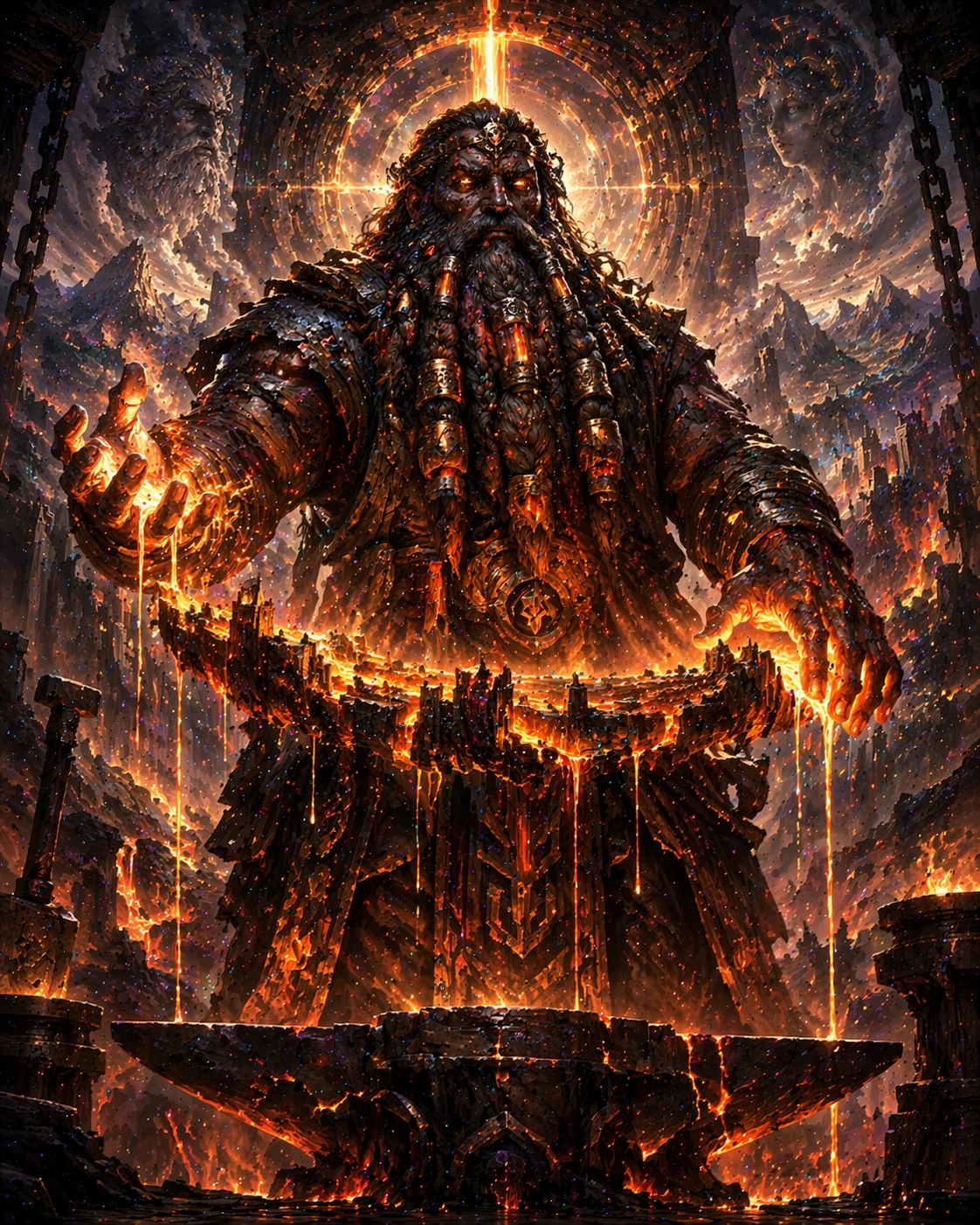
Beldrun Emberforge is the god of Craft, Flame, and Creation—governing the deliberate shaping of what exists through effort, pressure, and time. His influence is expressed both materially and conceptually: in the forging of tools and structures, and in the refinement of identity, culture, and purpose through sustained labor.
He is foundational to Barazûn existence and widely recognized across Khassid as the defining principle of continuity through making—that what endures is not accidental, but the result of intentional shaping under strain. Flame, within his domain, is not destruction, but controlled transformation. Craft is refinement toward durability. Creation is the act of ensuring that something persists.
When the Barazûn world was consumed by Entropy, it is recorded that Beldrun petitioned Aeru and carried his people into Khassid. This event is not treated within Barazûn theology as separate from his domains, but as their highest and most complete expression. They do not distinguish between what he is and what he did; the act stands as proof of the principle.
Following the Barazûn arrival, early records indicate a sustained period during which their established religious structures remained intact in form but functionally absent. Clergy continued rites, doctrine, and invocation consistent with pre-arrival practice; however, no verifiable manifestations of divine response were recorded. No spells, miracles, or granted abilities—comparable to those observed among other clerical traditions of the period—were attributed to Barazûn practitioners during this interval.
Within approximately five decades, this condition changed. Subsequent records document the emergence of verifiable clerical phenomena: restoration rites, material transmutation, and other manifestations consistent with recognized divine mediation. From that point forward, Barazûn clergy function in parity with other established traditions.
Contemporary accounts of the initial period frequently interpret the absence of divine response as evidence of divine loss. Later records, however, complicate this conclusion. The restoration of clerical function without corresponding doctrinal or structural shift remains unaccounted for within existing theological models. The Archives recognize multiple competing interpretations but confirm no singular explanatory framework. Notably, Barazûn doctrinal continuity during the inactive period shows no measurable deviation sufficient to account for the shift, further reinforcing the exceptional nature of the event.
Across Khassid, Beldrun is invoked wherever something must be made to last—particularly in the aftermath of failure or collapse, where what is built must endure beyond its origin. His relevance extends beyond the Barazûn as a framework for rebuilding, refinement, and the preservation of identity through sustained effort.