
This composite record describes the Tally as a whole. It does not imply that any merchant, foreign observer, or in-world reader can identify every channel through which knowledge reaches the Confederation.
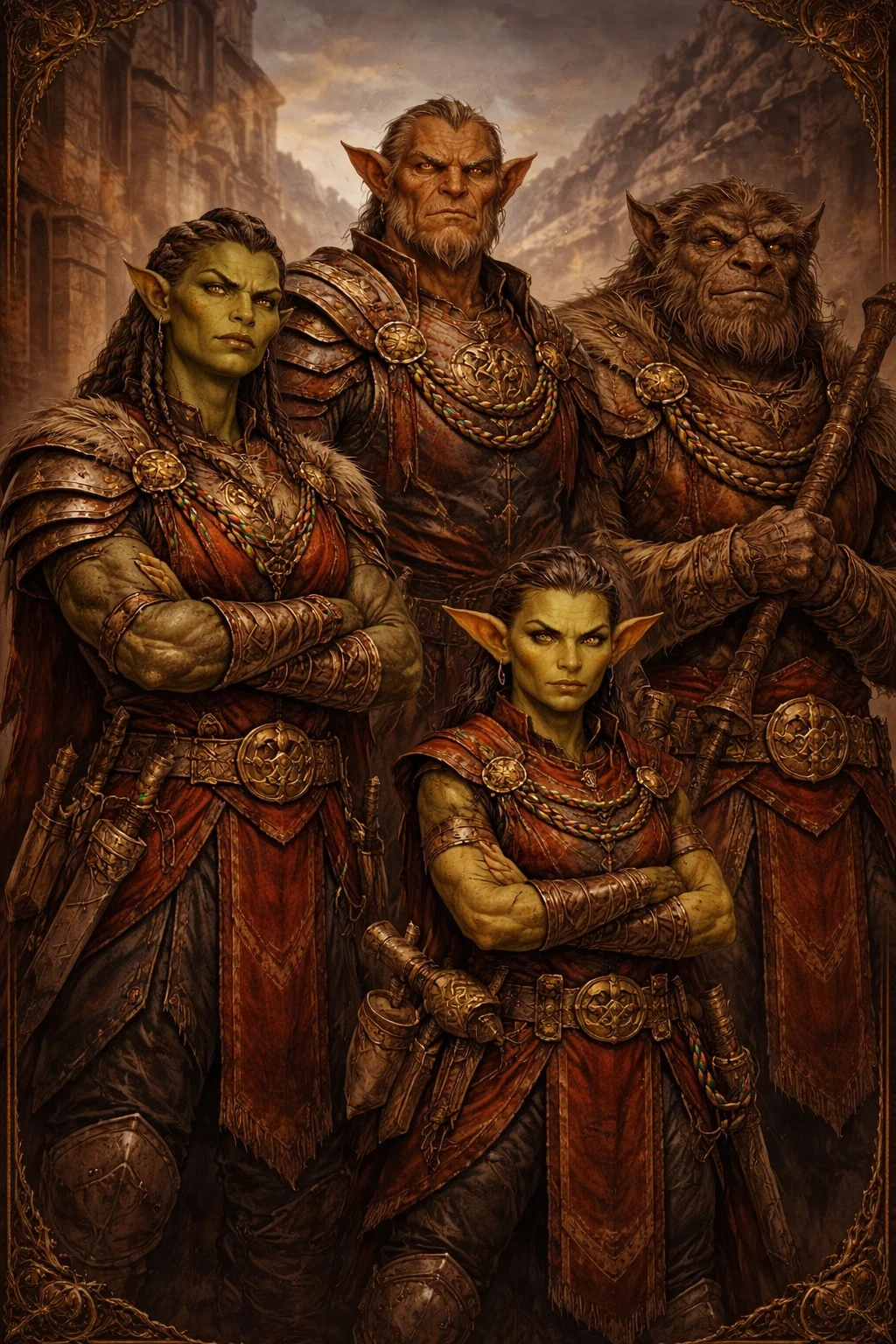
Faction Dossier
The Whole Account
The Black Tally began with formal Varnokh trade. Merchants carrying accounts home also carried observations; comparison revealed that those fragments described matters far beyond commerce. The Confederation answered by formalizing the COUNT as a genuine commercial clearing house without destroying the informal participation that made the wider account possible.
The modern Tally is therefore neither a secret service disguised as trade nor an accidental collection of merchant gossip. Formal commerce gives it presence. Informal reporting gives it breadth. The COUNT reconciles both until Varnokh dealings with the world become an account of the world itself.
Origins and Development
The Black Tally did not begin as a secret service. Its roots lie in the unavoidable commerce of a people who would otherwise prefer the security of separation. Varnokh society is aligned with Unity through faith, history, and practical function. The Betrayal of the Red Pact taught what uncontrolled dependence upon outsiders could cost; Varnokh territory is consequently guarded, admission is monitored, and Karmorr protects the very shores.
Separation, however, cannot produce everything a people require. The Confederation entrusted sustained foreign contact to merchants because trade made that contact necessary and useful. Those merchants carried goods outward and accounts home. They also returned with remarks about frightened suppliers, unusual commissions, altered tariffs, hurried shipbuilding, missing cargo, and roads newly closed.
At first, such observations appear to have reached leaders through ordinary commercial and communal reporting. Their importance became visible only when separate accounts were compared. A delayed ship might be misfortune; several delays, new buyers, and unusual military purchasing could disclose preparation. What began as formal trade therefore developed an informal intelligence function. The Confederation preserved that advantage by formalizing the Confederated Office of Underwriting, Notes, and Trade as a genuine commercial clearing house through which both kinds of account could be reconciled.
The result is the modern Black Tally: formal commerce supported by an institutional clearing authority, receiving intelligence from a network whose participation often remains deliberately informal.
Purpose and Mandate
The Black Tally administers the Varnokh Confederation’s necessary relationship with the world beyond its guarded shores. Its public work is not a disguise. It recognizes merchants, reconciles foreign accounts, underwrites approved ventures, monitors essential imports, compares markets, warns of unstable routes, and protects Varnokh commercial interests abroad.
Commerce gradually expanded the meaning of that mandate. The same records needed to protect a voyage could reveal foreign scarcity. The same price changes used to assess a market could expose military preparation. The same network that located essential goods could identify shifting loyalties, vulnerable dependencies, and ambitions likely to affect the Confederation.
The Tally now asks not only whether Varnokh commerce remains profitable and secure, but what commerce reveals about the world at large. It helps the Confederation obtain what it cannot produce, limits the exposure created by that dependence, and warns when distant developments may become dangers at home.
Organization and Authority
At the center of the institution stands the Confederated Office of Underwriting, Notes, and Trade, abbreviated in Varnokh instruments as COUNT. Its documented commercial functions make it the ordinary destination for accounts requiring comparison beyond a single merchant, ship, route, or market. Its restricted functions make it the clearing authority through which separate observations may become the Black Tally.
That COUNT is an institution can be established. Whether the Count is only that institution cannot. Foreign accounts describe a commercial lord, inherited office, unseen director, rotating title, and body of senior accountants speaking beneath one authority. Varnokh correspondence neither confirms nor cleanly contradicts these descriptions.
The uncertainty belongs to outsiders. No Varnokh account examined for this record shows confusion over what—or whom—is meant. Varnokh speakers know precisely what the Count signifies. They permit foreign interpretations to stand and decline to correct assumptions that serve them perfectly well.
The Archives preserve references to more deeply restricted concordances and identity indices associated with the question, but those records lie beyond the circulation authority of this entry. COUNT is certainly an office, while the Count may be the office, the authority within it, the person who bears that authority, or several of these at once. The Varnokh know which interpretation is correct. They are not saying.
Reach and Presence
Trade houses, ships, warehouses, factors, translators, commercial families, licensed agents, and familiar gathering places give the Black Tally durable presence wherever Varnokh commerce travels. It requires no conspicuous foreign intelligence establishment because the commercial network is already present for legitimate reasons.
That presence is not uniform. Some locations contain recognized Tally receivers or deliberate operatives. Others contain only merchants who know where a consequential observation should be carried. Still others may contribute nothing beyond ordinary trade. A foreign map marking every Varnokh business as a Tally post would exaggerate the institution and obscure the very distinctions required to understand it.
Its practical reach is nevertheless worldwide. Merchants enter ports where diplomats would be watched, speak with people who would guard their words before an official emissary, and observe workshops, households, routes, and markets unavailable to conventional state representation. Foreign powers may suspect that particular merchants serve the Tally. Their recurring difficulty is determining where ordinary commerce ends and intelligence begins. Often there is no clean division.
Membership and Recruitment
The Black Tally does not depend upon making every Varnokh merchant an operative. Most conversation among Varnokh abroad is exactly what it appears to be: people seeking kinship, language, worship, familiar food, shared custom, safety, or the relief of being among their own. Some participants recognize when an observation may matter and pass it onward because Unity makes the protection of Varnokh a shared responsibility.
One useful report does not necessarily create membership. Some people contribute once. Others knowingly maintain a channel. A smaller number show the repeated judgment, access, and discretion associated with deliberate recruitment. When recruitment occurs, it often formalizes a function the person is already performing without requiring a new public life.
Service does not require a Varnokh to abandon another organization, profession, or ordinary affiliation. A merchant, smith, translator, sailor, factor, or proprietor may belong to the Trade Winds, work occasionally with the Veiled Current, maintain a safe location, or hold no other organizational membership at all. From outside, a person with several connections may appear to be a double or triple agent. Within the Tally, they may simply be Varnokh ensuring that what concerns their people reaches those able to understand the whole account.
Information Channels and Control
Information usually enters the Tally informally and moves through established commercial or communal relationships. An observation may travel as conversation, an appended market note, a corrected manifest, a route warning, a commercial inquiry, a sealed statement, or a direct report to a trusted receiver. The channels already carrying prices, orders, credit, and shipping warnings allow consequential information to move without constructing a separate visible network.
What enters those channels does not remain casual conversation. Experienced listeners distinguish novelty from relevance, eyewitness knowledge from repetition, commercial judgment from personal suspicion, and confirmed pattern from attractive theory. Reports may remain marked as observed, supported, corroborated, disputed, deliberately offered, or unresolved. A useful warning and a proven conclusion are not treated as the same instrument.
Varnokh linguistic practice reinforces that control. Translators attend not only to vocabulary but to law, rank, mercantile custom, idiom, euphemism, accent, ritual language, and the assumptions a speaker expects listeners to supply. A note can be commercial correspondence and appended observation. An account may concern coin, conduct, or strategic condition. Meaning is not necessarily falsified; it is arranged so different listeners receive different portions of the same truth.
Once an observation is judged consequential, it travels upward rapidly toward the Count, where it can be compared against accounts unavailable to the original observer. What returns downward may be an instruction, a warning, a declined risk, a changed route, or no visible response at all. The merchant need not be shown the whole account to have contributed a necessary mark.
Methods and Operations
The Black Tally’s central method is comparison. Manifests reveal preparation. Prices reveal shortage. New routes reveal new relationships. A single remark is one mark; a shifted price is another. The Tally accumulates, compares, and remembers until ordinary details disclose a pattern no single merchant could see.
Material behavior carries particular weight because states may mislead diplomats more readily than they can conceal sustained changes in production, purchasing, freight, labor, and supply. When the resulting account requires action, the response often remains commercially plausible: a venture is declined, credit changes, cargo moves by another route, a representative arrives, an import is secured early, or Varnokh merchants quietly withdraw from a market before foreign observers understand the danger.
The institution also protects the network that makes such comparison possible. It watches efforts to identify receivers, manufacture attractive reports, map communal gathering places, or exploit assumptions of automatic Varnokh participation. Deliberate collection, counterintelligence, cultural interpretation, logistics, and ordinary commerce may all appear in its work, but the Tally’s most characteristic operation remains the conversion of distributed observation into coordinated preparedness.
The name preserves that commercial logic. A favorable account rests in the black: profitable, secure, and properly balanced. In Tally usage, the condition extends beyond coin toward knowledge, preparedness, and advantage.
Send the account to the Count. If it is worth the mark, it will be in the black before dawn.
Relations with Other Factions
The Trade Winds Merchant Consortium gives Varnokh merchants access to difficult goods, trusted routes, and relationships across factional boundaries. Some people belong to both institutions. Many Trade Winds members have no Tally connection, and many Tally contributors hold no Consortium membership. Shared names establish personal overlap, not automatic institutional alignment.
The Veiled Current hears what legitimate commerce cannot. Varnokh merchants are recorded dealing with its members, using its services, and occasionally serving it in narrower capacities. These relationships may yield valuable information, but they should not be mistaken for Tally control of the Current or proof that either institution receives everything the other knows.
The Morgdhavian Intelligence Authority is a functional counterpart shaped by a different society. Each appears to understand that the other derives intelligence from activity usually considered routine. No authenticated case of formal operative crossover has been found. Morgdhavian recruitment of a Varnokh Tally member would raise immediate questions of ultimate loyalty to Unity; placement of a Tally member inside the M.I.A. would risk exposing the Count’s routes and standards to an institution designed to reconstruct hidden systems.
Third parties, intercepted material, defectors, and unwitting sources may still pass between their edges. That proximity is not cooperation. It is the condition produced when two services know enough about one another to distrust every convenient discovery.
Limits and Vulnerabilities
Commercial sight privileges movement, exchange, production, scarcity, and material preparation. It may reveal that something is changing long before it explains the cultural, spiritual, or personal reason for the change. A network skilled at detecting capability may still misread intention.
Varnokh suspicion of outsiders creates disciplined caution and an evident interpretive risk. A reader expecting betrayal may overvalue hostile explanations, undervalue altruism, misunderstand conduct with no commercial logic, or assume that divided foreign loyalties must be weaker than Varnokh Unity.
The network also depends upon human judgment. Trusted receivers may become too trusted. Familiar accounts may be difficult to challenge. A merchant may mistake grievance for warning or be deliberately shown something meant to travel upward. The Archives has no access to the Tally’s internal correction practices, though its continued accuracy suggests some capacity to preserve contradiction rather than discard it merely because an existing sum is elegant.
Its reach should not be confused with omniscience. Not every merchant reports. Not every report arrives. Not every mark is understood in time.
Archival Assessment
The easiest way to misunderstand the Black Tally is to search for a moment when trade ended and intelligence began. No such moment is preserved because the institution did not develop through replacement. Formal commerce created sustained foreign contact. Merchants informally carried observations home. Repeated comparison revealed that those fragments could describe matters larger than trade. The COUNT then gave the Confederation a formal clearing authority without destroying the informal participation that made the system broad.
Its strength does not lie in turning every merchant into a secret operative. It lies in a worldwide Varnokh commercial community able to recognize when ordinary knowledge may matter, and in an institution capable of deciding when several ordinary things have become extraordinary together.
Publicly, the Black Tally records Varnokh dealings with the outside world. Through those dealings, it records the outside world itself.