The gods are real—and accountable
The gods of Khassid are neither distant abstractions nor convenient sources of divine magic. They are present within the world, possess distinct purposes and personalities, and may enter mortal affairs. Their power, however, does not place them beyond consequence.
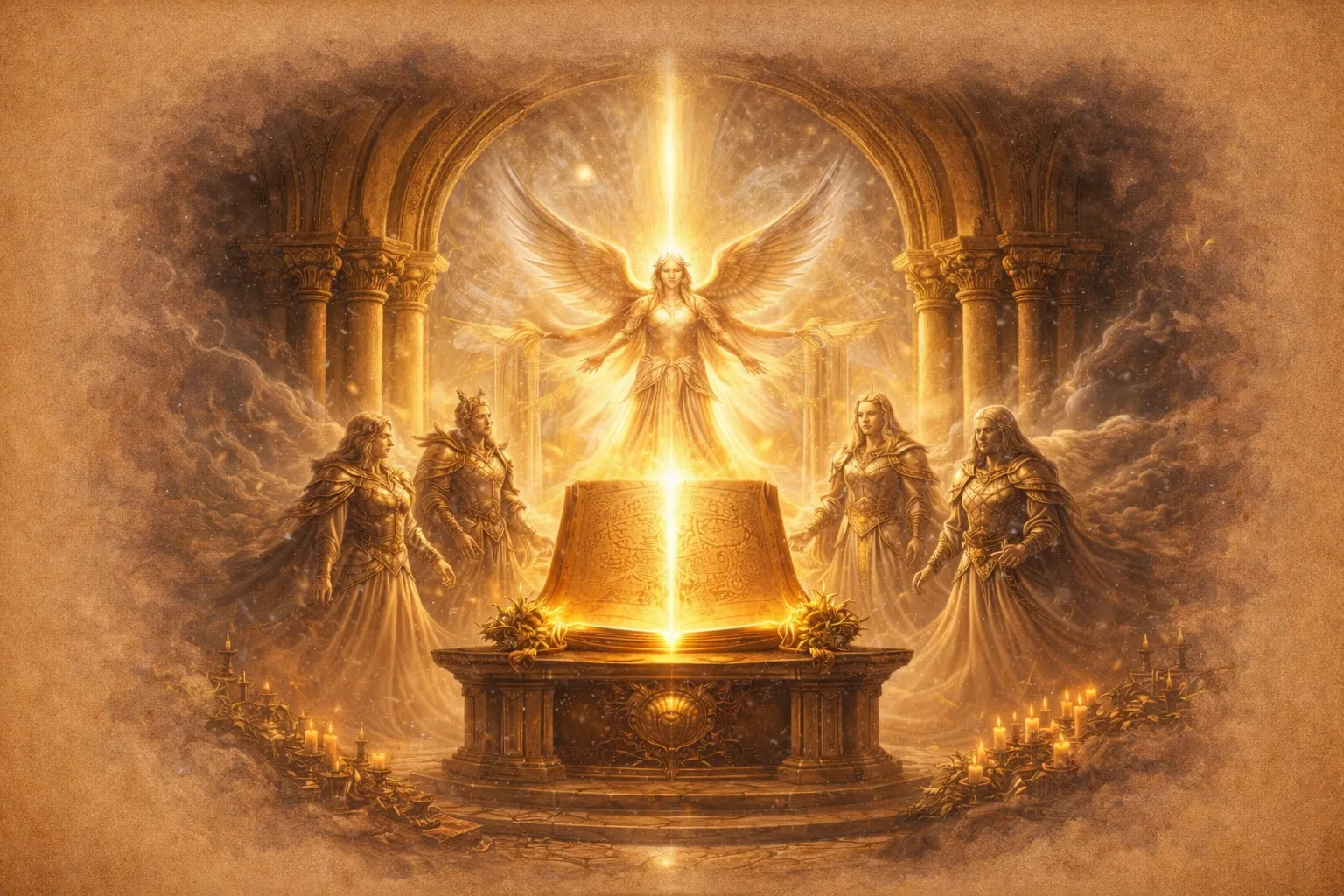
The gods once failed in the purpose entrusted to them. Their rivalries, corruption, and neglect helped break Khassid. When the Scream drew Aeru’s gaze back to the world, the pantheon was judged, compelled to repair what it had damaged, and bound beneath the Divine Accords. One god was erased entirely.
The gods may still answer prayers, appoint servants, guide their faithful, oppose threats, and exercise the Cosmic Truths placed in their keeping. What they may not do is treat mortal lives as possessions. Divine intervention ends where the violation of mortal will begins.
This makes the gods active participants in Khassid rather than explanations for a cleric’s abilities. They can become patrons, witnesses, rivals, reluctant allies, political forces, or subjects of investigation. A campaign may involve the will of a god without requiring its characters to surrender their own.
Mortal will is inviolate
The Fifth Pronouncement of the Divine Accords establishes that mortal will is inviolate. A god may advise, persuade, tempt, reward, warn, or refuse—but may not seize control of a mortal choice.
A cleric illustrates the distinction. By following a god, the cleric voluntarily enters a covenant and accepts the responsibilities of wielding power drawn from that god’s Cosmic Truth. This is consent, not ownership. The cleric remains free to question the god, reject an instruction, or leave the relationship altogether.
Walking away may end the cleric’s access to the power granted through that relationship. That loss is not divine punishment; it is the consequence of ending the covenant through which the power was received. The god may not retaliate, compel renewed obedience, corrupt the cleric’s will, or inflict suffering merely because the cleric chose to depart.
This creates meaningful religious conflict without making faith a trap. A cleric’s convictions can change. Gods and mortals can disagree. Devotion can be tested, withdrawn, or renewed—but the final choice remains mortal.
History is still being written
Khassid has an established canon. Its gods have histories, its nations carry old grievances, its institutions possess authority, and events already set in motion continue whether heroes intervene or not. That canon gives the world coherence, consequence, and a shared foundation.
But the moment Khassid reaches a gaming table, it also belongs to the people gathered there.
Every table’s Khassid is rightly its own version of the world. A group may embrace the published canon in full, change what no longer serves its campaign, or take only the people, places, conflicts, and ideas that inspire it. Established canon describes the Khassid presented by Tales of Khassid; it does not declare another table’s version incorrect.
What happens at a table can become part of Khassid’s continuing history.
The record comes from inside the world
Much of Khassid is presented through the Aelorian Archives, an institution within the setting rather than a voice standing above it. Its archivists gather testimony, examine surviving evidence, compare conflicting accounts, and record what they believe to be true.
Their knowledge is not complete. Sources can be lost, witnesses can disagree, translations can fail, and an archivist may overlook something important. An accepted account may be incomplete or, on occasion, simply wrong.
For the Game Master, that uncertainty is room to create. An archived account may be fact, disputed scholarship, political interpretation, incomplete evidence, or a confident mistake. The Archives give Khassid a foundation without deciding every truth before a campaign begins.
Fantasy is larger than one tradition
Fantasy has drawn deeply from medieval European traditions, and those traditions remain part of Khassid. They are not, however, the limit of its imagination. Khassid draws from the breadth of human history, culture, belief, and migration to create a world in which many traditions can exist, meet, disagree, and change one another.
A culture is not created by changing the clothing, architecture, or appearance of an otherwise familiar fantasy society. Its religions, governments, families, laws, economies, and customs arise from its particular history and circumstances. Its people are not monoliths; they contain regional differences, internal disagreements, exchanges, contradictions, and change over time.
The same principle extends beyond humanity. Khassid’s non-human peoples may begin from familiar fantasy foundations, but they are shaped by this world’s histories, lands, faiths, migrations, and wounds. Their differences are not changes made for novelty alone; they are consequences of having lived in Khassid. Recognition provides a doorway, but the world determines what waits beyond it.
The human gods reflect the people whose beliefs first gave them names and form. Because humanity in Khassid has never possessed a single appearance, culture, or history, neither does its pantheon. Each god bears a distinct identity shaped by mortal understanding, while the Cosmic Truth entrusted to them belongs to no single people.
Khassid is not an argument against familiar fantasy. It is an invitation to imagine how much larger fantasy can be.
What happens in play should matter
For weeks, the dice have been rolling. Sessions have been postponed because life intervened. There has been laughter, very cold pizza, and the genuine fear that a beloved character might not survive the night.
Then, at last, your party defeats the black knight who seized a fortress your Game Master placed in a forest four days earlier. The people are free. Your characters are celebrated. There is treasure to claim, experience to carry forward, and perhaps a new level waiting.
You are the heroes.
But who beyond your table will ever know what happened there?
Khassid was never intended to grow only through canon introduced by Aelorian Press. The Cataclysm shattered the world four centuries ago, leaving settlements destroyed, histories incomplete, roads forgotten, and vast stretches of civilization still being restored or rediscovered. Those open places were created for play to reach them.
Weight of Deeds™ gives players and Game Masters a way to offer the meaningful consequences of their campaigns for consideration within Khassid’s continuing history. A village saved, a shrine restored, a danger awakened, a sacrifice remembered, or a custom born at the table may become part of the shared world—something future tables can encounter and build upon.
The initiative does not take ownership of a campaign or quietly turn someone else’s work into a product. The table’s adventure, characters, writing, maps, and private memories remain theirs. If a Deed is accepted, its recognized canon form may enter Khassid as shared material available to the community. Any substantial commercial development of a contributor’s original material would require a separate written agreement.
Not every story becomes canon. Not every Deed will be accepted. But Khassid was built with room for its players to help restore, populate, and remember the world.
Some Deeds are too heavy to vanish when the dice are gathered.